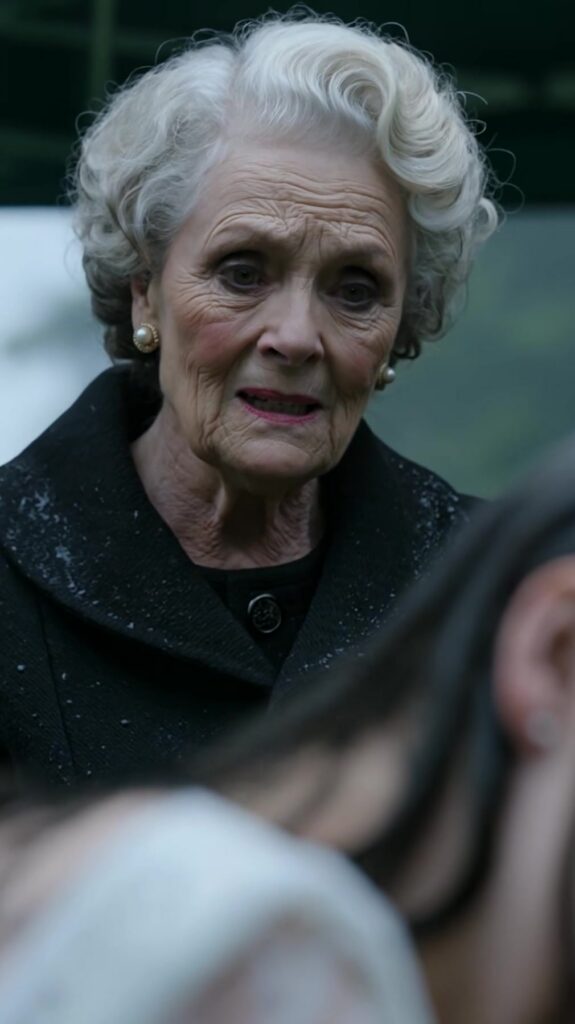
Rain struck the funeral tent like thrown gravel, hard enough to make the canvas shudder. Beneath it, a close-packed row of mourners stood with the stiff posture of people trying not to be moved by weather or guilt. Umbrellas tilted and trembled. Black sleeves held white tissues. The priest’s voice tried to sound like certainty as it floated above the hiss of downpour and the dull, steady impatience of thunder.
Outside the tent, the cemetery rolled away in slick, green swells. Headstones leaned like tired teeth. Puddles collected around fresh graves, turning the earth into a dark paste that clung to shoes and hemline alike. The casket lay on its stand, polished wood beaded with rain that had found its way under the tent’s lip. It looked too clean for the thing everyone said it contained.
They had gathered for Adrian Kells—adviser, philanthropist, the man who had taught the city to be grateful in public and ruthless in private. The obituary had been printed in every paper. The portraits had been carefully chosen. The cause had been carefully vague. A sudden tragedy, they’d said. A final, unforeseeable end.
Rowan Kells stood at the front in a dark suit cut like a promise. He didn’t fidget. He didn’t cry. His hands were folded as if he were waiting for a verdict, his face arranged into the practiced grief of someone who had been on camera too many times. Beside him, Marjorie Kells held herself upright in pearls and old money, a widow’s composure carved from years of never being surprised where anyone could see.
When the priest spoke of peace, Rowan’s eyes stayed fixed on the casket. There was no tenderness in that gaze. There was something else—an inventory, a calculation, an insistence that what was in that box stay in that box.
Then the storm split with a new sound: footsteps running.
A figure burst through the cemetery gate, white against all that black and green. For a moment the mourners stared as if a ghost had tripped into the world. It was a woman in a wedding dress soaked through to gray, the lace heavy and dragging, her veil gone, her hair plastered to her cheeks. She sprinted over the wet grass as if the ground could not claim her, as if she had made a bargain with grief and was racing to break it.
Umbrellas turned. Whispers rippled under the tent. Someone took a step forward, then stopped, unsure whether to intercept a stranger or make room for a miracle.
The bride did not slow. She slid in the mud, caught herself on a headstone, and kept going. Her breath came in ragged pulls, and the rain seemed to hang off her like a second, heavier fabric. When she reached the casket, she dropped to her knees so hard the mud kicked up and speckled the bodice of her dress.
Her hands flew to the wood as if she could hold it shut against the earth, or pry it open against the lie. She bowed her head over it, and her whole body shook. The sound she made wasn’t the neat sobbing of someone accepting a loss. It was the raw, animal noise of someone arriving too late to stop a crime.
For a moment, even the rain seemed to hesitate. Silence widened in the tent, swallowed the priest’s next sentence, and pressed against every face turned toward her.
Marjorie Kells leaned forward, pearl earrings catching the gray light. Confusion tightened her mouth. “Dear,” she called, voice clipped by disbelief, “who are you?”
The bride lifted her head. Water ran down her jawline and mixed with mascara, turning her tears into thin, black rivers. Her eyes were wild with panic, but there was focus there, too—an urgent intelligence that refused to let anyone dismiss her as hysterical.
She didn’t answer right away. Instead, she reached into the ruined folds of her skirt and pulled out a damp document, folded twice, protected by nothing but desperation. She held it up with shaking fingers so those closest could see the official seal and the inked signatures.
“My name is Lark,” she said, voice hoarse. “Lark Brennan.” Her gaze pinned the casket as if it might bolt. “And that man was my husband.”
A small sound escaped someone in the back—half a laugh, half a choke. Someone else whispered, No, no, no, as if trying to reverse the sentence.
Lark thrust the paper forward. “We signed it yesterday.” Her hands trembled harder. “Yesterday. In the courthouse on Ninth. He joked about how the clerk looked like she’d rather be anywhere else. He held my hand and promised we’d celebrate properly when the rain stopped.”
Rowan’s composure broke like thin ice. His face drained, and a sharp, involuntary horror pulled his features out of their arranged symmetry. It wasn’t the look of a man confronted with unexpected grief. It was the look of a man whose carefully sealed room had just been flooded.
Lark saw it. Her head snapped toward him. “You,” she said, and the word cut through the tent’s air. “You’re Rowan.”
Rowan’s jaw worked as if he had swallowed something too large. “This is… insane,” he managed, but he said it to the rain, not to her.
Marjorie took the marriage certificate with hands that finally betrayed her age. Her fingers traced the printed names, then the signature at the bottom. Adrian Kells, written with the same angled flourish she had seen on checks and holiday cards for decades. Her lips parted. The pearls at her throat rose and fell once with a sharp inhale.
“That’s my son’s handwriting,” she whispered, and for the first time, her voice wasn’t made of money. It was made of fear.
Lark crawled closer to the casket, palms splayed against the wood. “He’s not supposed to be here,” she said. “He was alive when I left him. He kissed me in the doorway of the hotel and told me to take the envelope to my aunt, because he didn’t want any more secrets between us.” She swallowed, throat working. “I went out for forty minutes. When I came back, the room was empty. His phone was on the bed. And there was blood on the bathroom tile like someone tried to wipe it up and didn’t have time.”
The priest shifted, lips moving as if trying to find a prayer that could plug this leak. The funeral director’s eyes darted between Marjorie and Rowan, waiting for instruction like a man trapped between etiquette and emergency.
Lark’s gaze sharpened on Rowan again. “And then,” she said, “this morning, I saw his photo in the paper. Under the word ‘deceased.’ I came here because I knew if they put him in the ground, I’d never find him. I’d never find out where they took him.”
“Where they took him,” Marjorie repeated faintly, as if the words were foreign.
Lark’s breath hitched. “Because the man inside that coffin,” she said, “is not Adrian.”
A collective, startled inhale swept the tent.
Rowan’s eyes flicked to the pallbearers. To the wet ground. To the line of mourners. In that instant, he moved—not forward, not toward the casket, but backward, as if distance itself could protect him. His heel skidded in the mud. His hand shot out and grabbed the tent pole for balance.
Lark saw the decision settle into his face. Panic hardened into action. He turned abruptly, shoulders hunching as though to shield his head from a blow, and then he ran.
He shoved through the edge of the tent, splashing into the open cemetery. His polished shoes filled with water. He didn’t care. He sprinted between the headstones, the rain and fog swallowing him in broken pieces—dark suit, pale face, then nothing but the churned path he left behind.
“Rowan!” Marjorie called after him, but the name fell apart in the storm.
Lark’s hands tightened on the casket. “He knows,” she said, voice low. “He knows who I am. He knows why I’m here.” Her eyes lifted to Marjorie. “Because I wasn’t supposed to exist.”
Marjorie stared at her, and the cemetery seemed suddenly too small for all the things that had been hidden inside it. “What are you saying?” she demanded, though her tone lacked conviction.
Lark swallowed, fighting for steadiness. “Twelve hours,” she said, each syllable deliberate. “Twelve hours before Adrian asked me to marry him, he brought me to a small chapel off the highway.” Her eyes flicked away, toward the gray horizon beyond the graves. “He made me stand at the back while a priest said words over a closed casket. There were only three people there, and none of them looked sad. They looked… relieved.”
A shiver ran through Marjorie that had nothing to do with the cold.
“Adrian told me it was a man who’d stolen from him,” Lark continued. “That it was over. That he was finally free.” She lifted the marriage certificate again, rainwater dripping from its edge. “Then he said he wouldn’t let anyone use him like that again. He said if anything happened to him, I should bring this to his mother. To you.”
Marjorie’s grip tightened on the paper. “Use him,” she echoed.
Lark nodded, eyes burning. “He was terrified,” she said. “Not of dying. Of being replaced.”
The priest’s voice returned faintly, attempting to reclaim the ceremony, but his words were useless now, like trying to stitch a wound with thread made of air. People shifted closer. Umbrellas leaned inward. Faces sharpened with hunger for explanation, for scandal, for some clean narrative that could put everything back in its proper box.
Marjorie stepped toward the casket as though drawn by gravity. Her manicured fingers hovered above the polished lid, hesitating at the edge of a truth she could not afford but could no longer avoid. “Open it,” she said suddenly, the command snapping out of her as if spoken by someone else.
The funeral director blanched. “Mrs. Kells—”
“Open it,” Marjorie repeated, voice flat and final, and the pearls at her throat seemed like a chain.
Lark didn’t wait. She hooked her fingers under the lip of the lid, ignoring the splinters that bit her skin. The nearest pallbearer moved to stop her, then froze when Marjorie lifted her hand in permission.
The clasps were cold and slick. Lark fumbled them open with frantic precision. Her breathing came fast, harsh, as if she were climbing out of water.
“Please,” she whispered, not to anyone there but to whatever thin line still connected her to the man she had married. “Please be wrong. Or please be right. Just don’t let me be nothing.”
With a final shove, the lid lifted.
The air under the tent shifted, thickened, and the mourners leaned forward as if pulled by an unseen rope. For one suspended second, the only sound was rain and Lark’s ragged breath.
Then Marjorie made a small, strangled noise—recognition and denial twisting together—and the world tilted. Because the face inside the coffin was not the face from the newspaper. Not the face from the portraits. Not the face Lark had kissed less than a day ago.
It was someone else entirely.
Lark stared down at the stranger’s slack features, the makeup attempting to turn him into a story he didn’t belong to. Her knees went weak, but she didn’t fall. She clutched the casket edge until her fingers ached, and her voice emerged steady as steel despite the shaking in her body.
“He did this before,” she said, looking up at Marjorie, then at the watching crowd, then toward the fog where Rowan had vanished. “He buried someone else under Adrian’s name.”
Marjorie’s eyes glassed over, the grief she had worn like a gown cracking to reveal something raw beneath. “Why would anyone—” she began, then stopped, as if the answers were suddenly marching toward her in perfect, terrifying order.
Lark lifted the sodden marriage certificate once more. “Because if Adrian can be declared dead,” she said, “then everything he owns can be moved. Everything he controls can be taken.” Her gaze hardened. “And the only thing standing between a thief and a fortune is the inconvenient fact that Adrian Kells is still alive somewhere, with someone else’s blood on the tile, and my ring on his finger.”
Outside the tent, the rain thickened, turning the cemetery into a blurred watercolor of stone and grass. Somewhere beyond the headstones, Rowan’s footsteps faded into the fog, chasing a truth he couldn’t outrun.
Lark closed the casket with a reverence that felt like rage. “I didn’t come to say goodbye,” she said quietly, more to herself now than anyone. “I came because I refuse to let them finish the lie.”
And as the mourners stared—some horrified, some fascinated, some already calculating which side to stand on—Marjorie Kells reached for Lark’s wrist with a grip that trembled but did not let go.
“Then,” Marjorie said, voice low and suddenly fierce, “we find my son.”