Everyone walked past him as if the air around the rusted trash bin had learned to swallow a child whole.
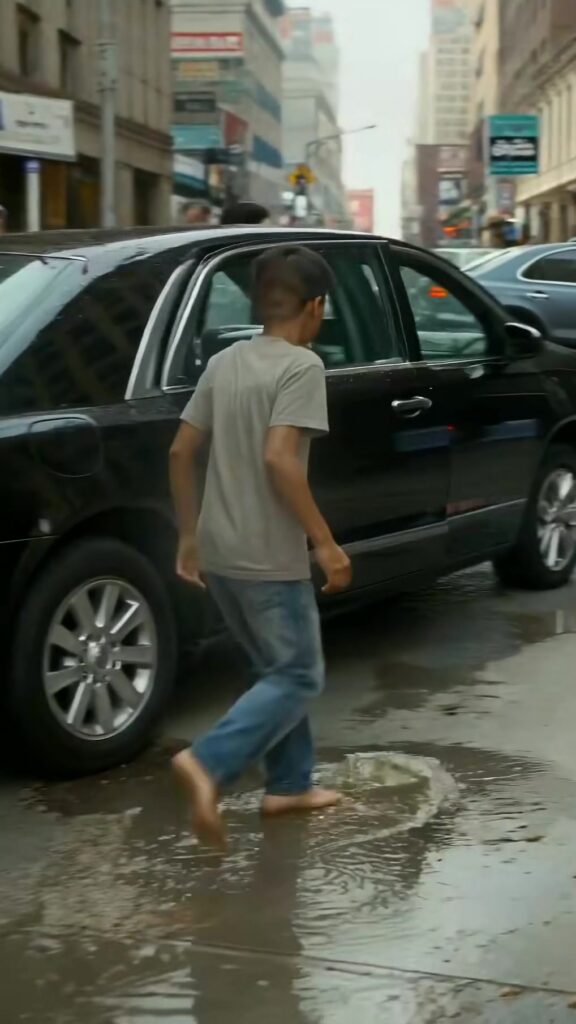
He stood on the curb with a plastic bucket at his feet, barefoot on sun-cracked asphalt that burned by day and cooled into knives by night. His shirt hung from one shoulder in tired threads. Dust caked his skin in the shape of old tears, and the street treated him like another piece of debris: a paper cup, a broken bottle, a boy.
He didn’t ask for coins. He didn’t call out. He didn’t even raise his hand the way the other kids did, hopping between bumpers and exhaust like sparrows. He waited.
Every car made him stiffen. Every honk made his ribs clench. But black cars—sleek bodies that swallowed light—made his heart slam hard enough to hurt. He would track them with eyes that were not empty, not dull with resignation, but sharpened to a single point.
“Please,” he mouthed, so softly the word fell into the gutter. “Let it be this one.”
Sometimes the street gave him false hope: a dark sedan with tinted windows, a black taxi, a delivery van that looked darker in the shadow of an overpass. Each time, the disappointment landed like a bruise.
He didn’t know what he would do when the right car came. He only knew that if he missed it again, the waiting would never end.
The bucket beside him wasn’t for washing windshields. It held water the color of old coffee and storm drains. He’d collected it from a leaking pipe behind the market and stirred in dirt until it looked like something that could stain a life.
A bus roared past, pushing hot wind into his face. Behind it, something different slid into view—too clean for this street, too silent, too sure of itself. A sleek black car, polished so perfectly it reflected the broken buildings like a cruel joke. It moved like it belonged to another city entirely, one with glass towers and guarded gates.
His throat tightened until breathing was a decision.
His fingers crept around the bucket handle. His arm trembled, not from fear but from memory. The moment stretched thin, and the street fell away, replaced by the corridor that still lived behind his eyes.
A hospital hallway lit in harsh white. The smell of disinfectant that couldn’t scrub panic from the air. His mother, standing with her back against a wall, pressing a torn scarf to her mouth to keep the sound of her crying inside.
A man’s voice, impatient and flat, drifting out of an office as if it were a weather report: “They’re not going to help you.”
His mother’s eyes in that moment had looked past him, as if she had already begun to vanish.
He came back to the street with the taste of that hallway on his tongue.
“They have to see me now,” he whispered.
He stepped off the curb.
The car was close enough that he could see his own small shape in the mirror of its door. He broke into a run, feet slapping the road, bucket swinging like a weapon. People noticed only in fragments—an old man’s head turning, a vendor pausing mid-argument, a teenager’s phone lifting instinctively as if chaos was content.
He threw the bucket with everything in him.
The dirty water exploded against the car’s side in a wet slap that echoed. Brown sheets slid across the glossy paint, dripping from the window seam. A single drop hit the hood and crawled, leaving a trail like blood.
Time snapped taut.
Someone gasped. A plastic bag fluttered in place as if confused. The street held its breath.
The black car stopped.
For one terrifying second, he thought it would simply accelerate—crush him like the street crushed everyone, without noticing.
Instead, the rear door unlocked with a soft click, the kind of sound money makes when it opens opportunities. The door swung outward. A woman stepped out as if stepping onto a stage.
Her heels didn’t hesitate on the dirty pavement. Her suit was pale and sharp-edged, untouched by the street’s poverty. Her hair was pinned back so perfectly it looked like it had never known wind. She turned her face toward him, and anger lit it from within—controlled, practiced, deadly.
“What have you done?” she shouted, voice slicing through the hush. “Do you know what you—”
He didn’t flinch. He didn’t apologize. His chin lifted, though his lips were already shaking.
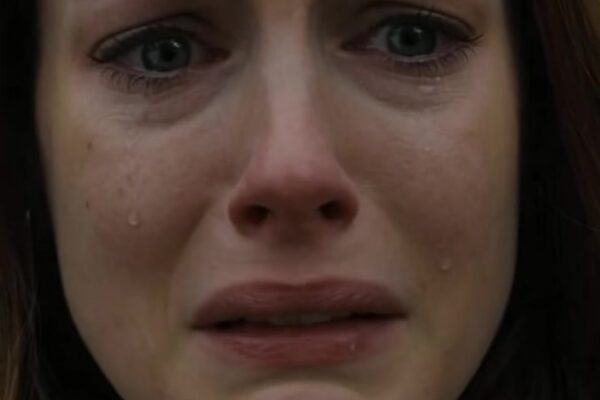
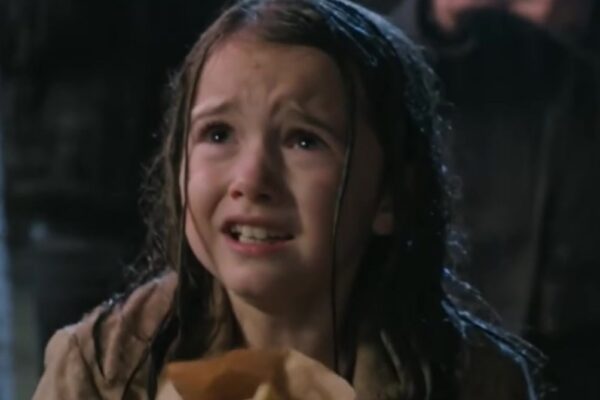
Tears slid down his face, carving clean lines through the dust. “You didn’t stop,” he said, voice cracking but stubborn. “You didn’t look. You just drove away.”
A murmur rippled through the onlookers—more curiosity than compassion, the kind that made people edge closer without offering a hand.
The woman’s expression faltered, confusion interrupting her fury. “What are you talking about?”
He swallowed hard. The words came out like stones. “My mom,” he said. “She was on the road… begging. She fell. She was waving. And you…” His eyes squeezed shut as if he could unsee it. “…you drove past her.”
The woman’s anger dimmed into something sharper. She took a step closer, and another, her perfume cutting through the smell of garbage and heat. For the first time, she looked at him like he was human, not a nuisance.
“That’s not possible,” she said, voice lower now. “I would remember.”
“You had music on,” he whispered. “You were smiling.”
The woman’s gaze flicked to the car, then back to him, as if measuring a truth she didn’t want. Her eyes narrowed, and something changed in her posture—like a door inside her had opened a crack.
“…That wasn’t me,” she said.
The sentence landed wrong, not comforting, not denying, but redirecting.
He blinked. The world tilted. “What…?”
She leaned in, close enough that he could see the fine lines at the corner of her eyes, the kind that came from squinting into bright boardrooms, not from crying in alleys. Her voice dropped until it was almost intimate, almost dangerous.
“So tell me,” she murmured, eyes locking onto his with a gravity that made the crowd disappear. “Why does the car you’re describing… have your father’s license plate?”
The street came back in a rush—heat, noise, breath, the sticky film of dirty water sliding down the car door. His heart stuttered.
He stared at the plate as if he’d never truly seen it before. Letters and numbers, ordinary to everyone else, but to him a haunted code. He had watched that sequence pull away from their building years ago. He had traced it on paper until the pencil broke. He had whispered it at night like a curse and a prayer.
His mouth opened, but nothing came out. The memory he had clung to—of a faceless rich driver, of a stranger with music and a smile—began to fracture.
“No,” he managed, a breath more than a word.
The woman didn’t look away. She didn’t soften. Her eyes held him in place, as if she were waiting for a confession she already knew.
Then, from inside the car, a phone began to ring.
The sound was startlingly cheerful against the thick silence—an expensive chime, bright and insistent. It rang once, twice, three times, and each ring felt like a knock on a locked door.
The woman turned her head slightly, listening, as if the call belonged to her. But she didn’t reach in. She stayed facing him. Her gaze sharpened further, and for the first time her calm slipped enough to reveal a thin thread of urgency.
“Answer it,” she said, not to him and not to the driver—just into the air, as if commanding fate itself.
The phone kept ringing.
The boy’s hands hung at his sides, wet from the bucket. His tears had stopped, replaced by a coldness spreading from his stomach to his fingertips. If the plate was his father’s, then the story he’d built—his single reason for standing beside a trash bin while the world walked past—was missing a piece so large it could swallow him.
The ringing cut off.
One beat of quiet.
Then the car’s screen lit again with an incoming call, the name flashing briefly on the dashboard display where anyone close enough could see it through the glass.
It was a name the boy hadn’t spoken in years, a name that tasted like abandonment and cigarettes and slammed doors.
Dad.
The woman’s face did not move, but her voice turned to ice. “You wanted someone to see you,” she said. “Be careful. Sometimes they do.”
The boy stared at the glowing name, and the street around him—people, buildings, the sun—felt suddenly unreal, as if the only solid thing left was that ringing promise of truth waiting to be picked up.
In the pause before anyone moved, he understood with terrifying clarity: he hadn’t stopped the car. He’d summoned it.
And now the past was calling back.