The red light glowed over the frozen street like a wound that wouldn’t close. Snow had fallen days ago and then hardened into gray crust under tires; the wind worried at it, scouring the asphalt until the surface shone. Cars idled in two neat lines, their breath rising in pale ribbons. Somewhere beneath the hum of engines, a bus sighed, doors hissing shut, and the whole intersection seemed to hold its own cold, impatient heartbeat.
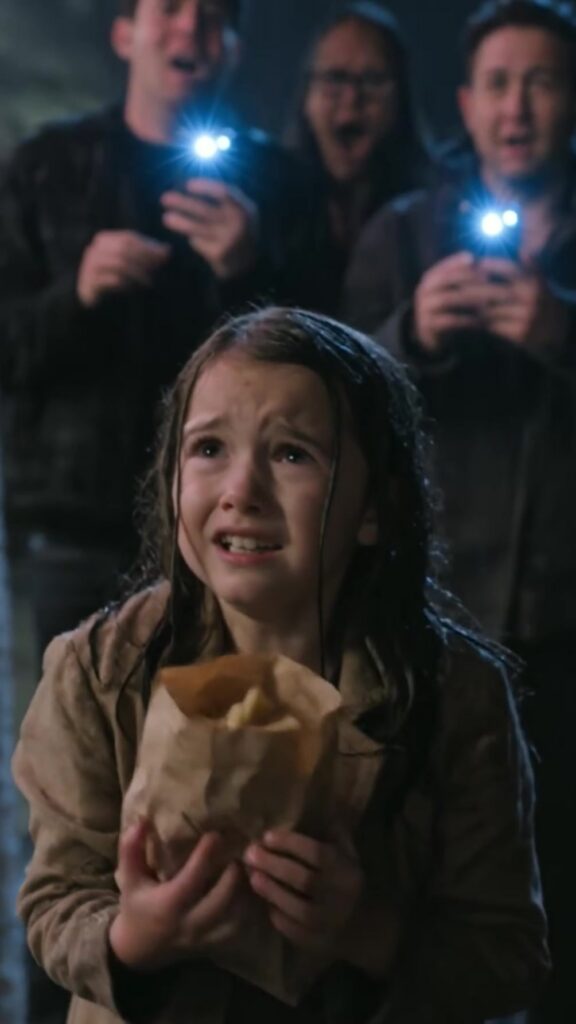
On the curb, where the shoveled snow had been piled and trampled into ridges, a small boy sat folded into himself. His knees were pulled tight to his chest, his arms cinched around them as if he could squeeze warmth out of bone. His jacket was too thin for the hour, his shoes the wrong size, his sleeves dark with damp. His shoulders shook, and the sound that came from him was more breath than sob—carefully quiet, as if he’d learned long ago that being heard could cost him.
People passed and looked away as if he were a stain. A man in a beanie glanced, hesitated, then checked his watch and kept walking. A teenager lifted a phone, framed the boy in a quick shot, then angled the camera toward her own face, narrating without feeling. The city was full of stories everyone wanted to witness and no one wanted to carry.
A black luxury sedan slid up to the curb, its paint swallowing the streetlight’s glow. The car was too clean for this weather, too glossy, like it belonged to a different season. The window lowered with an electric sigh. Inside sat a woman in a pale coat that looked expensive enough to be warm even without fur. Her hair was perfect. Her lips were not.
Her gaze dropped to the boy as if he were trash caught in a gutter. For a moment her expression held a dull distance, the kind that comes from never being forced to see. Then it sharpened into distaste, like she’d stepped into something unpleasant and was offended it existed at all. She reached to the seat beside her, lifted a wrapped sandwich, and tossed it out with a flick of her wrist.
The sandwich struck a puddle at the curb, collapsing into slush. The wrapper tore; bread soaked up black water and sagged. “There,” she said, voice loud enough to travel beyond the window. “If you’re hungry.” Her mouth curved. “Go on. Take it.”
The street seemed to tilt toward the moment. A couple of pedestrians slowed. Someone actually stopped. More phones rose like small, bright eyes. The boy stared at the ruined food. His crying thinned into silence, not because he’d stopped hurting but because something in him had gone hard and quiet. He reached out, fingers trembling above the puddle. The cold had painted his knuckles raw.
Before his hand could touch the soggy bread, a click sounded—subtle, mechanical. The car door opened. The driver stepped out into the cold with the stiffness of someone who lived behind glass. He was tall, wearing a dark coat that fit his shoulders precisely. His face looked carved by sleeplessness rather than age. Annoyance rode in the line of his mouth as if he’d been sent to fix a nuisance at the curb.
He took three brisk steps, then slowed. Something shifted in him, as if the air had changed. His eyes landed on the boy’s face—on the sharp little chin, the familiar shape of the brow, the way one eyebrow sat slightly higher than the other as if always asking a question. The driver’s breath snagged. Color drained from his cheeks. The irritation drained with it, leaving only a startled, naked fear.
The boy looked up. In the red light, his tears shone like thin, clear threads. He didn’t flinch from the man looming over him. He only stared, searching the driver’s face the way a starving person searches a pantry. His lips moved, and what came out was barely louder than the wind. “You used to sing,” he said. “When the thunder made me hide.”
The intersection fell into a strange hush, as if even the engines were listening. The driver’s hands began to tremble at his sides. His eyes flicked, helplessly, over the boy’s features, and a memory cracked open—small fingers curled around his thumb, a room with peeling wallpaper, the smell of boiled rice, a lullaby hummed through exhaustion. A name rose in his throat like smoke. “No,” he whispered, but it wasn’t denial so much as disbelief that the past had found him on this street.
Inside the car, the woman leaned forward, her smirk fading. “Daniel,” she snapped, voice suddenly tight. “What are you doing?” The driver didn’t answer. The boy’s gaze didn’t leave him. “Why did you stop coming back?” the child asked, the words simple enough to fit in a breath and heavy enough to crush a man.
Daniel—because that was his name, the name he’d built a new life around—took a step back as if the curb had become the edge of a cliff. He could feel the watchers, the cameras, the weight of eyes turning from cruelty into curiosity. He could also feel something else: the old guilt he’d buried under clean suits, the nights he’d told himself he’d done what was necessary. He’d been a driver then too, but for a different kind of car, a different kind of woman, a different kind of money. He’d made promises in a cramped apartment, humming songs over a child whose mother worked double shifts and smiled anyway. He’d vanished the day he was offered a way out—a job, a new identity, a contract that came with an unspoken warning: you don’t bring your past with you.
“I…” Daniel’s voice broke. He glanced toward the black sedan as if the woman inside could give him permission to be human. Her eyes were on him now, sharp and calculating, as if she were doing arithmetic. She had hired him because he was quiet, because he didn’t talk about where he came from, because he looked like a man who had nothing left to lose. She had never considered he might have left something behind.
The boy’s hand hovered over the puddle again, but not for the sandwich now—his fingers reached for Daniel’s coat cuff, for proof that the man in front of him was real. Daniel caught the small wrist gently, stopping him from plunging into freezing water. The touch jolted through him like electricity. The child’s skin was icy. Daniel’s own palm felt suddenly monstrous in its warmth.
“Don’t,” Daniel said, not to the boy, but to the scene itself. To the phones. To the woman. To the version of him that had learned to survive by obeying. He pulled off his gloves and wrapped them around the boy’s hands, then shrugged out of his coat and draped it over the small shoulders. The boy blinked, startled by the weight of kindness. For a second his mouth wobbled, and the quiet sob returned, a sound that refused to stay silent anymore.
The woman flung her door open. The cold slapped her face, and rage made her cheeks flush. “Daniel, get back in the car,” she said, each word edged like glass. “You’re making a spectacle. Do you know who I am? Do you know what this looks like?” She swept a hand at the cameras, the faces, the red light that still held everyone trapped. “This is—this is not our problem.”
Daniel turned his head slowly. His eyes met hers, and something in them settled, a decision forming with the inevitability of ice. “It is mine,” he said. His voice was steady now, deeper than fear. “It always was.” He looked back down at the boy, at the raw lips, the damp lashes, the too-thin clothes. “What’s your name?” he asked, though he already knew, and the boy—shivering, brave—gave it to him like a key.
The light above them held red a moment longer, as if unwilling to release what it had illuminated. Then it changed. Engines surged. Cars began to move. But Daniel didn’t. He crouched beside the boy, blocking him from the wind, and in that motion the life he’d carefully arranged cracked wide open. The woman’s face hardened into something dangerous, as if she’d sensed the collision coming—past meeting present, love meeting cowardice, truth meeting money—and understood that none of her polished power could stop it now.
Daniel lifted the boy, light as a bundle of sticks, and held him close. The child’s cheek pressed against his collarbone, and the warmth that passed between them felt like both forgiveness and accusation. “I’m here,” Daniel said, voice rough. He didn’t know yet what it would cost—his job, his protection, the city’s favors, his carefully curated anonymity. He only knew the frozen street had become a courtroom, and under the red light he could no longer pretend he hadn’t been the one who abandoned a song halfway through.