The mall shone with marble and glass, the kind of brightness that made people walk faster as if they had an appointment with perfection. Light spilled from skylights in clean rectangles, slid across polished floors, and climbed the mirrored storefronts until every passerby looked like a better version of themselves. Perfume drifted from the cosmetics counters like warm fog. A fountain murmured in the center court, its coins glittering like promises. Somewhere a piano played through hidden speakers, a melody too soft to interrupt spending.
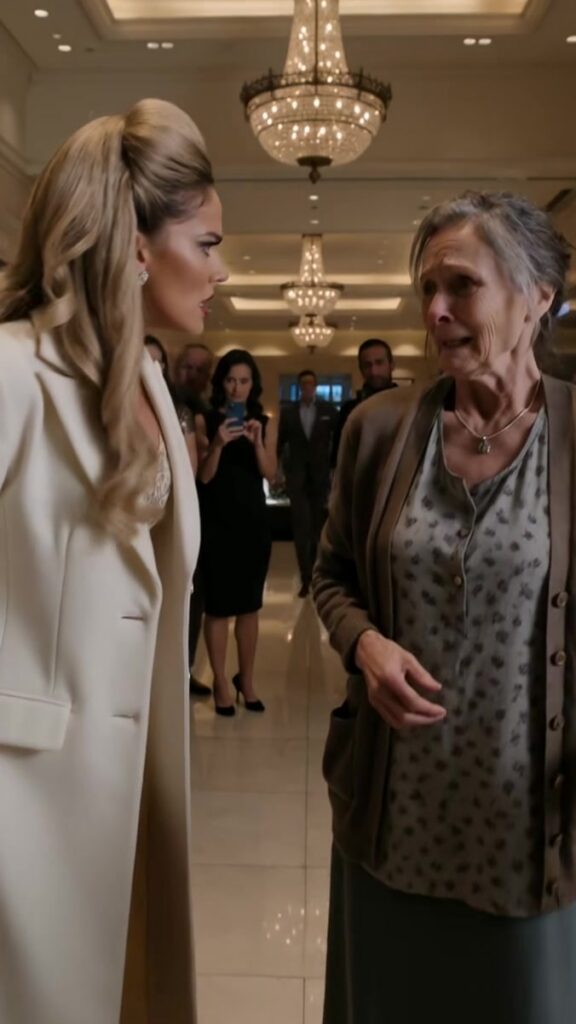
Celeste Rourke moved through it all as if she owned the air. Her heels struck the marble with confident clicks, her coat the color of fresh cream. Beside her, Isla—six years old and made of sudden feelings—skipped while clutching a plush rabbit with a satin bow. A nanny trailed a few paces behind with shopping bags stacked like trophies. Celeste’s phone buzzed in her hand; she kept glancing at the screen, half listening to the world, half hearing only numbers and notifications.
They passed the atrium where a small street performer stood near the fountain: an older woman with silver hair pulled into a braid, an oversized cardigan, and a battered little music box in her palms. She didn’t beg with a cup. She didn’t shout. She simply turned the key and sang in a voice that had survived something and come out soft. The song was old—older than pop, older than the mall—its notes like threads pulled from a distant home. Shoppers flowed around her like water around a stone, most of them never looking down.
Isla did look. Her skipping slowed, then stopped, as if someone had tugged a string inside her chest. Her eyes widened. She took one step toward the singer, then another, rabbit dangling by one ear. The older woman’s gaze lifted and met the child’s, and her song wavered—just slightly—before it steadied again.
“Isla,” Celeste said without turning, still reading her screen. “Stay close.”
But Isla was already reaching out, palm open, drawn by the melody as if it carried her name. The older woman smiled, small and startled, and the last line of the lullaby slipped into the air with a tenderness that didn’t belong among luxury boutiques.
Celeste looked up at last and saw her daughter near the fountain, inches from a stranger. Something hot flashed through her—fear dressed up as authority. She rushed forward, snatched Isla back by the arm, and the plush rabbit slipped free.
It hit the marble, skidded, then tumbled in an awkward spin. The slap was not a hand striking flesh, but the sound of a palm smacking the woman’s music box away—an impulsive, sharp motion that sent the little object clattering across the floor. Heads turned. A gasp rose and fell. The mall’s controlled music seemed suddenly too quiet.
“Don’t touch my daughter!” Celeste’s voice cut through the atrium like a thrown glass. Her cheeks were pink with righteous adrenaline. “What do you think you’re doing, creeping up on children?”
The older woman flinched as if the words themselves had weight. She stepped back, hands raised, fingers trembling. “I wasn’t—she came to me. I was only singing.”
Phones lifted in a synchronized rustle. A teenager leaned in for a better angle. A couple near the fountain froze mid-sip. Even the fountain seemed to hush, its water suddenly louder in the silence.
Isla’s face crumpled, the way a small face can become all emotion at once. She lunged toward the singer, crying hard enough to catch her breath. “But she knows it,” she sobbed, pointing toward the older woman with a trembling finger. “She sings the song Daddy sings to me at night!”
The words struck the air and stayed there. Celeste’s mouth opened to deny, to explain, to turn it into something harmless, but her throat tightened. That lullaby had been Andrew’s—one of those odd, old songs he claimed his mother used to hum before he could remember her face. He rarely sang it out loud; it belonged to their home, to dim lights and quiet rooms. Celeste had never heard anyone else sing it. Not once.
The older woman’s lips parted as if she could answer, but no sound came. Her eyes shone, not with performance, but with recognition so raw it looked like pain.
Behind them, the escalator delivered another wave of shoppers into the atrium. A man in a charcoal coat stepped off, slowing as he heard his daughter’s voice carrying over the crowd. He turned toward the commotion, irritation already on his face—until the last line of the lullaby reached him, broken by Isla’s sobs.
Andrew Rourke stopped so abruptly a woman behind him nearly bumped his shoulder. His gaze found Isla first, then Celeste—then slid, unwilling, toward the older woman by the fountain. His expression drained as if someone had opened a valve. The color left his skin, leaving him pale under the bright skylight.
Shoppers felt the shift before they understood it. A hush fell heavier than before. Even the phones paused mid-record, people sensing that this was no longer a simple scene of entitlement and humiliation. This was something else: a door cracking open.
Andrew walked forward, one careful step at a time, as if the marble had turned to ice. His eyes were locked not on the woman’s face, but on the chain at her throat. A small charm hung there—worn thin, metal dulled by years. It was shaped like a tiny locket, the kind that could hold a curl of hair or a pressed flower. Andrew knew it the way you know a scar on your own body.
His breathing turned uneven. “That…” he whispered, voice barely audible in the vast atrium. “That can’t be.”
Celeste turned toward him slowly, her earlier sharpness faltering into confusion, then unease. “Andrew?” she said, as if saying his name could restore order. “What are you doing? This woman—”
But Andrew didn’t look at Celeste. His eyes were fixed on the charm, on the tiny engraving at its edge, the half-moon scratch he had made with a nail when he was a boy and angry at the world. He took another step closer. His hands rose slightly, shaking, then lowered again as if he didn’t trust them.
The older woman stood utterly still. Tears gathered, but she did not wipe them away. Her gaze held Andrew’s with the exhaustion of someone who had carried a secret for too long. Her mouth moved, forming his name without sound.
Isla’s crying softened into hiccuping breaths. She stared from Andrew to the older woman, then back again, as if assembling a puzzle with missing pieces. Her small hand reached toward the singer with a certainty beyond her years.
“Grandma…?” Isla whispered.
The word fell into the marble-and-glass brightness like a stone dropped into deep water. Celeste’s face tightened, the last of her control slipping into fear. Andrew’s knees bent as if the floor had tilted. He stared at the charm one final time, then finally looked up into the older woman’s eyes—eyes he had tried to forget, eyes he had been told belonged to a ghost.
His voice cracked on the edge of something breaking. “Mom?” he said, and it wasn’t a question so much as a prayer that could ruin every story he’d ever been told. The crowd held its breath, phones hovering, while Celeste stepped back as if the truth had teeth. The older woman opened her arms a fraction, trembling, and the mall’s perfect shine reflected a family about to splinter—or be remade—in front of everyone.