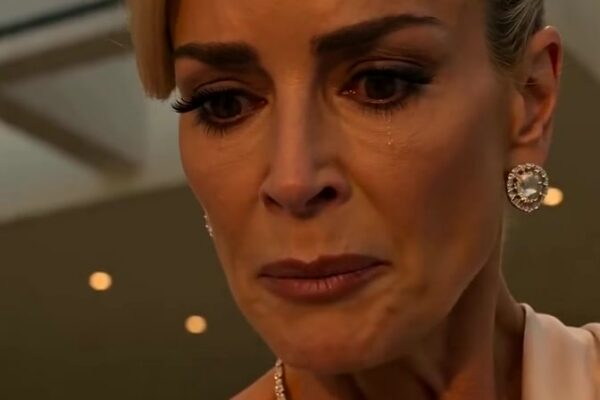
The judge had barely lifted her eyes from the file when the sound split the room—raw and jagged, like a violin string snapping under too much pressure. A widow’s voice, hoarse from nights spent rehearsing grief into anger, tore through the opening ritual of the hearing. For a breath, the courtroom was not a courtroom at all, but a theater where everyone forgot their lines.
Lenora Kestrel rose so fast the metal legs of her chair shrieked against the tile. Black crepe clung to her shoulders in expensive folds, and the diamond at her throat caught the fluorescent light like an accusation. She pointed across the aisle, arm rigid, fingers trembling with something that looked like certainty. “She’s lying,” Lenora said, and the words were sharp enough to cut paper. “She’s here to take what belongs to my husband’s memory—and to me.”
A collective turn rippled through the gallery. Whispered questions, the scrape of shoes, the quiet click of a reporter waking a phone camera. On the opposite side stood a young woman who seemed to have arrived by accident: a thin coat that had seen too many winters, hair pinned back with a practical clip, hands clenched so hard her knuckles blanched. Her gaze held steady even as heat crawled up her throat and into her cheeks.
“I didn’t come for your pity,” she said, voice shaking as if the words were too heavy for her lungs. “I came because Elias Kestrel was my father.” The sentence hung in the air like a thrown stone, and the room erupted in the way crowds do when they smell scandal—half outrage, half hunger.
The judge rapped her gavel once. Twice. The clerk stilled, pen poised above the minutes, as though the ink might spill the wrong kind of truth. Lenora’s laugh cut through the chaos—short and bitter, a sound that had learned how to survive on contempt. “Look at you,” she said, and her eyes swept the young woman from boots to collar. “You expect anyone to believe you share blood with him?”
The words struck with a cruelty that was older than this case: the old belief that legitimacy wore fine cloth, that family belonged to those who could afford to look like it. The young woman’s jaw tightened. She did not sit. She did not flinch away. She reached into her bag with fingers that trembled as if they were unthreading a live wire and pulled out a sealed envelope, thick and careful, stamped with a notary’s pressed mark.
Sound drained from the room. Even the reporters hesitated, sensing that whatever came next would be cleaner than gossip and harder to undo. “He gave this to me,” the young woman said. “Before he died.” Her name, when she finally said it, was Mara Vale—quiet as a confession.
Lenora’s expression shifted for a flicker—something like recognition, as if she had seen that envelope before in a drawer she pretended not to open. Then the widow’s composure snapped back into place. “Read it,” she demanded, voice rising. “Go on. Let’s watch you embarrass yourself properly.”
Mara broke the seal with a careful tear, the paper resisting at first, then giving way. A single document slid out, folded in thirds. Her hands shook so much she nearly dropped it. Before she could smooth the creases, a lawyer at the nearest table stepped forward on instinct, as if his training moved him before his conscience could argue. He took the page, scanned the top, and stopped.
The change in his face was small but unmistakable. It wasn’t surprise alone. It was the look of a man who has just watched the floor shift beneath a building and is calculating how many will fall.
Lenora leaned forward as if she could force the words out of him. “Well?” she hissed. “Tell the court what that is.”
He swallowed. “It appears to be a codicil,” he said, and the term—precise, legal, cold—carried more weight than any shouted insult. He glanced up at the bench, then back to the signature at the bottom. “An amendment to Mr. Kestrel’s will. Properly witnessed.”
Mara’s breath came in a sharp, involuntary pull. Lenora’s shoulders went rigid, and for the first time the widow looked less like a conqueror and more like a woman fighting to keep a door closed against a storm.
The lawyer continued, voice steadier now that the law had given him rails to stand on. “The document adds Ms. Vale as an heir.” A murmur crawled through the gallery, rising like wind in dry grass. “It assigns her… half of the estate.”
Lenora took a step back, as if struck. The diamonds at her throat trembled. For a moment her face collapsed—grief, fury, terror, all of it stacked behind her eyes. Then she snapped her head toward Mara with a violence that made the bailiff shift his stance.
“He was manipulated,” Lenora said. “He was sick. He didn’t know what he was doing.” Her voice cracked again, not with sorrow now, but with the panic of someone watching their world redivide itself in ink. “You came crawling out of nowhere with your sad little story and—what?—you think a signature makes you family?”
Mara did not look away. “I didn’t crawl,” she said. “I grew up where he sent me.” And then, because the courtroom was already drowning in revelation, she added the detail that made even the judge’s eyes harden: “He paid for my school. He visited twice a year. He promised me he would tell you. He never did.”
Lenora’s lips parted. A sound came out that wasn’t quite a word. She turned her gaze toward the front row where a man sat in a tailored suit—Elias Kestrel’s brother, pale and still, hands laced tight as prayer. He stared at the table as if the wood might offer a new reality if he stared long enough.
The judge’s voice cut in, calm and lethal. “Ms. Kestrel,” she said, “this court is not here to evaluate the wardrobe of the parties. We are here to determine whether this instrument is valid.” She nodded toward the lawyer. “Counsel, verify the notary and the witnesses.”
As the lawyer began naming dates, addresses, credentials, Mara felt the room’s eyes on her like heat. She had expected disbelief. She had prepared for humiliation. What she hadn’t prepared for was the strange, aching relief of having the secret spoken aloud in a place that forced people to listen.
Lenora’s hands clenched at her sides, the elegant gloves suddenly too tight. Her voice, when it came again, was lower, nearly intimate—more dangerous than shouting. “You want half,” she said to Mara, “but you don’t know what half costs.”
Mara’s throat tightened. In her mind flashed memories of Elias’s careful visits—his cologne lingering in cramped apartments, his hand lingering on her shoulder as if he wanted to claim her but didn’t dare. She thought of her mother’s silence, of the way their lives had been arranged around a man who belonged to someone else. “I know exactly what it costs,” she said. “It cost my mother everything. It cost him his courage.”
The judge called for order again, but it wasn’t the gavel that restored silence. It was the understanding settling over everyone that the inheritance was no longer the heart of the matter. The real trial had already begun: not of money, but of a man’s hidden life, and of the women left to carry the consequences.
As the clerk marked the codicil into evidence, Lenora’s gaze fell to the paper as if it were a bruise she couldn’t stop pressing. Mara watched her, and for the first time she saw beneath the widow’s armor something fragile and furious—a love that had believed it was exclusive, and a betrayal that did not care about class or polish.
The judge set the next hearing date, her tone procedural. The courtroom began to breathe again, chairs shifting, reporters whispering, people already composing their versions of the story. But Mara stood still, envelope empty in her hand. Across the aisle Lenora stood too, frozen in the wreckage of her certainty.
Between them lay a dead man’s signature—thin strokes of ink that could not speak, yet had somehow split a room wide open. And as they were ushered out into the hallway’s harsh light, both women understood the same brutal truth: whatever the court decided, neither of them would leave with the life they had arrived expecting to defend.