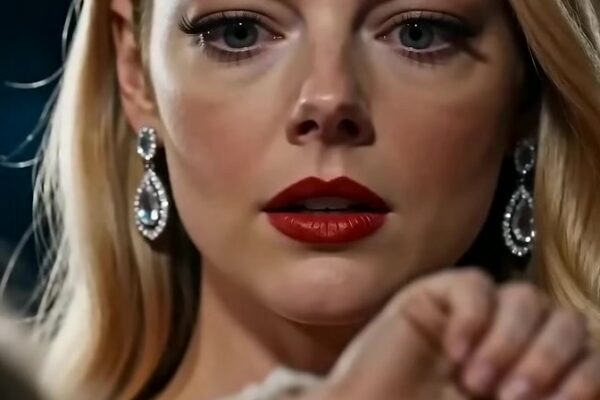
The crack of skin on skin snapped through Halcyon Jewelers like a gunshot, sharp enough to silence the soft jazz and the murmurs of moneyed conversation. Heads turned in unison. A champagne flute paused halfway to painted lips. Even the security guard by the door looked up from his practiced boredom.
Celeste Ardent—silk dress, diamond studs, the kind of composure that usually arrived before she did—stood rigid beside the glass display case with her palm still lifted, fingers slightly curled from the strike. Across from her, a young woman staggered, the edge of the counter catching her ribs. She gripped the glass to keep from falling, her knuckles whitening as if the boutique itself might tilt and pour her out onto the marble.
“You don’t touch what isn’t yours,” Celeste said, voice controlled and deadly. She wasn’t shouting; she didn’t need to. The boutique had gone quiet enough to make every syllable feel like a blade being set carefully on a table. “That ring was ordered for me. For my engagement. For my life.”
The young woman’s hair was damp from rain, her coat too thin for early spring. She said nothing. Her breathing hitched as she tried to steady herself, as if the slap had stolen the air from her lungs and she had to negotiate with her body to get it back. Around them, phones rose like periscopes. A salesman in a tailored suit took a nervous step toward Celeste, then thought better of it and retreated into politeness.
Celeste leaned closer, a smile that didn’t reach her eyes. “I recognize your kind,” she murmured, soft enough that it felt intimate, cruel enough to be public. “You appear when the price tag shines. You think you can slip a dream on your finger and pretend you belong here.”
The young woman—Mara, the jeweler would later realize, though he didn’t know the name yet—did not answer. She raised her trembling hand instead, not in defiance but with the slow deliberation of someone making herself visible. The ring sat there, too bright for her worn skin, and beneath it, crossing the side of her finger, was a pale scar—an old seam of damage that looked like it had been stitched by pain and time.
Behind the counter, Mr. Kessler, the elderly jeweler whose hands had measured a thousand promises, froze mid-motion. His eyes found the scar as if pulled by a hook. Color drained from his face in a swift tide; his mouth opened, and for a moment no sound came out. His fingers, usually so steady with stones and settings, began to tremble above the velvet pad.
He looked at the ring. Then at Mara. Then at Celeste. The air in the boutique tightened, as if everyone instinctively held their breath to keep from breaking whatever was forming. “That… that ring,” Mr. Kessler managed, each word scraped out of him. “It was sized… for her.”
Celeste blinked, a brief flicker of confusion like a crack in porcelain. “Excuse me?” she said, the edges of her confidence sharpening.
Mr. Kessler swallowed. His gaze didn’t leave Mara’s hand, as though the scar were a signature only he could read. “I remember,” he whispered. “Because she bled a little when the band caught on the healing skin. I offered water. I offered to stop.” His voice broke. “And because the man beside her—Julian Vale—kept saying, ‘Just a moment more. We’re almost done.’”
The name dropped into the room like a stone into deep water. Celeste’s posture stiffened, her throat working as if she’d swallowed something too large. “Julian?” she repeated, and now the syllables were thin, unsteady. “My fiancé?”
Mr. Kessler nodded once, miserably, as though agreeing caused him physical pain. “It was years ago,” he said. “Late afternoon. Rain like today. He brought her here in a hurry, asked for discretion. Paid cash. A small ceremony elsewhere, he said.” The old man’s eyes shone with a shame that had been waiting a long time for light. “He called her his wife.”
The boutique held still. A woman near the back lowered her phone as if the story had become too heavy to record. Celeste’s lips parted; no sound came out. Her gaze snapped to Mara, searching for a lie to grab. “This is—this is a setup,” she managed. “A con. I don’t even know you.”
Mara finally spoke, voice raw with restraint. “You’re right,” she said. “You don’t.” She slid the ring off with careful fingers and set it on the velvet pad as if returning a borrowed fire. “I didn’t come for diamonds. I came because the letter said he’d meet me here. Because he said there were things to settle. Things he owed.”
Celeste’s eyes flashed. “He owes you nothing,” she snapped, desperate now, not cruel. “Julian isn’t—Julian wouldn’t—” She stopped, because the room itself seemed to contradict her. Mr. Kessler’s shaking hands. The scar. The ring that fit too perfectly on a stranger.
Mara reached into an old canvas bag whose seams had been repaired more than once. Her fingers closed around something tiny, and when she brought it out, it looked absurdly small against the luxury around them: a single baby sock, faded blue, the fabric thinned from washing. The sight of it tightened the throat in a way that diamonds never could.
“He promised,” Mara said, and this time her voice trembled openly, no longer trying to be made of stone. “He said he’d come back before our son learned to walk. Before he could call another man ‘Father’ by mistake. Before the hospital bills ate the last of my savings. Before the nights got so long I started measuring them by the sound of my own breathing.”
Celeste’s face emptied, as if every practiced expression had been erased. “You’re lying,” she whispered, but it sounded like pleading, not certainty.
Mr. Kessler leaned forward, grief carving his features. “I kept the record,” he said softly. “Not in the system. In my drawer. Like he asked.” He pulled a worn ledger from beneath the counter and opened it with reverence, revealing a note in careful handwriting and a fingerprint of dried wax. He turned it toward Celeste, and though the boutique’s lights glittered on the glass, the ink was unmistakable: Julian Vale’s signature.
Celeste stared at it as if staring could rewrite it. Somewhere in the background, the door chimed—someone leaving quietly, unable to witness more. Mara’s eyes shone, but her tears did not fall; they clung stubbornly as if even sorrow had learned frugality.
“I didn’t come to take your ring,” Mara said, her voice steadier now, because the worst part—being called nothing—had already happened. “I came to ask him why. If the life he built with you was worth the silence. If he remembers the day he put that band on my finger and swore he would choose me every morning.”
Celeste’s hands rose to her mouth, fingers pressing hard as if to keep her from shattering. “Where is he?” she breathed.
Mara’s gaze flicked to the boutique’s front windows, where rain traced long lines down the glass like tears that didn’t belong to any one person. “He said he’d be here,” she answered. “That he was ready to do the right thing.” She looked back at the velvet pad, the ring sitting there like a verdict. “But he has always been good at arriving late.”
In the hush that followed, Mr. Kessler closed the ledger with a soft thud, as if ending a prayer. Celeste stood frozen between rage and ruin. And Mara, still holding that tiny sock, straightened her shoulders, not triumphant—only tired, and terribly brave. Outside, the rain intensified, and within the boutique of polished glass and perfect light, the cost of a promise finally came due.