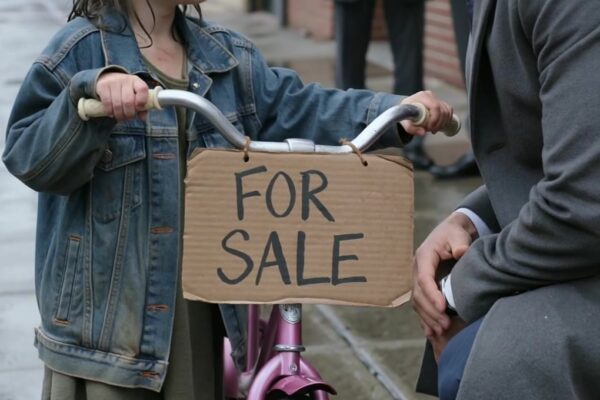
The bank on Halston Avenue had a way of swallowing sound. The air was conditioned into obedience, the marble floors polished to the point of intimidation, and every cough seemed to apologize for existing. On a Tuesday afternoon, when the light outside looked like a sheet of tarnished brass, a boy stepped through the revolving door and hesitated as if he had walked into a museum where touching anything could trigger an alarm.
He was twelve, maybe thirteen. His hair had been combed with water and hope. He wore a shirt that had known other owners and pants whose cuffs were mended with neat, careful stitches. The shoes drew the eye first—not because they were bright or new, but because they were so plainly cheap. Thin black soles, already worn at the heel, with laces that didn’t match. Two dollars, the kind of shoes bought from a folding table near the bus depot, the kind that admitted the world through every crack.
He crossed to the line marked by a velvet rope and waited as the queue shifted forward in small, impatient increments. When his turn came, he approached the nearest teller window. The woman behind the glass wore a navy blazer and a name tag that declared her importance in block letters. Her nails were pale pink, her smile preapproved.
“Hello,” the boy said, voice quiet but steady. “I need to speak to someone about an account. It’s urgent.”
The teller glanced down at him as though his height were an offense. “Do you have an appointment?”
“No. I—my uncle told me to come here. He said you’d help me.” The boy reached into his pocket, pulled out a folded slip of paper, and slid it forward with both hands. The paper was creased into fourths, smoothed and re-smoothed. On it was a phone number and a name written in careful pen strokes.
The teller didn’t take it right away. Her eyes moved from the paper to the shoes. She pressed her lips together, and something like amusement settled there. “Sweetheart,” she said, lowering her voice as if offering mercy, “we can’t just ‘help’ with an account because someone told you to come. You need identification. A guardian. Documentation.”
The boy swallowed. “I have a letter.”
“A letter.” The teller’s smile widened slightly, enough to be seen by her coworkers. “Do you mean like, a note?”
The boy nodded. “Yes. It explains.”
Behind him, a man in a gray suit sighed loudly. From another window, a second teller leaned toward a third, whispered, and both glanced over at the boy. The whispering gathered like a draft. It carried that soft edge of ridicule that only adults can manage—polite, controlled, and still sharp enough to cut.
“We’re very busy,” the teller said, tapping a manicured finger on the counter. “If you want to open a youth account, your parent has to be present. Otherwise, you can take a seat and wait until we have time.”
“I’m not opening an account.” The boy’s cheeks colored. “I’m… I’m here for the box. The safe deposit box.”
The words landed wrong, like a stone dropped into a fountain. The teller’s eyebrows lifted. For a moment she seemed to enjoy it, the absurdity of a boy in cheap shoes asking for a safe deposit box in a bank where the smallest box cost more per year than his entire outfit.
“The box,” she repeated, the way people repeat a joke to make sure everyone hears it. She glanced at the line behind him, then at her coworkers. “Well. That’s… ambitious.”
“Please,” the boy said, and the word trembled just once. “It’s important.”
“Take a seat,” the teller said. “We’ll call you when we can.”
He backed away, clutching his folded paper like a fragile thing. The waiting area consisted of two sleek chairs and a low table with magazines that seemed designed to make anyone who picked them up feel unqualified. He sat on the edge of one chair, knees close together, posture straight as if he were bracing for a storm. His eyes stayed fixed on the teller windows. Every time a suited customer approached, the tellers brightened, voices rising like curtains lifting.
Minutes passed. Then twenty. The boy’s foot tapped once, twice, stopped. A security guard in a starched uniform drifted near him and lingered, pretending to adjust his belt. When the boy looked up, the guard’s expression held a question: How long are you going to be here?
At the counter, the teller who had dismissed him leaned toward another employee and spoke with her hand partly covering her mouth. Their eyes flicked toward the boy and away again. A laugh—small, controlled—escaped. The boy stared at the floor, where his thin soles had left faint damp marks from the rain outside.
He was beginning to doubt his own right to the space around him when the revolving door turned again.
The man who entered did not rush. He moved with the deliberate patience of someone used to being waited for. His suit was dark, but not loud. His coat had a clean, heavy line. He carried no briefcase, no umbrella, yet the dampness on his shoulders did not look like rain so much as weather unwilling to touch him.
He removed his gloves as he walked, finger by finger, and handed them to no one. The guard straightened as if pulled by a string. One of the tellers glanced up, froze, and then stood as though she had forgotten she was allowed to sit.
The boy saw him and rose so quickly his chair scraped the floor. His shoulders eased, not because his life had become easier, but because he was no longer alone.
“Eli,” the man said, and the boy’s name sounded different in his voice—rounded, protected. “You waited like I asked?”
“Yes, Uncle.” Eli’s eyes shone with relief and something else: the stubborn pride of a child who had endured without crying.
The uncle’s gaze moved to the tellers. It was not angry. It was worse: it was measuring. He walked to the nearest window, where the first teller’s smile now looked strained, like a mask glued too tightly to skin.
“Good afternoon,” the uncle said. His voice was calm, but the room seemed to lean toward it. “I’m here for safe deposit box 417. Under the name Harrison Cole.”
The teller’s throat bobbed. “M-Mr. Cole,” she managed. “I—of course. One moment.” Her hands shook slightly as she reached for her keyboard.
Silence spread outward. Conversations at the other windows died mid-sentence. A customer in the line turned his head, recognizing something he couldn’t name. Even the air conditioner seemed to lower its hum.
Eli stood beside his uncle, shoulders squared now, his $2 shoes planted on the marble like a claim.
“My nephew came earlier,” Mr. Cole continued, “with written authorization. He was told to wait.” His eyes stayed on the teller. “How long has he been waiting?”
The teller’s cheeks reddened. “We—we didn’t understand—”
“No,” Mr. Cole said softly. “You understood enough to make him feel small. That is not the same as procedure.”
He produced a slim wallet and placed a card on the counter. Not a credit card—an identification badge with a small seal, the kind people only flashed in movies and in rooms where decisions were made that never made the news. The teller’s eyes widened. The manager’s office door, across the lobby, opened almost immediately, as if someone inside had been listening through the walls.
A man in a tailored vest hurried out, smile already in place. “Mr. Cole,” he said with too much eagerness, extending both hands. “We didn’t expect you today.”
“You never do,” Mr. Cole replied, not unkindly. He gestured to Eli. “This is my family. He was treated as though his shoes decided his worth. I’d like that addressed before we discuss anything else.”
The manager’s smile faltered. He turned toward the tellers, and the look he gave them was sharp enough to slice through their earlier amusement. “Of course,” he said quickly. “We can handle that immediately. Please, come with me. Both of you.”
As they walked toward the private hallway that led to the vault, Eli glanced back once. The people in line stared at him now—not laughing, not whispering. Watching with a cautious respect that felt almost like fear. The teller who had mocked him kept her eyes on the counter, hands clasped, as though praying the marble would swallow her.
The vault door waited behind a series of locks and silent cameras. The hallway smelled faintly of metal and cold paper. The manager fumbled with a key, hands still trembling. Mr. Cole’s expression remained composed, but Eli could see the storm under it: not rage for himself, but for the boy who had sat in a chair and tried to take up as little space as possible.
When the box was retrieved, Mr. Cole held it like something sacred. Inside was an envelope, thick with documents, and a small velvet pouch that clinked softly when moved. Eli didn’t ask what it contained. He didn’t need to. He had come because his uncle had told him this place held answers, and because his mother’s hands had been shaking when she packed his lunch that morning.
Mr. Cole opened the envelope, scanned the first page, and nodded as if confirming what he already knew. Then he looked at Eli. “You did well,” he said. “And you did not become what they wanted you to become.”
“What did they want?” Eli asked, voice barely above a whisper.
“Invisible,” his uncle replied. “Ashamed.” He folded the paper carefully, slid it back into the envelope. “Never let anyone teach you that lesson.”
When they returned to the lobby, the bank felt different, as if the walls had shifted. The manager walked beside them, speaking in a tone meant to be overheard, assuring them of apologies and internal reviews and additional training. The tellers stood stiffly at their stations. The first teller’s eyes met Eli’s for a fraction of a second, and in them he saw something raw: not compassion, but regret for being caught.
Mr. Cole stopped at the counter where Eli had been dismissed and set the folded slip of paper down in front of the teller. “Next time a child comes in with urgency in his eyes,” he said quietly, “treat it like it matters. Because sometimes it does.”
Eli followed his uncle toward the door. The revolving glass turned, and the air outside smelled like wet asphalt and possibility. As they stepped into the rain, Eli looked down at his $2 shoes. They were still cheap. They still leaked at the seams. But they had carried him through the marble silence and back out again, and for the first time that day, he didn’t feel the need to hide them.
Behind them, through the glass, the bank remained hushed—less like a museum now, and more like a courtroom after the verdict has been read.