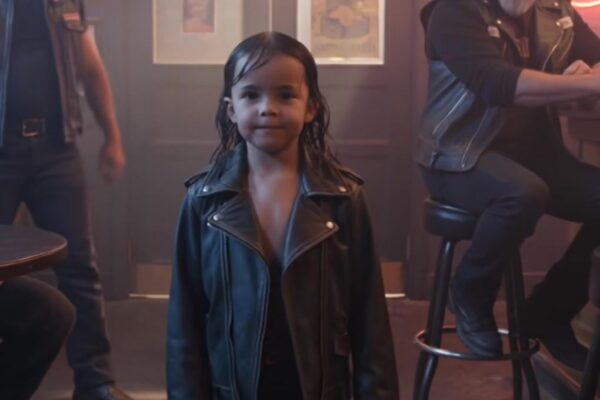
The first thing everyone noticed was the rain—how it made the marble foyer of Hargrove Conservatory shine like a spill of oil. The second thing, if they noticed it at all, was the boy. He came in through the revolving doors with the cautious timing of someone who had been told too many times that doors were not meant for him.
He was small for fifteen, or maybe he only looked smaller because the building was designed to dwarf people into reverence. His hair clung to his forehead in wet strings. His shoes were the kind that absorbed water and shame in equal measure. In his hands he carried an envelope, not tucked away safely in a bag but held in front of him, tight enough that his knuckles blanched. As if letting go would mean letting himself disappear.
Inside the conservatory, the air smelled like polished wood and old money. A chandelier hung above the grand staircase like a frozen bouquet. Students in black coats and instrument cases drifted in clusters, laughing too loudly—laughter that bounced off the walls as if it owned them.
The boy paused at a bronze plaque listing the benefactors. Names ran down the metal in rows of authority: Hargrove. Minton. Harroway. DuMont. He traced one of them with his eyes and swallowed, hard.
“Can I help you?” The voice was crisp, practiced. A woman in a navy blazer stepped into his path like a closing gate. Her lanyard read: Ms. Carrow, Admissions. She looked him over the way one inspects a stain to determine whether it will come out.
He lifted the envelope slightly. “I have… an appointment. I think.”
“Name?”
“Eli Calder.” His voice was steady, which surprised even him. He had practiced it on the bus ride here, repeating it until the syllables stopped trembling.
Ms. Carrow’s eyes flicked to a clipboard. She ran her finger down a list, then stopped and frowned as if the paper had insulted her. “There’s no Calder scheduled. This is the scholarship audition day. Families were advised to arrive through the east entrance.”
“I’m not—” Eli began, then stopped. The word family lodged in his throat like a stone. “I was told to come here.”
Ms. Carrow’s attention softened for exactly half a second, then snapped back into form. “Who told you?”
“Mr. Sutter.”
The name did something to the air. Ms. Carrow’s mouth tightened, and she glanced toward the hallway that led to the administrative wing. “Mr. Sutter is—unavailable. And even if he weren’t, this isn’t a place you can simply walk into.”
A couple of students nearby had begun to watch. Their whispers floated like moths around a lamp.
“Is he lost?”
“Maybe he’s delivering something.”
“He’s soaked. Did he even come in a car?”
Eli kept his gaze on Ms. Carrow’s collar, on the sharp V of the blazer that looked like it had never known weather. He could feel the envelope in his hands, the paper edges cutting softly into his skin. If he let go, he would have nothing to keep him upright.
“I can wait,” he said. “It’s important.”
“Important to whom?” Ms. Carrow asked, and the question was gentler than her expression. She had decided what he was: an inconvenience, a misunderstanding, a boy with the wrong shoes and the wrong address.
Before Eli could answer, a man with silver hair and a symphony of keys clipped to his belt approached, drawn by the quiet tension. His suit was the shade of ash, and his eyes were tired in a way that suggested he had spent decades telling people no.
“What’s happening?” he asked.
“This student says he has an appointment,” Ms. Carrow replied. “There’s no record of him. He’s insisting. He mentioned Mr. Sutter.”
The man’s gaze slid to Eli. “Sutter’s been gone for months,” he said. “Medical leave. No one schedules appointments through him.”
Eli’s throat tightened. The envelope seemed to pulse against his palms. “He wrote me,” Eli said. “He said to bring this.”
He held the envelope out as if offering a fragile, dangerous animal.
The man did not take it. “Son,” he said, the word thick with finality, “I’m going to need you to leave. We have donors arriving. Parents. This is not—”
“—not a place for someone like me,” Eli finished quietly. He didn’t mean to say it out loud. It had been said to him enough times that it had become a voice in his own head.
For a moment there was only the rain tapping the glass doors and the distant hum of a piano somewhere deeper in the building. The watching students shifted, some uncomfortable, some amused. A woman in pearls arrived at the top of the stairs with a violin case and a bored expression, and her eyes snagged on the scene like it was entertainment.
Eli’s hands shook. He could feel the careful composure cracking. He thought of the bus transfer, the coins counted twice, the damp hem of his only good shirt. He thought of the note he’d found tucked under his apartment door three days ago, written in clean, slanted handwriting: If you want the truth, come to Hargrove. Bring what I left you. Don’t let them turn you away.
He drew in a breath that tasted like cold marble. “Then I’ll show you why I’m here,” he said, and before anyone could stop him, he tore the envelope open.
Paper slid out—several sheets, heavier than ordinary letters. At the top of the first page was a seal pressed in dark blue wax. Beneath it, a name in bold type: Hargrove Conservatory Board of Trustees.
Ms. Carrow’s eyes narrowed. The silver-haired man leaned forward despite himself.
Eli unfolded the first page. His fingers were clumsy, numb from the rain, but the words inside were sharp and unmistakable. He didn’t try to read them all. He didn’t have to. He held the document up so they could see the line that mattered, the one Mr. Sutter had highlighted in red ink.
In recognition of services rendered and as stipulated in Clause 9B of the Hargrove Endowment Agreement, the bearer, Eli James Calder, is granted full admission and scholarship, inclusive of housing, materials, and instruction, effective immediately.
The foyer seemed to inhale. The whispers died mid-syllable.
“That’s impossible,” Ms. Carrow said, but her voice lacked force, as if the word impossible had been robbed of its meaning.
The silver-haired man reached out slowly, then stopped, as though the paper might burn him. “Where did you get that?”
Eli slid out the second sheet. A photocopy of a contract, signatures at the bottom—some elegant, some hurried, but all official. A note stapled to it in the same slanted handwriting: They will deny you. They always do. Make them look at their own promises.
“Mr. Sutter gave it to me,” Eli said. “He said it was owed.”
Something shifted in the man’s face. Recognition, maybe, or fear. His eyes traveled from the seal to the highlighted clause, then to Eli’s soaked sleeves and trembling hands. “Sutter was our legal counsel,” he murmured, as though speaking to himself. “He wrote half those agreements.”
Ms. Carrow’s lips parted. “Clause 9B was a contingency—”
“—for emergencies,” the man finished, but he sounded less certain now. His gaze sharpened on Eli. “Services rendered,” he repeated. “What services?”
Eli hesitated, and in that hesitation the weight of the last year pressed down: the sirens, the smell of smoke, the way his mother’s hands had gripped his shoulders as if to keep him from floating away. The newspapers had called it an accident when the old dormitory wing caught fire. They had called the boy who pulled two students out of the stairwell “unnamed.” They had never printed his face.
He reached into the envelope and took out the last item: a photograph, slightly warped from having been folded and unfolded. In it, a boy stood outside a burning building, his shirt blackened, his eyes wide and fierce. Behind him, flames clawed at the windows. Two students sat on the curb wrapped in blankets, their faces turned toward him with stunned gratitude.
Eli held the photo up. “That was me,” he said. “I was delivering food to the kitchen that night. I heard yelling. I went in.”
A silence fell so heavy it seemed to bend the chandelier light.
The woman in pearls at the stairs stopped moving. One of the students watching—tall, immaculate—stared at the photo with a dawning horror, as if remembering a story told at dinner tables and assuming the hero had been someone else.
Ms. Carrow’s expression changed in tiny fractures: disbelief giving way to calculation, calculation to something that looked dangerously like shame. “The board never…” she began.
“They never looked,” Eli said, not harshly, just plainly. “Mr. Sutter did.”
The silver-haired man exhaled. “If this is authentic…”
“It is,” came a new voice from the hallway—a man’s voice, roughened, carrying pain like gravel. Heads turned.
Mr. Sutter stood near the administrative wing, thinner than any photograph on the conservatory website, leaning on a cane as if the building itself had tried to break him and failed. His suit hung on his shoulders like a borrowed promise. In his hand was a small recorder.
“You told admissions I was on leave,” he said, eyes fixed on the silver-haired man. “You told the board I was unstable. You told yourself it would be easier if no one asked why Clause 9B existed.”
The silver-haired man’s face drained of color. “Sutter—”
Mr. Sutter lifted the recorder. “I have copies. Emails. Minutes. The agreement was written after the dormitory fire because the conservatory needed to avoid a lawsuit and a scandal. They chose a clause instead of responsibility. And when the clause named the boy who ran into the flames, they decided the boy didn’t belong.”
Eli’s grip on the photo loosened. He hadn’t known Mr. Sutter would come. He’d only known the handwriting, the insistence of it. Now he felt the room tilt, not from fear but from something unfamiliar: the sensation that the ground might hold.
Mr. Sutter took a step forward, each movement deliberate. “He belongs,” he said, and his voice, though tired, carried the finality of law. “Not because of pity. Because you signed your name.”
The foyer held its breath again, but this time it was not to push Eli out. It was to make room for the truth that had been forced into the open, wet and shaking, clutching an envelope that had become a key.
Ms. Carrow looked at Eli—really looked—and her posture softened in a way that seemed to cost her. “Eli Calder,” she said, as if tasting the name anew. “Come with me.”
Eli glanced once at the bronze plaque of benefactors. The names were still there, heavy and gleaming. But now he understood something he hadn’t when he’d stepped through the doors: marble could be cold, contracts could be cruel, and people could be wrong—yet even in places built to exclude, a single piece of paper could stop a crowd and make the walls listen.
He followed Ms. Carrow toward the hallway, past the staring students, past the chandelier light, past the place where he had almost been turned into nothing. Behind him, Mr. Sutter’s cane tapped the floor like punctuation.
The boy who had walked in unnoticed did not leave the same way he entered. He walked as someone whose name had finally been spoken where it mattered, and every step sounded like an answer.