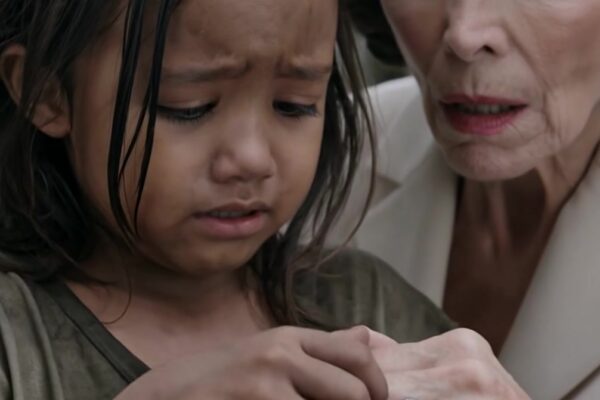
He slipped through the courthouse doors like a shadow that had learned to breathe. No one looked twice at the boy in the too-big jacket, the cuffs rolled to hold his wrists the way a promise held a secret. He kept his head down and his shoulders tight, one hand buried in the pocket where the envelope sat—thick, creased, and held as if it might bolt away.
The hall outside Courtroom 3 smelled of old paper, floor polish, and something sharper—anxiety, or anger, or the residue of too many verdicts. People moved with purpose there: attorneys gliding like slick fish; clerks hustling stacks of files; families in stiff clothing whispering prayers into their collars. The boy didn’t have a tie, and his shoes were scuffed at the toes. He didn’t have anyone walking beside him, either.
The bailiff at the door scanned him like an inconvenience. “Where’s your guardian?”
The boy swallowed. His throat worked as if the words had to be hauled up from a deep place. “I need to speak. I have something for the judge.”
“That’s not how it works.” The bailiff’s hand hovered near the boy’s shoulder as if to guide him back into the hallway and out of the building entirely. “This is a closed hearing. Family only.”
“I am family,” the boy said, quietly enough that it might have been mistaken for a cough.
The bailiff snorted. “Kid, I know everyone in the Foster case. I’ve seen your social worker. You’re not on the list.”
The name stung like a thumb pressed into a bruise. Foster. It made him think of brittle laughter in the group home and nights when the pipes clanged like chains. He tightened his fist around the envelope until the paper edges bit his palm. “Please,” he said. “Just… let me in. One minute.”
Behind the boy, a cluster of women in tailored coats paused, faces turned in mild curiosity. One of them—a woman with a neat bun and eyes that didn’t soften—stepped forward. “This is sensitive,” she told the bailiff. Then, to the boy, with a smile that didn’t reach her eyes: “Sweetheart, you can’t just wander into court. You don’t belong in there.”
The words were soft, but they landed like a door slammed shut. The boy’s face went hot. He tasted metal, as if he’d bitten his tongue. “I belong,” he repeated. This time it wasn’t quiet. It was a thread pulled tight to keep from snapping.
A man in a gray suit—one of the lawyers—leaned over to the bun-haired woman. “Is that the kid from the shelter down on Halstead?” he murmured, as though the boy couldn’t hear. “He’s probably here for sympathy.”
Sympathy. Like it was a coin people tossed to feel generous.
The courtroom door cracked open as someone exited, and a slice of sound spilled out: the judge’s low voice, the scratch of a chair, a whispered objection. The boy seized the moment. He slid past the bailiff’s arm before it could settle on his shoulder, and stepped into Courtroom 3.
The room was colder than the hallway, the kind of cold that came from rules. Dark wooden benches held bodies packed close. At the front, beneath the seal, Judge Merrick sat like a carved figure, eyes narrowed at a stack of paperwork. To the left, the Department’s attorney arranged files in tidy towers. To the right, a man with a wide jaw and restless hands sat behind his counsel, his knee bouncing. The boy recognized him from a photograph he’d stared at for years: Deputy Sheriff Alan Crowe.
The boy’s stomach lurched. Crowe was older than in the picture, heavier in the face, but the eyes were the same—blue, hard, and alert in a way that made you feel hunted even when you were still.
Every head turned toward the interruption. The bailiff followed, already reaching for the boy’s elbow. “Your Honor, I’m sorry. He just—”
Judge Merrick lifted one hand. “Who are you?” His tone wasn’t angry, yet. It was weary, as if he’d seen a hundred disruptions that all meant nothing.
The boy stood alone in the aisle, the distance between him and the front feeling like a canyon. He had practiced this in his mind at night, whispering words into his pillow, but now his tongue felt thick. Still, the envelope in his hand anchored him. “My name is Jonah Reed,” he said. “I’m here because you’re about to sign an order that will send my sister back to him.”
A murmur ran through the courtroom. The Department attorney’s face tightened. Crowe’s counsel leaned in, whispering urgently.
Judge Merrick’s eyes sharpened. “Jonah Reed,” he repeated, tasting the name. “And who is your sister?”
Jonah’s chest ached with the thought of her. Lily, with her missing front tooth and her habit of counting steps as if the world needed to be measured to be safe. “Lily Reed,” he said. “She’s nine. She’s in temporary placement right now. They said… they said she should go back to her father because there isn’t enough evidence.”
“That is not for you to decide,” the Department attorney snapped, standing halfway. “Your Honor, this is improper. We can’t allow—”
Jonah’s voice cracked, then steadied. “I have evidence.”
The word hung in the air like a match struck in a dark room.
Judge Merrick leaned forward. “What evidence?”
Jonah lifted the envelope with both hands. It looked small against the room’s authority. “This,” he said. “And what’s inside it. It’s addressed to you. It’s not… it’s not from me.”
The bailiff took a step toward Jonah again, but the judge raised his hand once more, freezing everyone. “Bring it,” Judge Merrick said.
Jonah walked the aisle. His knees threatened to buckle, but he kept moving. He stopped at the railing and reached up. The judge didn’t ask the bailiff; he extended his own hand and took the envelope as carefully as if it might explode.
Judge Merrick turned it over once. The seal was a simple strip of tape. Jonah watched the judge’s fingers, watched the tape peel back, the flap lift. The courtroom held its breath.
Inside was a folded letter, a flash drive, and a photograph. Judge Merrick’s eyes flicked to the photo first. Color drained from his face so suddenly it was as if someone had opened a drain in his skin.
On the far side of the room, Deputy Crowe stopped bouncing his knee. His shoulders went rigid. Something like recognition flashed through his expression and vanished.
The judge stared at the photograph as if it were a wound. He set it down with care, then unfolded the letter. The room was silent enough that Jonah could hear the soft rustle of paper and, somewhere behind him, a child’s small sniffle.
Judge Merrick read. His jaw tightened. He read again, slower. Then he looked up, and the authority in his gaze sharpened into something else—dangerous clarity.
“Bailiff,” he said, voice suddenly steady in a way that made every spine straighten. “Lock the doors.”
A ripple of confusion and fear ran through the benches. The Department attorney stood fully now. “Your Honor, what is the meaning—”
Judge Merrick didn’t look at her. His eyes were fixed on Deputy Crowe, who had gone pale around the mouth. “Mr. Crowe,” the judge said. “Do you recognize this?”
Crowe’s counsel rose, but Crowe’s voice cut through, hoarse. “I don’t know what that is.”
“You do,” Judge Merrick replied, and now his words were iron. He lifted the photograph. “This is you, in the evidence room of the county precinct, holding a sealed bag labeled with case number 18-4471. The letter states you removed items from that bag the night before the search warrant was executed—items later listed as ‘missing’ when the Department reviewed the file.”
The courtroom seemed to tilt. Jonah gripped the railing as the world swayed. He hadn’t known what the photograph would do, only that the man who’d slipped it to him at the shelter had told him, “If you want your sister safe, you give this to the judge and you don’t let anyone stop you.”
Judge Merrick tapped the flash drive with one finger. “And this drive contains audio recordings,” he continued, each syllable measured, “including a call between Deputy Crowe and a supervisor discussing ‘cleaning up’ the report before it reaches the court.”
The Department attorney’s mouth opened, then closed. She looked as though she’d swallowed glass. Crowe’s counsel sputtered objections, but the words sounded thin and far away.
Judge Merrick stood. The sound of his chair scraping back was a gunshot in the silence. “This proceeding is suspended. I am ordering an immediate review of all evidence in the Reed case, and I am issuing an emergency protective order for Lily Reed. She will not be returned to Deputy Crowe pending investigation.”
Jonah’s vision blurred. For a moment he couldn’t breathe at all. The world had been a long hallway of locked doors for so long that hearing one open felt unreal.
Crowe surged to his feet. “This is bullshit,” he barked, but his voice shook. His eyes snapped to Jonah, and there was something in them that made Jonah’s blood go cold—an old, familiar threat, as if even here, even now, the man believed he could reach out and take what he wanted.
Judge Merrick’s gaze turned sharp enough to cut. “Sit down,” he ordered. “Bailiff, take Deputy Crowe into custody for questioning. And get Internal Affairs on the phone. Now.”
The bailiff moved fast. Hands on Crowe’s arms. Metal glinting. The click of cuffs was a sound Jonah would remember forever, not because it was loud, but because it was final.
As Crowe was led toward the side door, he twisted once more to stare at Jonah. His face held rage, and beneath it, the faintest sliver of panic. Jonah didn’t flinch. He couldn’t afford to. He stared back until the door swallowed Crowe whole.
Only then did Jonah’s knees give a little. Judge Merrick looked down at him, the sternness easing into something human. “Jonah,” he said, quieter now, “who gave you this envelope?”
Jonah swallowed hard. He thought of the shelter’s fluorescent lights, the man in the maintenance uniform, the way he’d said Lily’s name like it mattered. “Someone who said they were tired of being afraid,” Jonah answered. His voice trembled, but he kept it upright. “Someone who said the truth doesn’t belong to the people who can hide it.”
The judge nodded slowly, as if weighing the courage it took to walk into a room designed to keep boys like Jonah out. “You did the right thing,” he said.
Jonah looked back at the benches, at the faces that had dismissed him, at the woman with the bun whose lips had gone colorless. He felt the envelope’s absence like a missing limb, and yet his hand unclenched for the first time in hours.
He hadn’t walked in with power. He’d walked in with paper and fear and a love big enough to make him reckless. And for a single, stunned heartbeat in Courtroom 3, everyone had learned what they should have known all along—he belonged wherever the truth needed a witness.