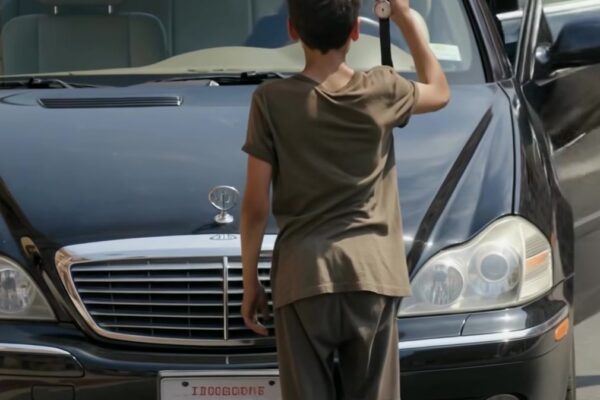
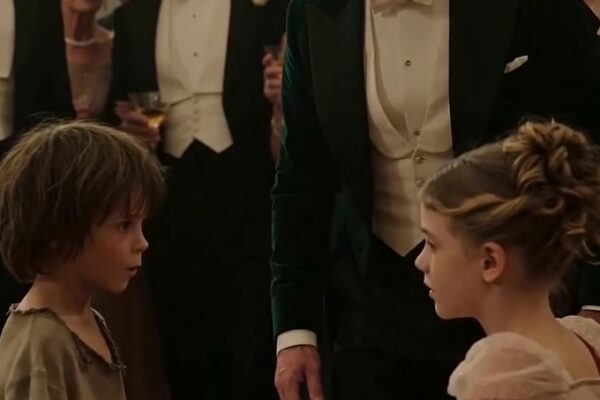
The bell over the glass doors rang like a small warning. A boy stepped into Halverton Trust wearing shoes that looked more like cardboard than leather—thin soles, frayed seams, the kind of footwear that absorbed puddles the way paper drank ink. He paused on the marble tile as if the floor were a lake and he wasn’t sure it would hold him.
Behind the teller line, the morning moved with polished routines: drawers clicking open, receipt paper feeding out in neat ribbons, phones murmuring in practiced voices. A faint, sweet smell of coffee floated from the break room. It was a bank that had mastered the art of making money feel quiet.
And yet the boy made it loud.
“What is he doing here?” someone breathed, not quite whispering, not quite saying it aloud. A laugh fluttered like a nervous sparrow. Another voice followed, softer and meaner: “Maybe he’s here to cash in his lunch money.”
The boy’s cheeks tightened. He held a brown envelope with both hands, fingers pressed so hard the paper bowed. His hair was cut short, uneven at the edges as if trimmed by someone who didn’t own proper scissors. He tried to walk toward the desk that sat just inside the lobby—Customer Services, a sign in brushed steel letters—but his stride slowed when he heard the laughter again, this time from the desk by the waiting chairs.
“Hello,” he said, forcing the word out as though it were heavier than it should be. “I—um—I need to make a deposit.”
The customer services representative, a woman named Marla who wore her headset like a crown, looked him up and down. Her eyes snagged on his shoes, then on the envelope, then back to his face. She gave a smile that had no warmth in it, a smile built for cameras and complaints.
“A deposit,” she repeated. “Sure. Do you have an account?”
He nodded quickly. “My mom does. I—I’m on it.”
Marla turned her keyboard toward herself with a flourish. “Name?”
He spoke it and watched her fingers move. She paused, frowned, typed again. Behind her, two tellers leaned closer, pretending to check a ledger while listening.
“Honey,” Marla said after a moment, voice syrupy, “this account is restricted. You can’t just—” She tapped a nail on the counter, a little metronome of impatience. “Do you have identification?”
The boy reached into his pocket and pulled out a crumpled student card. The corners were soft from being handled too much. Marla took it with two fingers as if it might stain her manicure. She studied it, then gave a small laugh that wasn’t meant to be unkind but landed that way anyway.
“This won’t do,” she said. “We need something official.”
His throat bobbed. “I brought the deposit slip,” he said quickly, and held out the envelope. “It’s… it’s important. My mom said it had to be today.”
“Your mom should have come herself,” Marla replied. “We can’t accept random—” She stopped, searching for the proper word. “—papers from a child.”
Random. Child. Papers. The words struck him like slaps.
“Please,” he said, quieter. “She’s at work. She can’t leave. She said the late fee…” He swallowed. “She said we can’t afford another one.”
One of the tellers snorted softly. Another chuckled, covering her mouth with a hand. The laughter stayed just under the surface—contained, but visible, like oil on water.
Marla leaned in, lowering her voice as if sharing advice. “Sweetheart, you should go home. Have your mother call us.”
The boy’s hands trembled. He pressed the envelope to his chest as if it might be taken from him. For a heartbeat he looked around, as if searching for an adult who might translate his urgency into a language the bank respected. There were only suits and clipped expressions, people who had learned to keep their desperation invisible.
“I called,” he blurted. “I called this morning and they said I could bring it.”
Marla’s smile sharpened. “Who is ‘they’?”
He opened his mouth, then closed it. The bank’s air-conditioning hummed. Somewhere behind the wall, a printer whirred. Time, the bank’s favorite instrument, ticked on.
At the entrance, the bell rang again.
The sound was the same as before, but the bank reacted differently, like a flock sensing a predator’s shadow. Heads lifted. The murmured laughter died mid-breath. Even Marla’s posture shifted, her spine straightening as if pulled by an invisible thread.
A man walked in wearing a dark coat that didn’t look expensive because it screamed status; it looked expensive because it didn’t need to scream at all. His hair was silver at the temples, neatly combed back. His shoes shone so softly they seemed to drink in the light rather than reflect it. He carried no briefcase, no umbrella, no unnecessary proof of importance.
He scanned the lobby once, eyes calm and precise, then found the boy near the counter, clutching his envelope as if it were a life raft.
“Eli,” the man said, voice low.
The boy turned so fast his shoes squeaked against the tile. Relief broke across his face in a way that was almost painful to witness, like a dam giving way. “Uncle Wes,” he breathed.
The man crossed the lobby with unhurried steps. He didn’t glare, didn’t storm, didn’t demand attention. He simply arrived, and the bank rearranged itself around him, as if the room understood weight better than words.
Marla’s headset mic hovered near her mouth. She looked suddenly younger, uncertain. “Sir—can I help you?” she asked, though she already knew the answer by the way her hands had gone still.
“You can,” the man replied. He rested one hand on the counter, beside the boy’s trembling envelope, and the gesture was gentle enough to be mistaken for comfort. “My nephew is here to make a deposit into the Alvarez account.”
Marla blinked. “That account is restricted,” she said automatically, but her tone had changed. The words no longer carried authority; they sounded like an excuse.
“It is,” Uncle Wes agreed. He turned slightly, meeting Marla’s eyes with a steady look. “Because your institution placed a temporary hold after misposting a payment last month. Which resulted in overdraft penalties and a cascade of late fees for a single parent who did everything she was supposed to do.”
The tellers behind Marla froze, hands hovering above keyboards. The laughter had evaporated completely, leaving only the thin, sharp air of consequence.
Marla’s mouth opened, then closed. “I’m not—” she began.
“You are,” Uncle Wes said, not raising his voice. “You are the face of this place. And your face was laughing at a child who came in here trying to keep his family from drowning.”
The boy stared at the counter, eyes wet but stubbornly unblinking. Uncle Wes’s hand remained near the envelope, not taking it, not forcing. Waiting.
Marla’s cheeks reddened. She reached for her keyboard as if it could save her. “Sir, if you have concerns, you can speak to the branch manager.”
“I will,” Uncle Wes said. “But first, the deposit.”
He slid a slim wallet from his coat and placed a card on the counter. Not with a flourish, but with quiet finality. Marla’s gaze flicked to it. Something in her expression shifted—recognition, then alarm, like a door closing in her mind.
Without asking permission, she stepped back from her chair and hurried toward the office at the end of the teller line. Her heels struck the floor in rapid, apologetic clicks. The lobby held its breath.
The boy looked up at Uncle Wes. “I tried,” he whispered, voice cracking. “I really tried.”
Uncle Wes’s eyes softened. “I know,” he said. “And you did the hard part. You showed up.” He leaned closer, lowering his voice so only the boy could hear. “No one gets to decide your worth by your shoes.”
When Marla returned, she wasn’t alone. The branch manager followed, tie slightly askew, a sheen of sweat appearing at his hairline. His eyes went straight to the card on the counter as if it were a lit match.
“Mr. Wescott,” he said, and the name carried more respect than the boy had been offered in the last ten minutes. “We—uh—we weren’t expecting—”
“Clearly,” Uncle Wes replied. “Because if you had been, your staff would have remembered to behave like human beings.”
The manager swallowed. “Of course. We can process the deposit immediately. And we’ll review the account hold.”
“You’ll remove it,” Uncle Wes corrected, “and refund the fees. Today. And you’ll document, in writing, why a child was denied service after being told he could make this deposit. You’ll also document why multiple employees found it appropriate to mock him.”
Silence settled in the lobby like dust after a collapse.
The manager nodded too quickly. “Yes. Absolutely.”
Uncle Wes finally picked up the envelope, opened it, and slid the deposit slip forward. The boy watched as if witnessing a magic trick: the same paper that had been dismissed as “random” now handled with reverence, as though it were a contract.
A teller processed the transaction with hands that didn’t tremble, though her eyes avoided the boy’s. A receipt printed, warm and definitive. Uncle Wes placed it into the boy’s palm and folded his fingers around it.
“Keep that,” he said. “Proof matters, even when people pretend it doesn’t.”
As they walked toward the doors, the bell above the entrance waited. The bank was quiet now—no laughter, no whispers. Only the faint hum of air-conditioning and the soft shuffle of regret.
The boy glanced down at his shoes. The cardboard-thin soles. The frayed seams. He looked back up, shoulders squaring a fraction.
Outside, sunlight struck the glass, turning the bank’s polished interior into a reflection. For a moment, the boy saw himself in that shine: small, tired, determined. He held the receipt like a lifeline.
Behind him, Uncle Wes paused and turned, not to threaten, not to boast, but to leave a final sentence hanging in the air like a verdict.
“You don’t get quiet because I walked in,” he told the bank. “You get quiet because you forgot who you were serving.”
The bell rang as they stepped out, and this time it sounded less like a warning and more like a door finally opening.