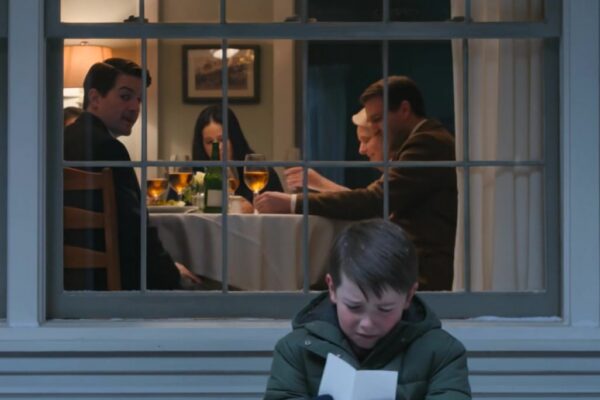
The bell above the glass door gave a bright, tinny ring that didn’t belong in a place like Hawthorne National. The lobby smelled of lemon polish and old paper, as if the bank were scrubbing away time itself. A boy stepped in alone, the kind of thin, alert child who looks as though he’s learned to take up as little room as possible. His shoes were the color of clay after rain—cheap canvas, fraying at the seams, with soles worn so smooth they shone.
He stood just inside the entrance, blinking at the marble floor, the high counters, the velvet rope that made the line feel like a stage. In his hands he held a small envelope that had been opened and resealed with careful tape. A string bracelet—blue thread with a knot—circled his wrist. He tucked his fingers around the envelope as if it could keep him from being blown away.
At the nearest teller window, two women leaned together over a monitor. Their eyes lifted, traveled down the boy’s body, and lingered on the shoes. One of them covered her mouth with a manicured hand and said something without sound. The other’s shoulders rose in a tiny, private laugh.
Behind them, a man in a pressed suit—Evan Maddox, branch manager—stepped out of his glass office and surveyed the lobby with the mild irritation of someone interrupted. His gaze snagged on the boy. It wasn’t concern that crossed his face; it was calculation, as if he were estimating how long this inconvenience would take and how much attention it might draw.
The boy walked forward until he reached the rope. He hesitated, then slipped under it instead of finding the proper opening. The motion drew another ripple of amusement from the teller line.
“Hey,” a security guard called, not moving from his stool, just lifting his chin as though the word itself should correct the boy. “You need to stand in line.”
The boy stopped short, cheeks reddening. “I… I just need to talk to someone,” he said, voice thin but steady. “About an account.”
“Everyone needs to talk to someone,” the guard said. “Line.”
So the boy obeyed. He stood at the end of the velvet rope, staring at the backs of adults who smelled of cologne and entitlement. He kept smoothing the envelope with his palm, flattening it again and again. When it was finally his turn, he approached the window where the laughter had begun.
The teller’s nameplate read: MARLA. She smiled the way a door smiles when it’s being closed. “Can I help you?”
He slid the envelope under the glass. “My mom told me to bring this,” he said. “And… she told me to ask about the savings. The— the one my dad started.”
Marla’s eyes flicked to the envelope, then back to his shoes. “Is your mother here?”
“No. She’s at the hospital,” the boy said quickly, as if the word might be punished. “She told me— she can’t leave. She said the bank would understand.”
Marla let out a soft breath that might have been a laugh if it had more air in it. “Sweetie, we can’t just talk to anyone about accounts. There are rules. Do you have identification?”
The boy reached into his pocket and produced a folded school ID with his picture and a smear of cafeteria ketchup on the corner. He held it up, hopeful.
Marla didn’t take it. Her smile sharpened. “That’s not a legal ID. Where’s your guardian?”
“I’m supposed to—” He swallowed. “I’m supposed to deposit this check. For the rent. And ask about— about the letter.” He tapped the envelope. “They said the account was closed. But my mom said it can’t be.”
Marla turned the envelope over with two fingers, as if it might be sticky. “This is addressed to your mother. Not you.” She glanced sideways at Evan Maddox, who had drifted closer as if drawn by the scent of trouble.
“Problem?” Maddox asked, voice bright enough to be heard by everyone within ten feet.
“He’s trying to access an account,” Marla said, tilting her head toward the boy the way one might indicate a stray cat. “Without proper documentation.”
Maddox looked down at the boy, his eyes settling—again—on the shoes. “We have policies,” he said, as if the boy had questioned the existence of gravity. “Do you have an appointment? Anyone with you?”
“No, sir,” the boy said. His ears burned. “My mom said— she said to ask for Mr. Harlan. Uncle Harlan.”
At the name, the tiniest pause flitted across Maddox’s face, so brief the boy didn’t notice. Maddox’s mouth rearranged itself into something neutral. “We don’t have an employee by that name,” he said, too quickly. “You’ll need to come back with your mother.”
The boy’s fingers tightened until the knuckles turned white. “She can’t come,” he whispered. “She can’t.”
Behind him, a couple in a business jacket and silk scarf murmured. Another teller glanced over, amused, as if this were a small performance to brighten the afternoon. The security guard shifted on his stool, readying himself to stand if instructed.
Maddox leaned closer, lowering his voice in a way that was meant to sound kind but carried the weight of authority. “Listen. You’re causing a scene. We can’t help you today. Take your things and go home.”
“I don’t have—” The boy’s voice cracked. He swallowed hard, and for a moment the bank’s polished quiet seemed to press in from all directions. “I don’t have a home if I don’t do this,” he said, barely audible.
Marla’s expression softened for half a second, then hardened again, as if softness were a liability. Maddox straightened, his patience draining. “Security,” he called without raising his voice.
The guard began to rise.
The bell above the door rang again.
The sound was the same bright tinny chime, but this time it struck the room differently—like the first note of something inevitable. A man stepped into the lobby, tall and broad-shouldered, wearing a charcoal coat despite the mild day. He moved with a contained urgency, as if time had wronged him and he meant to collect. He carried no briefcase, no folders, nothing that announced wealth. Yet his presence drew attention the way thunder draws eyes to the sky.
He paused just inside the entrance, scanning the room with a gaze that measured every corner. His hair was silver at the temples, his jaw set. When his eyes found the boy at the counter, his expression shifted—something protective, something fierce.
“Eli,” he said, not loudly, but with a certainty that made heads turn. The boy flinched, then spun around.
“Uncle Harlan,” Eli breathed, and relief flooded his face so suddenly it looked like pain.
A hush traveled through the lobby like a curtain dropping. The tellers’ hands stilled over keyboards. The murmuring customers fell silent, sensing without understanding that the air had changed. Evan Maddox’s posture stiffened; the practiced managerial ease slid off him, revealing something tight beneath it.
The man walked forward, each step unhurried, the marble floor reflecting his shoes—polished leather, but scuffed at the toe as if he’d walked through places that didn’t care about shine. He stopped beside Eli and placed a hand on the boy’s shoulder, not as comfort alone but as declaration.
“I told you not to come alone,” he said softly, eyes still on Maddox. “But you did what you thought you had to.”
Eli swallowed. “They wouldn’t listen,” he whispered.
Harlan’s gaze lifted to the nameplate on Maddox’s lapel. “Mr. Maddox.” It wasn’t a greeting. It was an indictment wrapped in etiquette.
Maddox forced a smile that did not reach his eyes. “Sir. If you’re with the child, you can take him—”
“I’m not ‘with the child,’” Harlan said, and the words cut through the lobby with quiet precision. “I am his guardian. And I’m the trustee on the account you attempted to close without authorization.”
Marla blinked rapidly, her fingers hovering over her keyboard as if unsure whether to type or pray. Maddox’s face lost a fraction of color.
“There seems to be a misunderstanding,” Maddox began.
Harlan slid a slim folder from inside his coat—so thin it looked like it couldn’t possibly carry the weight in his eyes. He placed it on the counter with care, then pushed it forward. “Power of attorney,” he said. “Court order. And correspondence from your legal department, dated three weeks ago, acknowledging receipt.” He looked at Marla, and his voice softened just slightly. “You can scan those.”
Marla’s mouth opened, then closed. She reached for the folder with both hands and began to flip pages, her nails clicking faintly against paper. Her face changed as she read, the amusement draining out as if someone had pulled a plug.
“Mr. Maddox,” Harlan continued, “when my sister called last week from a hospital bed and asked why her husband’s account had been emptied and labeled ‘inactive,’ your branch gave her a scripted answer and transferred her three times. She asked for compassion. You gave her a policy.”
“Sir, I don’t—” Maddox tried again, but his voice faltered. He glanced around, aware of the audience now—customers who had been bored moments ago, now quietly alert.
Harlan leaned in, just enough to lower the temperature of the room. “My nephew walked in here in shoes that cost less than your tie,” he said, and though his tone remained controlled, the truth in it landed like a slap. “Not because we don’t know better, but because every dollar has been keeping machines running and medicine flowing and a roof overhead. You laughed at him.”
Marla’s cheeks flushed crimson. The security guard sat back down as if gravity had doubled.
Maddox’s smile collapsed. “No one laughed,” he said weakly.
Harlan didn’t argue. He simply looked at him until the lie grew too heavy to hold. Then he turned back to Eli, brushing his thumb once over the boy’s shoulder. “You did the right thing,” he murmured. “You asked for help. That’s never wrong.”
He faced the counter again. “Now,” he said, voice clear enough for the whole lobby, “we are going to correct your records. You will restore the funds. You will waive the penalties you applied. And you will provide a written explanation for why a minor was nearly escorted out for trying to deposit a check that would keep his family housed.”
Maddox swallowed, his Adam’s apple bobbing. For the first time, he looked not like a manager but like a man who realized the building he stood in could, in an instant, become a courtroom exhibit.
Marla cleared her throat. “Mr. Maddox,” she said quietly, eyes still on the documents, “this… this is real. It’s all filed.”
The silence that followed was absolute. Even the air conditioner seemed to hold its breath.
Maddox nodded once, stiffly, as if his pride were a suit he couldn’t remove. “We’ll… take care of it,” he said.
Harlan didn’t smile. “Good.” He slid Eli’s envelope back toward him. “And he will deposit that check today. With dignity.”
Eli’s hands trembled as he took the envelope, but his chin lifted. He looked around the lobby—the polished floor, the velvet rope, the faces that had watched him shrink and now watched him stand. He glanced at his shoes, suddenly aware of them, and then—because he was still a child and still brave—he didn’t try to hide them. He simply stood where he was.
Harlan remained at his side, a steady shadow. The bank, which had been so loud with quiet ridicule, stayed wordless now, not out of politeness but out of understanding: something had entered with the second ring of that bell, and it wasn’t just a man. It was consequence.
And for the first time since he’d walked in, Eli felt the marble beneath his feet and knew he wasn’t about to be pushed off it.