The cardboard sign was too big for the hands that held it. FOR SALE! sprawled in thick marker, the letters wobbling like they’d been written in a hurry—or with fingers that couldn’t stop shaking. The older boy stood at the edge of the grocery store parking lot where people streamed past with warm bread and plastic bags, and he lifted the sign higher each time his courage slipped.
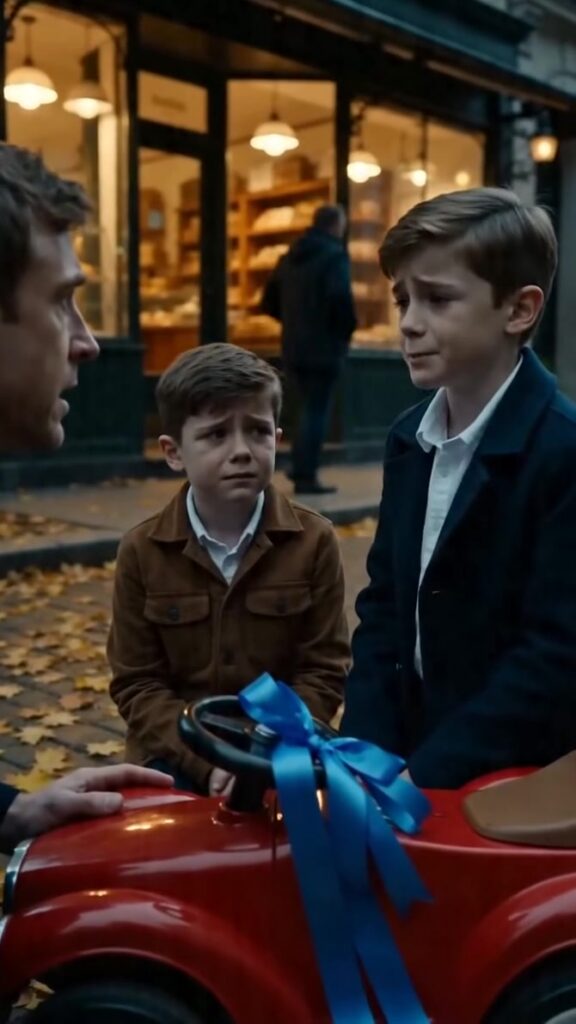
“For sale!” he called, louder than he meant to, the sound cracking at the end. His little brother stayed behind him, half-hidden in a jacket that was too thin for November, his nose pink, his eyes fixed on the asphalt as if it could swallow him. Between them sat a toy car—small, red, clean despite the grime of the curb—set carefully on the flattened lid of a shoebox like it belonged in a display case.
People looked. People didn’t stop. One woman’s gaze snagged on the boys’ faces and jumped away as if it had touched something hot. A man in a beanie slowed for half a step, then remembered somewhere else to be. The older boy kept his shoulders square, trying to mimic the posture he’d seen on grown-ups when they wanted to seem unbreakable.
A camera clicked somewhere—one of those quick, accidental sounds made by a phone when someone pretends they’re doing something else. The older boy heard it and flinched anyway, humiliation rising like bile. He told himself it didn’t matter. Embarrassment didn’t buy medicine. Pride didn’t lower fevers.
A car door closed with a heavy thunk. The man who stepped out of the driver’s seat looked like he had come from a different life—clean coat, expensive watch, the kind of hair that had been cut recently by someone who took their time. He paused with one foot still angled toward the sidewalk, as if he’d almost forgotten how to walk without an agenda. Then his eyes found the toy.
He stood still long enough for the world to move around him: carts rattling, an engine revving, the wind worrying a strand of leaves across the pavement. Something tightened in his expression, not quite recognition, not quite pain. His attention slid from the red car to the boys, and a decision seemed to settle in his chest. He started toward them slowly, like he was approaching a skittish animal.
When he reached the shoebox lid, he crouched. His polished shoes looked absurd next to the curb. He didn’t touch the boys, didn’t crowd them; he only extended a hand and brushed a thumb along the toy’s roof with a gentleness that didn’t match his sharp suit. “You’re selling this?” he asked, voice low, careful, as if he knew the wrong tone could make them bolt.
The older boy swallowed. “Yes, sir. It’s mine.” The words came out stiff, rehearsed. He had practiced them in the bathroom mirror while his mother slept on the couch, her face shiny with sweat. He had promised himself he wouldn’t cry in front of strangers. But his eyes burned anyway, and his jaw worked like he was chewing glass.
The man’s gaze shifted to the younger brother, who had started to shiver harder, his hands tucked into his sleeves. “Why would you sell your favorite toy?” the man asked, and the question landed like a hand on the back of the neck. The wind raked through the parking lot and lifted the corner of the FOR SALE! sign, snapping it against the older boy’s knuckles.
The older boy hesitated, then exhaled with a kind of surrender. “Because our mom needs medicine.” He didn’t raise his voice this time. He didn’t have to. The sentence was small, but it split something open. The man’s face tightened as if he’d been struck, and for a beat he forgot to breathe.
He looked back down at the toy car. Only then did he notice the ribbon: a thin strip of blue tied around the steering wheel. Old. Faded. The kind of ribbon you got from a hospital for a newborn, the kind people kept in a drawer because throwing it away felt like erasing the day. The man’s fingers hovered over it, trembling. “No,” he whispered, and the word sounded like a prayer that had arrived too late.
“Who is your mother?” he asked, but the question had changed. It wasn’t polite curiosity anymore. It was urgency, fear, the sudden need to confirm what his own memory was already screaming. The older boy stiffened, suspicious now, protective. For a moment he looked like he might grab the toy and run.
Instead he reached into his pocket and pulled out a folded paper. The creases were soft from being opened and closed too many times. He held it like it was a fragile thing that might crumble if handled roughly. “This is what the doctor gave us,” he said. “We’re trying to get the medicine from the pharmacy but they said… they said it costs a lot.”
The man took the paper with both hands. When he unfolded it, the wind threatened to steal it, and he curled his fingers around the corners. His eyes skimmed the printed lines—dosage, warnings, a date—and then stopped at the name at the top. The color drained from his face so quickly it was as if someone had pulled a plug. His mouth opened, closed, then opened again on a sound that wasn’t quite a breath.
“That’s her name,” he said, and his voice broke on the last word. His eyes blurred, and he blinked hard, refusing to let tears win in a parking lot. But the shaking in his hands betrayed him. He didn’t need to read further; he had already been transported years back, to an apartment hallway that smelled like cooking oil and laundry soap, to a door that never opened again after the last argument, to a voicemail he never returned because he was too angry, too proud, too sure there would be more time.
His gaze drifted down the page anyway, drawn by a final line like gravity. The words stared up at him in clinical ink: Unknown father. The man’s throat tightened. Unknown. As if he were a missing person. As if he were no one.
He looked up at the older boy’s face—the shape of the cheekbones, the stubborn set of the mouth—and then at the younger brother, whose eyes were wide with a frightened, exhausted hope. The man saw himself in them in flashes: a dimple that appeared when the younger one tried to smile, a slight tilt of the chin that had once belonged to him in school photos. Guilt rose sharp and immediate, a blade sliding between his ribs.
“How old are you?” he asked, though the answer was already there in the math of years he had tried not to count.
“I’m nine,” the older boy said, suspicion turning into confusion. “He’s six.” The younger boy didn’t speak. He watched the man like he was watching an approaching storm, unsure if it would pass or hit.
The man swallowed. He wanted to say I didn’t know. He wanted to say I was afraid. He wanted to say I thought you were better off without me. But excuses felt obscene next to a prescription and a child selling a toy on a curb.
Instead, he reached into his wallet, then stopped. Money was the simplest part, and the least important. He tucked the paper carefully back into the older boy’s hands, as reverently as if returning a relic. “I’m going to help your mom,” he said. “Right now.”
The older boy’s eyes narrowed. “Why?”
The man’s breath hitched. He looked at the blue ribbon again, and the world seemed to tilt, as if the past had grabbed the present by the collar. “Because,” he said, and his voice lowered to something raw, “I should have been helping all along.”
He stood, unsteady, and held out his hand—not to the toy, but to the boys. Around them the parking lot kept moving, indifferent. Cars rolled by. People walked past with their lives intact. Yet something had cracked open beneath that cardboard sign, and it wouldn’t close again.
The older boy stared at the offered hand as if it were a trap. Then, slowly, he lifted his own, small fingers hovering over the man’s palm. The younger brother crept closer, drawn by a thread of instinct he didn’t understand. The man didn’t force it. He waited, the wind tugging at his coat, at the ribbon, at the fragile moment balancing between fear and truth.
“Where do you live?” he asked, and the question sounded like the beginning of a return.
“Two blocks that way,” the older boy said, pointing. His voice was still guarded, but the FOR SALE! sign drooped in his other hand as if it had finally grown too heavy to hold.
The man nodded once, as if sealing a vow. He bent, picked up the red toy car, and placed it gently into the older boy’s palm. “Not for sale,” he said. “Not today.”
And as they started walking—three figures leaving the curb behind—the man’s eyes kept drifting back to the paper, to the line that had tried to erase him. Unknown, it said. But the boys were real. The ribbon was real. The choice in front of him was brutally, irrevocably real.
He followed them into the cold, carrying the weight of years he couldn’t undo, and a single desperate hope: that medicine could ease a fever, and that presence—finally, painfully—could begin to heal what absence had done.