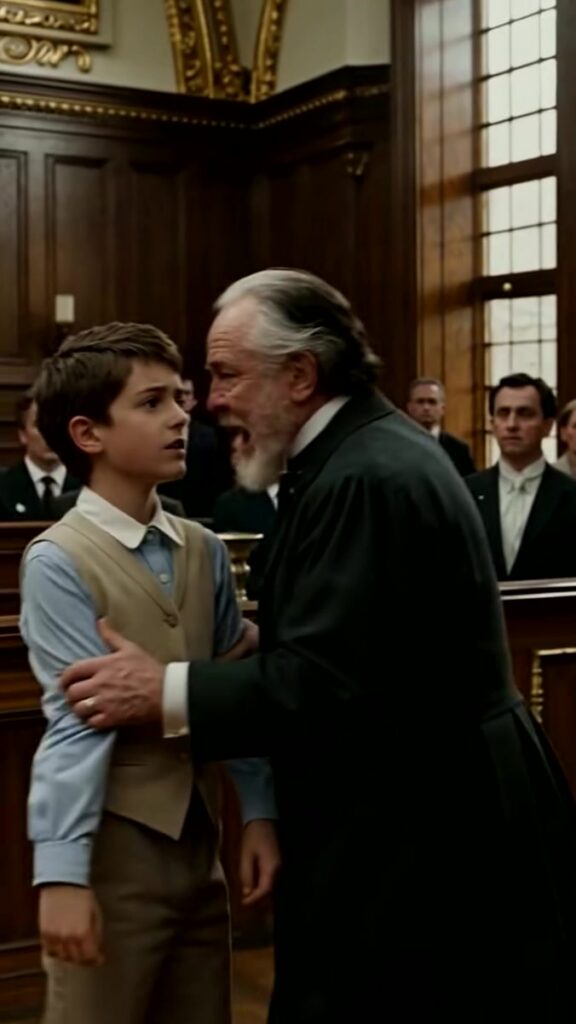
The courtroom breathed in noise—paper whisper, bench creak, the soft rasp of cheap suits shifting against varnished wood. It was a living thing, a beast made of people who had come to watch another person be named a monster. Fans stirred the humid air without cooling it. A bailiff stood like a carved pillar at the aisle. Above them, the seal on the wall looked down with blind authority, as if it had judged everything already.
On the defense side sat Maribel Santos in a plain gray dress that did not fit her shoulders. She had been the family’s maid for five years, and now she looked smaller than any chair should allow a human to be. Her wrists were bruised in faint purple rings where the cuffs had been, though the cuffs were off. She held a handkerchief balled in her fist until her knuckles blanched, and she stared at the table as if the wood might open and swallow her away.
The prosecutor paced with practiced confidence, a man who spoke the language of certainty. “You were alone with Mr. Alden in the study,” he said, turning the words into a corridor with no doors. “You had access to the letter opener. You had motive—money troubles, resentment. Your fingerprints are on the handle.” He let the sentence hang. In the gallery, someone muttered the word guilty like a prayer. The judge’s eyes flicked down to her notes, then up again, patient and tired, as if truth were an appointment she had to keep on schedule.
Behind Maribel, the Aldens sat in their own constellation of grief and composure. Eleanor Alden, the widow, wore black gloves that climbed to mid-forearm, despite the heat. A pearl at her throat rested precisely in the hollow of her neck. Her face was serene in the way marble is serene—beautiful, distant, made to endure. Beside her sat her father-in-law, Conrad, a man whose silence felt like a hand on the back of your neck. In the row behind them, a boy sat rigidly, too young for the gravity pressing into his bones. Jonah Alden’s shoes didn’t quite touch the floor.
The defense attorney tried to plant doubt—about the timeline, about the police who had decided early what they wanted to find. He spoke of class, of convenient scapegoats, of a frightened woman who had returned from the market to find blood where there should have been books and brandy. But doubt was fragile in a room that had come hungry for closure. The prosecutor’s narrative was a net, and Maribel was already caught in it.
Then Jonah rose.
It happened so abruptly that the courtroom’s constant rustle snapped into a single, stunned breath. The boy’s chair legs scraped the floor with an ugly squeal. His hands shook as though the air itself were cold, though sweat shone at his hairline. “It wasn’t her,” he cried, his voice too loud for his small body, a sound that tore through the practiced cadence of the trial. Heads jerked toward him. The stenographer’s fingers froze. Maribel turned, hope and terror colliding on her face.
“Jonah,” Conrad hissed, and lunged. His hand closed around the boy’s upper arm, not quite a squeeze, but not gentle either—the kind of grip that suggests consequences. “Sit down. Now.” It was low enough that only those nearest would hear, but it carried the weight of a door slamming shut. Jonah flinched, yet he didn’t fold. His eyes stayed wide, fixed on the front like a diver staring at black water.
“The guilty one is here,” Jonah said, each word cracking like thin ice underfoot. “I saw what happened.” The judge struck her gavel once, sharp as a warning shot. “Order,” she demanded, but the room had already shifted. The murmurs died not into calm, but into something heavier—attention sharpened into a blade. Jonah’s chest rose and fell too fast. He tugged against Conrad’s grip with a child’s strength that had decided to become a man’s.
The prosecutor stepped forward, voice soothing, predatory. “Jonah, sweetheart, you’re upset. You miss your father. Let’s not—”
“Don’t call me that,” Jonah snapped, surprising even himself. His gaze swung, searching, and then it landed like a verdict. His arm lifted, trembling, and his finger extended across the aisle. Not toward Maribel. Not toward the prosecutor. Toward his mother in her perfect black gloves.
For a moment, Eleanor’s expression did not change. Her eyes stayed trained on the judge, as if refusing to acknowledge the direction of the child’s accusation could unmake it. But something in her posture betrayed her—a subtle tightening at the shoulders, a stillness that didn’t belong to grief. The pearls at her throat did not rise with breath.
“She still has it,” Jonah said, and his voice dropped into an awful clarity. “Under her ring. She washed her hands. She hid the gloves. But she didn’t get it all.” He swallowed. “There’s blood trapped under her ring.”
The word blood did what the gavel could not. It flooded the room, thick and metallic in everyone’s imagination. The jurors leaned forward as if pulled by strings. Maribel’s handkerchief fell from her hand, drifting to the floor like surrender. Eleanor’s eyes widened a fraction too late—control slipping, truth surfacing in the brief flicker of a human face beneath the marble mask.
“That’s enough,” Conrad barked, and for the first time his voice rose, shredding the careful decorum he had worn like a suit. He yanked Jonah’s arm down, hard. The boy winced but did not look away. The judge stood, chair scraping, her robe swinging as she leaned forward. “Mrs. Alden,” she said, and there was steel now, “remove your gloves.”
Eleanor’s throat moved as she swallowed. Her gloved fingers tightened, then loosened. She looked at Jonah—not with maternal warmth, but with something like appraisal, as if measuring the cost of a mistake. “He’s confused,” she whispered, yet the whisper carried. “He’s traumatized.”
“Remove them,” the judge repeated. Two deputies moved into the aisle.
Eleanor’s hands hovered over her wrists. The gloves did not come off. Conrad’s face had gone a strange gray, and he stepped between Eleanor and the approaching deputies as if his body could become law. “Your Honor,” he began, but the judge’s eyes did not leave Eleanor’s hands.
Jonah spoke again, softer, almost pleading. “Mom, please,” he said, and it was the most terrible line of the day because it still contained love. “Just show them. Then they’ll stop hurting Maribel.”
Eleanor’s gaze dropped to her own left hand. A diamond ring sat there, heavy, immaculate. And now that everyone was staring, the illusion of immaculate began to fracture. A faint, dark crescent showed at the base of the setting where the metal met skin—too small to notice in ordinary life, too damning in this one.
Maribel made a sound—half sob, half laugh—like someone waking from a nightmare into another. The prosecutor’s mouth fell open. The judge’s face tightened, and she signaled to the deputies with a sharp motion. “Seize the gloves. Secure the witness. And someone get that child—”
The lights went out.
It was not a gentle dimming but a violent cut, as though the building had been unplugged from the world. Darkness slammed down, swallowing faces and authority alike. A collective shout rose, chairs scraping, bodies stumbling. Somewhere near the Alden row, a scuffle erupted—fabric tearing, a grunt, the brittle crack of something striking wood.
In the black, Jonah’s voice cut through again, smaller now, scared. “Maribel, run,” he whispered, and there was urgency in it, not drama. “They’ll make it disappear.”
When the emergency lights flickered on—thin red bars bleeding across the walls—the courtroom looked less like a temple of justice and more like a ship in distress. Conrad stood panting in the aisle, one hand empty, the other clenched. Eleanor was no longer in her seat. The black gloves lay on the floor like shed skin, and beside them, caught in the dim glow, the diamond ring glittered from the wood where it had fallen—its underside stained with a dark, dried arc that no amount of washing could pretend was anything else.
Maribel stared at it as if it were a key to a door she’d forgotten existed. Jonah, arm reddening where he’d been grabbed, met her eyes and nodded once, steadying himself in the chaos. The beast of the courtroom inhaled again, but the sound it drew in this time was not noise. It was the first raw breath of something like truth—and the terrifying knowledge of what people will do to bury it.