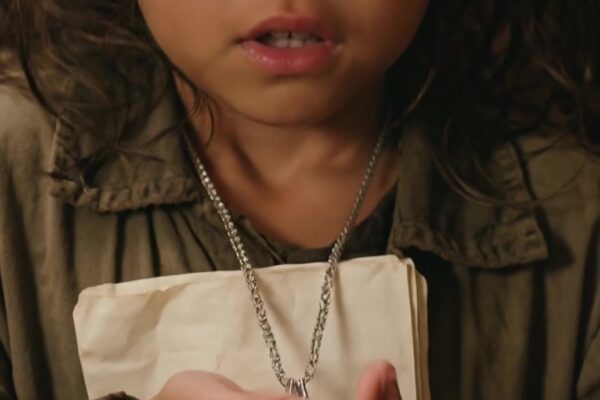
The bell above the café door chimed with a tired little sound, like it was embarrassed to interrupt anyone. Rain fell in thin strings outside, turning the street into a ribbon of glass. In the doorway stood a boy who looked as if the storm had chosen him personally—his sleeves too short, his shoes dark with water, his hair plastered to his forehead. He hesitated, then stepped in and wiped his palms on his trousers as though he could scrub away the fact that he didn’t belong.
The place was warm and bright, filled with the kind of laughter that came easily when your pockets weren’t empty. A row of customers leaned against the counter, shiny coats, confident voices. A young server moved between tables balancing plates that steamed and perfumed the air with butter and pepper. Every clink of cutlery felt like a reminder: this was a room where people expected to be answered.
The boy chose the smallest table, tucked against the wall by a framed photograph of the café’s grand opening. The picture showed a ribbon being cut, a smiling manager, and a crowd gathered as if something important had just begun. The boy kept his eyes down. He pulled a folded slip of paper from his pocket and smoothed it on the tabletop with careful, trembling fingers, as if it might crack. It was a menu he’d found days ago on the sidewalk, rescued from a gutter, dried beneath a mattress. Along the margin he’d made pencil marks—tiny tallies beside a bowl of soup, a bread roll, a cup of tea.
He waited.
The counter line thinned and thickened again, and people who arrived after him were greeted, seated, and served. A family breezed in, shaking umbrellas and complaining about traffic; within minutes, mugs of cocoa and pastries appeared for them. Two office workers laughed loudly and got sandwiches without glancing at the menu. A woman in a pearl scarf snapped her fingers once and received an apology for an invisible delay.
The boy didn’t snap his fingers. He didn’t raise his hand. He sat very straight, hands in his lap, eyes fixed on the edge of the table as though he were studying it. Every so often, his stomach made a sound he pretended not to hear. He swallowed and looked again at his pencil tallies, adding and subtracting in his head like a person negotiating with fate.
A server passed his table three times without stopping. The fourth time, she paused long enough to ask, without meeting his eyes, “Are you waiting for someone?” Her tone carried the same message as the rainwater dripping from his cuffs: You are out of place.
“No, ma’am,” he said quickly. “I— I just want soup. If that’s alright. The smallest one.”
She glanced at his hands, at the worn seams of his coat, at the damp shoes. “We’re busy,” she said, though the line at the counter had momentarily cleared. “You can wait.”
He nodded as if she’d granted him a gift and watched her walk away. A hot flush burned behind his eyes. He kept it in. He’d learned long ago that tears invited questions, and questions invited attention, and attention could be dangerous. In the places he slept—doorways, stairwells, the back of a laundry—survival depended on being unnoticed.
In the corner, near the register, an older man sat alone with a newspaper spread like a shield. The boy felt the man’s gaze slide over him briefly, then return to the print. Somewhere behind the kitchen door, someone shouted an order. The café continued its smooth, indifferent rhythm, like a machine that didn’t register the smallest cog.
The boy’s fingers tightened around the edge of the paper menu until it bent. He forced himself to loosen his grip. He would not ruin it. He had only one clean piece of paper to prove to himself that he could still want something ordinary.
Minutes stretched. The warmth of the café made his wet clothes itch against his skin, and the smell of food became less comforting and more punishing. He tried to imagine his mother’s voice, soft as steam, telling him to be patient. He tried not to imagine her last night in the hospital, her hand slipping from his as the monitors flattened into a single tone that changed the world.
He had promised her, then, in a whisper meant to keep the doctors from hearing the foolishness of hope, that he would be fine. That he would find a way.
He didn’t say how.
At last, he stood and walked to the counter with careful steps, as if sudden movement might cause someone to notice the poverty clinging to him. The server who had dismissed him earlier was ringing up a customer. When she saw him approach, her jaw tightened. “You need to wait at your table,” she said.
He reached into his pocket and pulled out a small bundle of coins tied in a corner of cloth. The knot looked like it had been undone and redone too many times. “I— I have money,” he said, and his voice shook despite his effort. “Not much. But enough for soup. I counted.”
The server’s eyes flicked to the coins and away. The customer beside her—a man with a watch that flashed gold under the lights—snorted quietly. The boy felt his ears burn. His hand hovered, unsure whether to offer the coins or hide them again.
Then, from the back office, the door swung open.
The manager appeared so abruptly it was as if he’d been summoned by the boy’s shame. He was a tall man in a crisp shirt with sleeves rolled to his forearms, moving with the kind of purpose that made people instinctively step aside. His gaze landed on the boy and locked there.
For an instant, the manager’s face went pale. Not the polite pallor of surprise—something deeper, like recognition hitting bone. He crossed the floor quickly, weaving around chairs. The café noise softened as people noticed the change in the air.
“Eli?” the manager said, and the name sounded like it had been held in the man’s mouth for years. “Eli Marlow?”
The boy’s breath caught. He hadn’t heard his last name spoken in weeks, not since the shelter clerk had read it off a form and then forgotten it. “Yes,” he whispered. “How do you—”
The manager didn’t answer. He crouched so they were eye level, as if the entire room had become irrelevant. His voice lowered, urgent and oddly gentle. “Where have you been? We— I’ve been looking. Your mother… I went to the hospital the day I heard.”
The boy’s throat tightened. “She’s gone,” he said, although it felt like stating a fact about weather. “They said there wasn’t anyone else.”
The manager’s eyes shone with something that looked dangerously like guilt. He stood abruptly and turned to the staff. “Stop,” he said, and the single word cut through the café like a blade. “No more orders for a moment.”
The server froze, hand still on the register button. Conversations dwindled. Even the espresso machine seemed to pause, steam hissing softly as if uncertain.
“This boy,” the manager said, voice steady but carrying, “is not to be kept waiting. Not here. Not ever.”
He took the cloth bundle of coins from the boy’s trembling hand and pressed it back into his pocket with a firm, protective motion. “You don’t pay,” he added quietly, only to Eli. “Not today.”
The boy stared at him, dizzy with the sudden shift. A moment ago, he’d been invisible; now the room’s attention sat on him like a spotlight. Part of him wanted to run.
The manager motioned toward a table near the window—larger, brighter, with a view of the rain and the street beyond. He pulled out a chair himself, as if hospitality were a debt he intended to repay personally. “Sit,” he said. “Please.”
Eli obeyed, feeling every eye follow him. The manager spoke to the kitchen in a rapid, low tone. Within minutes, a bowl of soup arrived, richer and fuller than the “smallest one” he’d asked for, with bread that still breathed warmth. A cup of tea followed, fragrant and steaming.
But Eli couldn’t lift the spoon. His hands shook too much. “Why?” he asked, voice barely audible over the renewed murmur of the café.
The manager sat across from him without caring what anyone thought. “Because your mother saved my life,” he said simply. “Before this place existed, before I had anything worth showing off. I was… careless. I made choices that should’ve ended me.”
Eli watched the man’s face, searching for the lie that would make sense of this. He found only memory. “She worked at the hospital,” Eli murmured. “She used to come home with tired eyes and stories she wouldn’t finish.”
“She found me on a night shift,” the manager said. “I was brought in after an accident that was partly my own fault. I had no one. She stayed. She made calls. She fought for me when I didn’t deserve it. And later, when I tried to thank her, she said, ‘Do something good with your second chance.’”
The manager’s hand curled on the tabletop. “I built this place because of her. When I heard she was sick, I tried to reach you. She wouldn’t let me come to your house—pride, maybe. Or protection. But she made me promise something.”
Eli’s eyes stung. “What?”
“That if anything happened,” the manager said, “I wouldn’t let you disappear.” He leaned forward. “You’re not alone, Eli. Not anymore.”
The words hit like a door opening in a hallway he hadn’t realized was locked. Eli looked down at the soup, at the bread, at the clean spoon waiting patiently for him. Hunger rose up, fierce and immediate, and with it came something else—relief so sharp it almost hurt.
He lifted the spoon and took a mouthful. The heat spread through him, loosening knots he’d carried since the hospital room, since the shelter, since the nights he’d listened for footsteps. He swallowed and blinked hard.
Across the café, the pearl-scarfed woman stared, confused by the reversal. The man with the gold watch looked away, suddenly interested in his phone. The server who had dismissed him stood rigid behind the counter, cheeks flushed. The manager didn’t glance at any of them.
He watched Eli eat as if it mattered more than the day’s receipts.
Outside, the rain continued, relentless and gray, but inside the café, the boy who had sat quietly while others were served first found himself at the center of a story he didn’t know he’d inherited—a story of debts repaid, promises kept, and the fragile, dramatic moment when being seen could save a life.