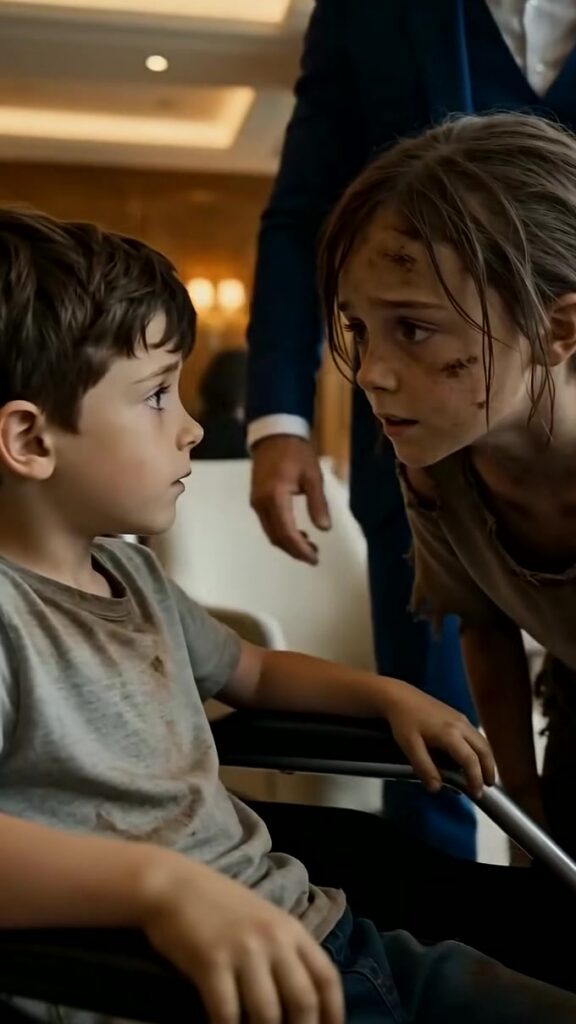
The restaurant was quiet, expensive, and full of people pretending not to notice each other. It was the kind of hush money bought: not silence exactly, but a disciplined absence of surprise. Cutlery touched porcelain like polite rainfall. Conversations were folded into murmurs and tucked away as neatly as napkins. Sunlight spilled through tall windows and lay in bright rectangles across white linens, as if the day itself had been invited and instructed to behave.
At a table near the center sat a man in a blue suit cut so cleanly it seemed to carry its own sharpness. His cuff links flashed when he moved his hands, and his watch face caught the light with every small tilt of his wrist. Across from him, angled slightly to allow the aisle to pass, sat his son in a wheelchair. The boy’s hair was combed flat, his collar straight, his expression practiced into vacancy—as though he had been taught the proper way to be looked past.
The father spoke to a waiter about a sauce, about the wrong temperature of water, about a detail no one else could hear and yet everyone could sense. He spoke the way men do when they need the world to feel controllable. The waiter nodded with the soft-eyed patience of someone who had learned that humiliation, delivered in a low voice, could still be loud.
The boy stared at his hands in his lap. Not the table, not the chandeliers, not the high-backed chairs upholstered in quiet. Just his own hands, pale against dark fabric, fingers unmoving as if they belonged to someone else. It wasn’t sickness that held him so still so much as exhaustion—the kind that follows years of being told to accept what would never change.
Then a small dirty hand slammed down onto the white tablecloth.
The sound was obscene against the restaurant’s polished restraint. Plates rattled. A wine glass shivered in place. Heads turned in a coordinated betrayal of their own pretense. A ragged little girl stood at the edge of the table, shoes split at the toes, knees bruised, dust smeared across her cheek like a rough blessing. Her eyes were wide and dark, set in a face sharpened by hunger, but there was nothing timid about her. She pointed straight at the boy.
“Feed me,” she said, voice raw but steady, “and I’ll heal him.”
The waiter flinched. Somewhere behind them, a chair scraped softly as someone leaned back for a better look without meaning to be seen looking.
For one second the father only stared, the way people stare at a crack appearing in a glass they were sure was unbreakable. Then he laughed. Not kindly. Not even nervously. Cruelly, as if mockery could scrub the dirt from her presence.
“You’ll heal my son?” he said, and the laugh rose again, louder, bright enough to draw another wave of glances. He pushed his chair back so fast it complained against the floor. He leaned over the table, close enough that the scent of expensive cologne tried to crowd her out of the air. “Go away.”
The girl didn’t flinch. She didn’t step back. She didn’t even look at him.
She moved around the table with the certainty of someone who had walked through danger so often that safety no longer impressed her. She dropped down until she was level with the boy’s face, bringing her eyes into the exact line of his. That simple act—meeting him where he lived—changed something.
The father’s grin faltered, not because of fear but because of a new, unwelcome sensation: doubt. The kind that grows teeth.
The girl studied the boy as if he were not an object of pity or an emblem of tragedy, but a person who could be spoken to plainly. “Do you want to stand?” she asked.
The boy lifted his eyes. Not with belief. With desperate hope, the kind that hurts to carry. It was the first real expression anyone had seen on his face all afternoon, and it made the father’s throat tighten in a way he would never admit. The boy swallowed. His lips parted as if he might answer, but no sound came. Still, his gaze held hers, pleading without language.
The father stepped forward. He reached to seize the girl by the arm, to remove the problem the way he removed any inconvenience—from his path, from his sight, from his story. His hand hovered inches from her sleeve.
Before he could touch her, the boy lifted one hand off the wheelchair’s armrest.
It wasn’t a grand motion. It was small, tremulous, uncertain. But it was movement, and it was impossible.
The room went so still the air seemed to harden. A woman at the next table lowered her glass mid-sip. Someone farther back paused with a fork suspended between plate and mouth. Even the waiter forgot to breathe, his notepad hanging uselessly at his side.
The father froze, half-bent over the table, staring at his son’s raised hand as if he’d just watched a dead thing twitch. “What did you do?” he demanded, and the mockery had drained out of his voice, replaced by a jagged edge of fear. “What did you do to him?”
The girl didn’t smile. She didn’t celebrate. She only reached out slowly, palm up, like she was offering something delicate and not daring to grab it. “Nothing yet,” she said. Her tone was calm, almost tired, as if she had said these words before to other people who didn’t want to believe in anything they couldn’t purchase.
The boy’s fingers trembled in the air between them, searching. His eyes flicked once toward his father—an old habit, checking for permission—and then back to the girl, where permission didn’t seem required. The father watched, caught between outrage and the terror of losing control over the narrative he had built around his son: the narrative of permanence, of limits, of acceptance. Limits were manageable. Miracles were not.
The girl leaned closer, her voice dropping until it belonged only to the boy, though everyone strained to catch it. “Then trust me,” she whispered.
The boy’s hand closed around hers.
It was the simplest clasp—two hands meeting. But it looked, in that bright rectangle of sunlight, like a bridge being laid across a canyon. The boy’s shoulders lifted. His chest expanded as if air had suddenly become heavier, more necessary. One foot slipped off the wheelchair’s footrest. The movement was clumsy, involuntary, and real.
The father lunged forward with a strangled sound, trying to catch the moment before it could become a fact. His chair toppled behind him. Silverware clattered as his hip struck the table edge. “Stop!” he barked, but the command was aimed at the world, not at the girl.
The girl held the boy’s hand firmly now, anchoring him. With her other hand she pressed two fingers lightly against the inside of his wrist, as if listening for something beneath the skin. The boy gasped—not in pain, but in shock, as warmth surged up his arm like a tide returning to a shore it had forgotten.
“It’s not magic,” the girl said, and for the first time she glanced up at the father. Her eyes were unblinking, ancient in a face that should have been young. “It’s a trade.”
“A trade?” the father sputtered, clutching the edge of the table to steady himself. “You’re a child. You’re filthy. You—” He couldn’t find the right insult fast enough to cover his fear. “What do you want?”
“Food,” she said, as if it were obvious. “And for you to look at him like he isn’t broken.”
The father opened his mouth, then closed it. His gaze darted to the boy, and for a heartbeat the mask slipped. There was grief there, deep and guarded, a grief he had armored with money and rules and dining rooms where nothing unexpected was allowed to enter. He had loved his son so ferociously it had turned into control. It had turned into a cage with velvet padding.
The boy’s second foot slid free. His legs shook, muscles waking like startled animals. His knuckles whitened around the girl’s hand. Tears sprang into his eyes without permission, and a sound escaped him—small, broken, like the first note of a song long unsung.
The girl’s jaw tightened with effort. Sweat beaded at her hairline, cutting pale tracks through the dust on her skin. Whatever she was doing was not effortless. It cost her. That, the father realized with a jolt, was what made it terrifying: she wasn’t performing. She was paying.
“Wait,” the father said, voice suddenly hoarse. “Don’t—if you hurt him—”
“I won’t,” she interrupted, not unkindly. “But you might, if you keep grabbing.”
He stopped moving, hands hovering uselessly in the air, stripped of their authority. Around them, diners watched with wide eyes and carefully blank faces, as if neutrality could protect them from being changed by what they were witnessing.
The girl nodded once to the waiter without looking away from the boy. “Bread,” she said. “And water. Not from the bottle. From the tap. I don’t need it polished.”
The waiter blinked, then hurried away as if obedience might keep the world from tilting further.
The boy’s knees bent. His body wavered. The father flinched, ready to catch him, but the girl shifted and pressed her shoulder lightly against the boy’s shin, bracing him. “Slow,” she murmured. “You’re remembering.”
“Remembering what?” the father whispered, and to his horror he realized he was pleading.
The girl’s eyes flicked up again. “How it feels,” she said, “to be more than what people decided you were.”
When the bread arrived—warm, torn by nervous hands—the girl didn’t snatch it. She waited until the father, trembling, pushed the basket toward her. It was the first thing he offered without conditions. She took a piece, ate quickly, then placed the rest on the boy’s plate instead of her own.
“Eat,” she told him. “You’ll need it.”
The boy obeyed, chewing with an intensity that made it clear he wasn’t just eating bread. He was eating possibility.
The father watched them both, his expensive suit suddenly feeling like a costume. He realized, sick with recognition, that the room had been full of people pretending not to notice each other because noticing meant responsibility. Noticing meant that suffering could not be dismissed as background noise.
The girl squeezed the boy’s hand once. “On three,” she said. “We try.”
The boy nodded, tears spilling now, but he didn’t look away.
“One,” she said.
The father’s breath caught.
“Two.”
The sunlight shifted across the tablecloth, bright as a blade.
“Three.”
The boy pushed down—hard—arms shaking, face contorted with effort. The wheelchair creaked. For a heart-stopping second, nothing happened. Then his hips lifted. His legs straightened in a violent tremor. He rose—not tall, not steady, but undeniably up.
A sound went through the restaurant, a collective intake, half gasp and half prayer.
The father staggered back as if struck. He brought a hand to his mouth, eyes wide, and the first tear he’d allowed in years slid down his cheek without permission. “My God,” he breathed, and it wasn’t a performance this time.
The girl held the boy’s hand and didn’t let him fall. “Not God,” she said softly, voice edged with something like sorrow. “Just someone finally listened.”
And for the first time in that quiet, expensive room, no one pretended not to notice. They stared openly. Not at the girl’s torn sleeves, not at the father’s wealth, but at a boy standing on shaking legs, and at the fierce, grimy child who had demanded to be fed—and in doing so, had fed something starving in all of them.
The father took one step forward, slow, careful, as if approaching a wild animal he had once caged. “What’s your name?” he asked, voice breaking around the words.
The girl glanced at the door, where the bright street waited like another world. “Names are for people who get to stay,” she said. Then she looked back at the boy, her expression gentling just enough to hurt. “But you,” she added, “you should learn his again.”
The boy swayed. The father moved—this time not to take, but to support. He slid an arm beneath his son’s shoulders. The boy leaned into him with a trust so fragile it made the father’s knees threaten to buckle.
“Eat,” the girl repeated, quieter now. “Love him without locking him.”
And as the father held his son upright under the hard, honest sunlight, he realized the trade had never been about bread. It had been about the price of noticing—and the cost of finally, devastatingly, seeing.