The ballroom glittered like a place where nothing bad was supposed to happen. Light swam across the ceiling in gold ripples, caught and thrown by chandeliers cut to a thousand sharp stars. The air tasted like champagne and expensive perfume, like money turned into fragrance. Laughter rose at rehearsed intervals, too polished to be real, and the music—soft strings, a piano that never dared to strike a wrong note—floated through the room as if it had been paid to behave.
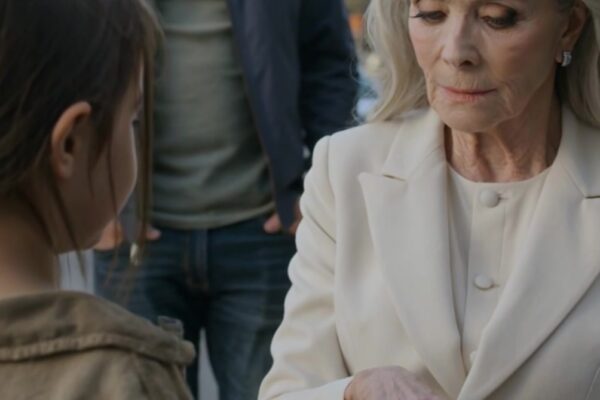
At the center of it all sat Clara Ainsley, the donor everyone had come to orbit. Emerald satin draped her legs in clean, obedient folds, a color chosen to set off her pale hair and make her eyes look impossibly green. She held herself still in the wheelchair as if stillness were part of the gown’s design, her fingers resting on the armrests like ornaments placed there for symmetry. People smiled at her with the warmth you offered a portrait.
Beside her stood Victor Lorne, tall and immaculate in a navy suit, his white shirt open at the throat as though ties were for men who accepted limits. He never touched the chair, yet his presence claimed it. He greeted sponsors, directed staff with a glance, pressed a hand briefly to Clara’s shoulder when cameras turned their way—always a careful, curated tenderness. He had built this night to glitter, and he watched it like a man guarding a vault.
Clara watched the crowd watch her. She could feel their questions hiding behind their compliments: how tragic, how brave, how fortunate she had survived. Survived what, exactly, depended on which version of her story people preferred. An accident. A robbery. A fall. She owned the headlines but not the memory. There were blank places in her mind that doctors called trauma and Victor called “not worth reopening.”
When the side doors opened again, she barely noticed at first. A draft moved the hem of her dress. Heads turned toward the disturbance, annoyance rising like a tide. A boy stepped into the glow—thin as a question mark, hood up despite the heat, a green sweatshirt so worn it looked more like an old bruise than a garment. His shoes were tired. His face was streaked with city dust, yet his gaze didn’t flinch under all that light.
He walked straight through the lacquered crowd as if it parted for him by instinct. Guests drew back, their eyes widening, their hands drifting toward their purses and watches. A security guard started forward, hesitated, then glanced at Victor as if seeking permission to exist.
Victor moved first. He slipped between the boy and Clara with the ease of someone who had done it a hundred times, bending just enough that his shadow swallowed the boy’s shoes.
“You’re lost,” Victor said quietly, the smile still fixed on his face like a blade hidden in a bouquet. “Step away.”
The boy swallowed; Clara saw his throat bob like he’d forced down something sharp. But he didn’t retreat. His eyes didn’t even settle on Victor. They searched past him, anchored on Clara with frightening focus.
“I’m not here to hurt her,” he said. His voice was soft, but it carried in the hush that had fallen. “I just need—”
Victor’s jaw tightened. “Need what? Money? Attention?” He let a brittle laugh escape, too controlled to be natural. “Do you know who she is?”
At that, the boy looked at Victor as if seeing him for the first time. “I think she forgot,” he answered, and the words struck the room like a dropped glass.
Clara’s breath caught. She didn’t know why, only that something inside her stirred—an old door rattling on rusted hinges. Victor’s expression flickered, a fraction of a second where his composure lost its grip.
The boy lifted one hand, trembling, palm open and empty. Not begging. Asking. “Please,” he said, and his voice cracked around the edges. “Just… let me hold your hand.”
Victor reached to push him back. “Absolutely not—”
Clara heard herself speak before she decided to. “Wait.”
Her voice came out thin, like paper pulled too hard. Victor turned, startled, his control recalculating. Clara kept staring at the boy’s face. It was unfamiliar and yet… there was a shape to it, a tilt of bone and stubbornness that tugged at the blank places in her mind.
Slowly, as if her arm belonged to someone else, she lifted her hand from the chair’s armrest. The movement should have been small. It wasn’t. It felt like lifting a stone from a grave.
The boy stepped closer and took her hand with both of his. His fingers were cold. Dirty. But he held her gently, as if his touch might break something sacred. When their skin met, Clara felt it—an electrical shiver that raced up her wrist, along her forearm, and slammed into her chest.
The ballroom seemed to hold its breath. Music continued, but it sounded far away, muffled behind a wall of sudden silence.
Clara’s fingers tightened without permission. Her palm tingled. Somewhere deep in her body, a memory tried to find a path out.
Victor went very still. His eyes narrowed, then widened, as if he were watching a lock pick itself.
The boy’s lashes glittered with tears he refused to let fall. “You used to hold mine,” he whispered. “Like it mattered.”
“That’s enough,” Victor snapped, and the polished veneer finally split, showing something raw underneath. He started forward again.
Clara didn’t look at him. She couldn’t. Her attention clung to the boy’s hands, to the faint tremor in his grip. “Why does this feel…” The word wouldn’t come. She swallowed. “…why does this feel familiar?”
The boy’s face crumpled for a heartbeat. He dipped his head, fought for control, then looked up at her again with wet, unblinking eyes. “My mom told me,” he said. “She said if I ever found the lady with green eyes, and the tiny scar by her wrist… I should ask her for my hand back.”
Clara’s stomach turned. Her gaze dropped, compelled. Slowly she rotated her wrist. Just below the edge of her sleeve, pale against her skin, lay a thin white mark—small enough that she had stopped noticing it, large enough to feel like a sentence when pointed out.
Victor’s face drained of color. He stared as if the scar had materialized from thin air, as if it had not been part of Clara’s body until this moment threatened him.
Clara heard herself again, a different voice, older and frightened and furious all at once. “Who are you?”
The boy opened his mouth, but the words struggled, trapped behind years. He held her hand as if it anchored him to the floor. “My name is Eli,” he managed. “But you used to call me—”
Clara’s fingers suddenly pressed hard into his palm, not in pain but in panic, in recognition. A flash tore through her: a dark street slick with rain, her own breath fogging, a child’s small hand in hers. A shout. A car’s headlights blinding white. Someone grabbing her wrist—hard—right where the scar lived. A voice, Victor’s voice, younger but just as commanding: Let go. You don’t know what you’re doing.
Her heart hammered. The wheelchair creaked as her body jerked forward. For a horrifying second she felt her legs—felt them as if they were waking from a long, cruel sleep, though the sensation was more like pain remembering itself. Her heel pressed against the marble floor, not because she could stand, but because something inside her refused to remain still.
Victor’s hand shot out, hovering near her shoulder without touching. “Clara,” he said, low and urgent, a warning disguised as concern. “Don’t.”
Clara stared at him now, and the glittering room tilted, its beauty suddenly grotesque. She saw the way he had positioned himself by her chair all night, the way his fingers had guided her, the way the staff had watched him instead of her. The blank spaces in her memory weren’t empty. They had been kept.
Eli’s grip tightened around her hand, and she clung back, desperate. His tears finally spilled, hot tracks on a dirty face. “You left,” he whispered. “Or… they made you.”
The word they lit another flare in her mind: men in suits, paperwork, a hospital room where Victor’s shadow fell across her bed. She doesn’t need to remember. She needs stability. Her own voice, hoarse and stubborn: Where is he? Where’s the boy? Then a needle, a soft darkness, and afterward a life smoothed into something safe and sparkling and wrong.
Clara’s throat tightened until breathing hurt. She looked down at her scar and understood it not as an accident but as evidence. She looked back at Eli and saw not a stranger, but a piece of the story she had been cut away from.
“Eli,” she said, testing the name like a key. “What… what did I promise you?”
Victor’s composure snapped back into place like a mask strapped on too tight. “This is a scam,” he announced to the room, louder now, inviting the crowd back into the lie. “Security—”
Clara lifted her hand—still held by Eli—and the gesture silenced even Victor. Her eyes, once decorative, sharpened. “No,” she said. “No more.” Her voice trembled, but it didn’t break. “Don’t touch him.”
Victor’s lips parted. For the first time, he looked afraid. Not for Clara’s safety. For his own.
Clara leaned forward, gripping Eli’s hands as if she could pull herself back through time. “Tell me,” she demanded, her words shaking loose from somewhere buried and ferocious. “Tell me everything. In front of everyone. Right here, in the place where nothing bad is supposed to happen.”
And as Eli drew breath to speak, the glittering ballroom—its gold lights, its crystal glasses, its practiced smiles—began, finally, to look like what it had always been: a stage built to hide a crime.