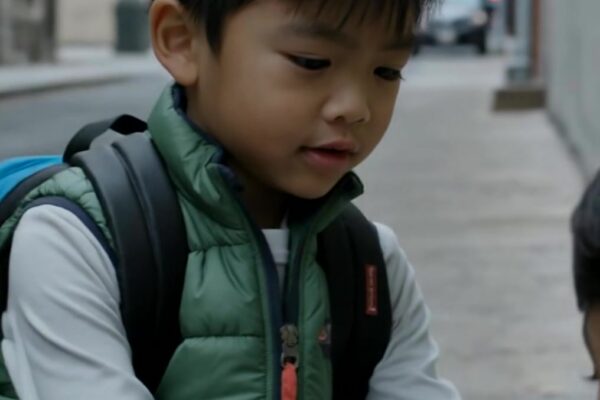
Nobody paid attention to the little boy until the bag hit the marble. The sound wasn’t a thud so much as a crack—sharp enough to slice through the low hum of printers, the shuffling of deposit slips, the bored murmurs of people waiting to be called. Heads turned as if pulled by the same string. Even the customers leaning at the far windows paused mid-sentence, staring toward the center of the lobby.
He stood there in a bright blue hoodie that looked too thin for the season, both palms splayed against a black duffel bag as if it might jump away. The bag was enormous beside him, half his height, its straps twisted like it had been dragged. He rose on his toes to keep it steady, jaw clenched, breathing fast in a way that didn’t match the stillness of his body.
At Window Three, the teller—Marianne—had been counting out a roll of quarters when she noticed him. She frowned, not unkindly at first, then with the practiced impatience of a woman who’d learned to expect trouble from anything out of place. “Hey,” she called, leaning forward. “You can’t leave luggage in here.”
The boy didn’t answer. He stared at the bag as if he could see through it, as if something inside might leak out and stain the polished floor. Marianne’s annoyance sharpened. “Sweetheart,” she said, lowering her voice the way adults did when they assumed children were slow, “you need a parent. This isn’t—”
He lifted his head. His eyes were raw around the rims, as though he’d been crying for hours, but there was no wobble in his stare. Only urgency, like a hand pressed against the back of his neck. “I need an account,” he said.
A couple of people laughed, the sound quick and dismissive. Someone whispered, “That’s adorable,” and someone else muttered about cameras and TikTok. Marianne almost let herself smile, almost waved him away the way she would a kid trying to trade a jar of pennies for attention. Then the boy nudged the duffel toward her, not pleading, not pushing—just placing it in her space like it belonged there.
Something in the careful way he did it—like he was delivering a fragile animal, like he’d been coached to do it exactly—made Marianne reach out instead of calling the guard. The zipper was heavy. When she pulled it back, the teeth rasped loud in the sudden quiet. She expected clothes, maybe tools, maybe the kind of junk people hauled around when they didn’t have anywhere else to keep it.
She found money.
Stacks of hundreds, clean and banded, packed so tight they held the shape of the bag. The scent hit her a moment later: paper and ink and something metallic, like a safe that had been sealed for too long. Her mouth went dry. She looked up, and the security guard by the front desk was already moving, slow and uncertain, as if he couldn’t decide whether he’d imagined it.
“Where did you get this?” Marianne whispered. Her voice came out wrong—small, afraid. She could feel every customer in the lobby leaning in with their eyes.
The boy swallowed. His fingers disappeared into the front pocket of his hoodie and came out holding a small white card. He set it neatly on top of the money, as if placing a napkin on a dinner plate. “My mom told me,” he said. His voice caught once, the only fracture in him, then hardened again. “If anything happened to her, I had to bring this here.”
Marianne stared at the card. It wasn’t a bank card. No logo, no magnetic stripe. Just plain white stock with something written on it. “What’s on it?” she asked, and hated herself for the tremor she couldn’t hide.
The boy didn’t glance down. He kept his eyes on her, as though he needed her to understand exactly who she was in this moment. “The name of the man who killed her.”
Time did something strange then. Marianne’s fingers hovered above the card, unwilling to touch it, like it might burn. Her mind tried to reject what she’d heard by breaking it into pieces—name, man, killed, her—each word a separate object she could set down and pretend wasn’t connected to the boy in the hoodie. But the boy’s face was too composed. Too practiced. Not the face of a child making up a story. The face of a child repeating instructions because he didn’t have room for grief yet.
She flipped the card over.
Her stomach dropped, not because she recognized the handwritten name on the front—she didn’t—but because of what was on the back. A signature, looping and confident, signed with a flourish that said the signer knew the world would make room for him. A signature Marianne had seen on emails, on memos, on holiday cards left by the coffee machine. A signature she’d watched dry on forms every morning for six years.
Samuel Ketter. Branch Manager.
Her vision tunneled. She heard a faint ringing, as if the bank’s fluorescent lights had turned into an alarm. The guard’s shoes squeaked. Someone whispered, “Is that real?” as if money could be fiction. Marianne looked up to find Samuel stepping out of his office, posture relaxed, smile fixed. He moved with the calm certainty of a man accustomed to rooms bending around him.
“Step away from the counter,” Samuel said softly, not to the boy—but to Marianne.
Marianne’s hands refused to obey. She could still feel the card’s edge pressing into her thumb. The boy remained at her window, shoulders square, his small body like a post driven into the floor. Samuel’s smile widened, a teacher’s smile, a patient smile, the kind that didn’t need permission. “There’s been a misunderstanding,” he added. “We don’t want to frighten our customers.”
The boy’s gaze flicked toward Samuel, and something tightened in his face—recognition, yes, but also a kind of grim confirmation. He shifted his weight, as if bracing for a blow. Marianne realized then that the boy hadn’t come here for safety. He’d come here because someone had told him the bank was where the truth would be forced into the open.
“Your mother,” Samuel said, voice gentle enough to be obscene, “she wasn’t well. People do foolish things when they’re desperate. We can talk about this privately.” His eyes slid to the duffel bag, then back to Marianne. “Marianne. Please.”
Marianne’s mind raced through rules, procedures, the silent training that told her to defer, to comply. But the signature on that card burned through every policy. She looked at the boy again—at the red-rimmed eyes and the steady mouth—and a new thought struck her with sick clarity: the money wasn’t a bribe.
It was evidence. A weight heavy enough that a child could carry it only if he had nothing left to lose.
Marianne’s hand moved, not away, but down. She pressed a hidden pedal beneath her counter, the silent alarm her trainers had told her was for robberies. She saw Samuel’s eyes narrow as if he’d heard the click through the floor. His smile held, but it became thinner, a blade instead of a welcome.
“I told you to step away,” Samuel repeated, and now the softness was gone. Behind him, the lobby seemed to shrink, people frozen between curiosity and fear, unsure if they were witnesses or targets.
The boy reached into his hoodie again and pulled out something else: not a weapon, not a phone—just a folded sheet of paper, damp at the corners as if it had been clutched too long. He laid it beside the card. Marianne saw a stamp at the top, the kind she’d only ever seen when customers came in to certify documents.
Notarized. Dated. Names. Amounts. And in the margin, written in her mother’s hand, a sentence that Marianne didn’t read so much as feel: If you’re holding this, I’m already gone. Trust no one who smiles.
Samuel took a step forward. The guard finally moved too, caught between orders and instinct. The boy didn’t run. He only looked at Marianne, and in that look Marianne understood the cruel genius of the plan: if Samuel tried to take the bag by force, the whole bank would see it. If he tried to laugh it off, the money and the paperwork would remain on the counter, undeniable. The boy had turned the lobby into a stage.
Outside, distant and growing louder, came the wail of sirens. Samuel paused, his smile failing for the first time. For a heartbeat, the branch manager looked like a man who had always believed he could sign his way out of consequence—and had just realized the ink was running out.
Marianne closed her fingers around the white card, anchoring herself to it like a life raft. She kept her eyes on Samuel as the lobby held its breath, and she said, loud enough for everyone to hear, “This account,” she told the boy, “will be opened today.”
Samuel’s face went still. The sirens grew nearer. And the little boy, finally, let his shoulders drop—as if the weight he’d been carrying wasn’t money at all, but a message delivered exactly where it was meant to explode.