Rain hammered the stone steps outside the church, turning the broad staircase into a slick ribbon that funneled everyone toward the heavy oak doors. Black umbrellas pressed together like a flock of crows. Bouquets that had looked proud in the florist’s window now drooped under the weight of water, their petals bruised and darkened by cold. The mourners moved with careful, rehearsed slowness, as if grief required etiquette and a measured pace.
At the center of the gathering stood Eleanor Voss, the widow, her posture so impeccable it looked carved. Her dress was a deep, unreflective black that swallowed the gray daylight. A veil netted the edge of her cheekbones. She held her umbrella steady, a small island of composure in the storm, while friends, partners, rivals—people who had learned to smile at dinners and calculate at boardrooms—lingered at a respectful distance. Sympathy hovered in their faces; caution lived behind it. A fortune had just become ownerless, and everyone was pretending they didn’t notice.
Inside, the organ droned low and patient. Outside, the rain did the louder work.
Eleanor listened for the sound she expected—soft sobs, broken breath, someone calling her name. She received none of it. Harold Voss had been admired, feared, envied, and accommodated, but few had loved him in a way that made noise. Eleanor had learned long ago that silence could be mistaken for strength. She wore it like jewelry.
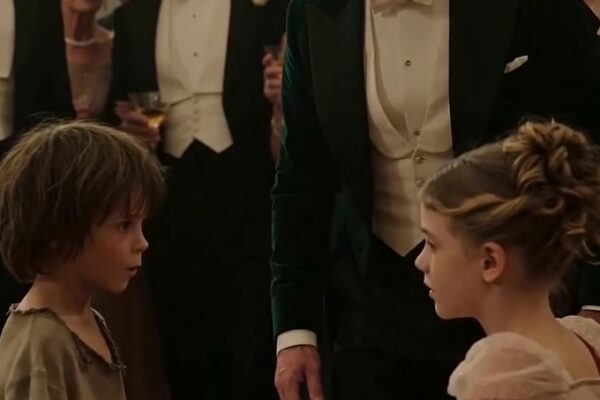
When the boy appeared at the bottom of the steps, he didn’t look like he belonged to anyone’s careful plan. He was small, soaked through, hair plastered to his forehead, clothes clinging to angles that should have had more years to fill out. His sneakers slapped against the wet stone as he ran, skidding once, catching himself with a palm that came away black with rainwater and grit. The umbrellas shifted to block him instinctively, as though he were weather made human.
“Hey—kid!” someone hissed, but the boy’s eyes were fixed on Eleanor. He pushed between two men in tailored coats and climbed the final steps with a stubborn, breathless determination. In both hands he held something wrapped loosely in a plastic grocery bag. The bag was torn; the object inside was old and cracked, its outline rigid and unmistakable.
He stopped in front of Eleanor and lifted the bundle as if it weighed more than it should. Before anyone could reach for him, he pressed it into her gloved hands. Plastic clung to wet leather. The phone inside was heavy, cheap, and battered—nothing that belonged near a woman whose jewelry could have paid for the whole church roof twice over.
Eleanor’s gaze dropped. Her mouth tightened with a reflex of disgust she couldn’t fully hide. Around them, the entrance quieted. Even the rain seemed to pause between impacts, as if waiting to hear what would happen next.
She peeled the plastic away. The phone’s screen was cracked like spiderwebbed ice, yet it glowed stubbornly, refusing to die. On the lock screen a single icon pulsed: a saved audio file, ready to play.
“What is this?” Eleanor’s voice cut through the storm, thin and sharp as glass.
The boy shivered so hard his shoulders jerked, but he didn’t step back. “He said… if something happened… if he didn’t come back… I had to give it to you.” His words stumbled out with his breath, and he swallowed hard after each sentence as if forcing it past a knot in his throat.
A name formed in Eleanor’s mind before she allowed it to. Harold, she thought, and felt an irritation flare—irritation at being interrupted, at the scene becoming untidy, at being forced to consider anything beyond the polished story the day was supposed to tell.
“Who are you?” she demanded, though her eyes had returned to the screen as if it might answer for her.
The boy’s lips were bluish from cold. “My name’s Micah.”
“Micah what?”
He hesitated, and in that hesitation a hush spread wider. A few umbrellas tilted in, as if eavesdropping were a form of shelter. The priest at the doorway had paused with his program half lifted, his expression fixed in a polite, brittle smile that did not reach his eyes.
Micah’s gaze slid toward the church doors, then back to Eleanor. “He—Mr. Voss—he used to… he had another place.”
Eleanor’s fingers tightened around the phone. In the distance, thunder rolled like furniture being dragged across a floor. She felt her pulse in her throat, a quick betrayal.
“Speak clearly,” she said, the widow’s composure now edged with something else—fear, or anger, or the two braided together.
Micah drew a ragged breath. “My mom cleaned his apartment.”
The words landed with a dull force. Not the penthouse everyone knew, not the house pictured in magazines, but the other address—one Harold had called an office, a crash pad, a place he used when work ran late. Eleanor had never asked for details, because details had a way of multiplying into questions, and questions were dangerous to a life carefully arranged.
“He gave me this,” Micah went on, nodding at the phone. “He said it was for you. He said… you wouldn’t want to hear it from anyone else.”
Eleanor’s throat tightened. She lifted the phone, her glove hovering over the play button. In that moment, she became sharply aware of every face angled toward her, every breath held under fabric and rain. She could feel the weight of her last name on her shoulders like wet wool.
She pressed play.
The speaker crackled, a thin, intimate sound. Then Harold’s voice, weakened, came through—hoarse, uneven, unmistakable. It wasn’t the confident voice that had commanded rooms; it was the voice of a man who had learned the cost of time and was trying, too late, to spend what remained wisely.
“Eleanor,” the recording said, and the way he spoke her name made her stomach drop. “If you’re hearing this, it means I didn’t get the chance to say it clean. I’m sorry for that. I thought I could keep everything separate. I was wrong.” A pause, filled with a breath that rattled. “Micah is my son.”
A murmur rippled through the umbrellas like wind through reeds. Someone gasped, the sound swallowed quickly as if shame could be inhaled back into the lungs. The priest’s hand went to the doorframe, fingers whitening on the wood.
Harold’s voice continued, quieter. “His mother kept him safe when I didn’t have the courage. I told myself it was for you. For the company. For the image. But if I’m honest, it was for me. I didn’t want to lose what we built, and I didn’t want to lose him, so I pretended I could have both by keeping the truth buried.”
Eleanor’s face drained of color. Rain slipped past the edge of her umbrella and ran down her cheek, tracing a line like a tear she hadn’t earned. Her lips parted, but nothing came out.
On the recording, Harold swallowed audibly. “You may think you’re being robbed,” he said. “You may think this is an insult. But listen to me: he isn’t a threat. He is a child. And he is mine.” Another pause, longer. “Take care of him. Not because of guilt. Not because of appearances. Because it’s the only decent thing I have left to ask.”
The audio ended with a soft click, as final as a coffin lid.
Eleanor stared at the phone as if it might argue with itself and retract. The rain kept striking stone and fabric and hair, indifferent. Her umbrella had slipped slightly; water gathered along its rim and spilled over in cold sheets.
“Who are you to him?” she asked Micah again, but her voice had changed. The sharpness was still there, yet now it trembled at the edges, strained by something she could not easily name.
Micah lifted his chin. In his eyes was exhaustion too old for his face. “I’m his,” he said simply. Then, as if he had been carrying the next sentence like a weight and could no longer bear it alone, he added, “He said you loved what he could give you more than you’d ever love what he hid.”
Eleanor flinched as if struck. Around them, the crowd shifted, sensing blood in water. She could already hear tomorrow’s whispers, the market’s assumptions, the board’s emergency meetings. A widow’s grief was acceptable; a widow’s surprise son was scandal. She felt the trap closing: protect the fortune and crush the child, or acknowledge the child and risk the empire Harold had left balanced on her shoulders.
Micah stood in the rain with his arms at his sides, shaking, waiting. He did not plead. He did not beg. His quiet was not politeness—it was defiance, the kind that comes from having nothing left to barter.
Eleanor looked past him for a moment, toward the church doors where Harold’s casket waited and the ceremony waited and the life she understood waited to continue without interruption. The priest’s eyes met hers, uncertain, as if he too were deciding which version of morality would be preached today.
Then Eleanor looked back at Micah. She noticed, with a startling clarity, the curve of his brow, the shape of his mouth when he clenched it, the slight asymmetry in his ears—details that echoed Harold in a way no recording ever could. Her chest tightened, not with tenderness, but with something more complicated: the sensation of being forced, at last, to see what she had avoided.
She lowered her umbrella until it covered both of them, a small canopy in the storm. Her arm stiffened with the effort of sharing. “You’re freezing,” she said, and the words sounded strange in her mouth, like a language she hadn’t practiced.
Micah’s eyes widened, suspicion mixing with hope so quickly it hurt to witness.
Eleanor held the cracked phone close, as if it were a live coal. “We’re going inside,” she said, not to the crowd, but to the boy—an order and an invitation in one. “Not because anyone is watching.” She glanced at the umbrellas, the waiting ears, the poised judgments. “Because he asked.”
Micah took a careful step forward beneath her umbrella. Together they moved toward the doors, leaving a wake of stunned silence behind them. Rain continued to hammer the stone steps outside the church, but now the sound was different—less like mourning, more like insistence, as if the world itself demanded that secrets, once spoken, be carried somewhere new.