The football field was full of celebration—one of those late-spring evenings when the sun seems to polish everything it touches. The bleachers glittered with phone screens and cheap jewelry. Folding chairs lined the track in neat rows, some decorated with paper flowers and ribbons that fluttered like small flags. A brass band warmed up near the end zone, and the smell of cut grass mixed with perfume and sunscreen.
At the center, a stage had been built over the fifty-yard line, draped in blue fabric that matched the graduating gowns clustered behind it. The seniors stood in a loose, shifting crowd, laughing too loudly, tugging at sleeves, checking tassels, trying to act like their knees weren’t shaking. Somewhere in the front row a toddler screamed with joyful defiance, and no one scolded her. Tonight, every sound felt permitted.
In the donor section—white chairs, reserved signs, bouquets arranged as if this were an opera instead of a public school—Warren Crowell sat with his legs crossed and his smile practiced. He wore a suit that fit like an insult: sharp, expensive, unwrinkled by any ordinary life. He was the kind of man people thanked without knowing why. He had funded the scoreboard, paid for the turf, put his name on a plaque that shone even in shadows.
He didn’t look at the stage so much as he looked through it, eyes already moving ahead to the handshake photos, the congratulatory comments, the minutes he’d spend pretending to remember names. His wife, Lila, waved at someone across the aisle and whispered a joke. Warren’s son, Camden—tall, handsome, cap tilted just so—stood with the graduates, glancing toward the donor section every few seconds like an orbiting moon checking its planet.
That was when the bouquet entered the frame of everyone’s attention: a cheap cluster of daisies tied in crinkled cellophane, held by a boy who seemed too small to be on a field that big. He hovered near the track, half-hidden by a camera tripod and the legs of adults. His clothes hung on him like hand-me-down apologies—frayed hem, ripped knee, a shirt that had seen too many washes and not enough rest. He held the flowers with both hands, and pressed a folded card against his chest as though it could stop his ribs from showing their panic.
The guard noticed him late, and then all at once. The man’s posture snapped into authority, as if the boy’s presence were a stain spreading toward the donors. “You can’t be here,” the guard barked, stepping in front of him. The boy didn’t move fast enough. The guard’s boot came down on the bouquet—hard, deliberate—crushing petals into the rubber of the track. The sound wasn’t loud, but it landed. Paper crinkled. Stems snapped. A few people nearby stopped clapping mid-beat, hands suspended in the air like they’d forgotten what they were doing.
The boy stared at the ruin, face blank for a second as though his mind refused to accept the sight. Then something bright and wet gathered in his eyes. He didn’t cry. He simply stood there, holding the broken stems, humiliation tightening his mouth. A woman in the third row started to rise, then hesitated. Another parent turned away, pretending the moment hadn’t happened. The field, so full of noise a moment before, thinned to an uneasy hush.
Warren Crowell turned with irritation, the kind that came easily to him. His gaze landed on the boy like a verdict. “Why is he here?” he called, voice sharp enough to cut through the band’s tuning notes. The guard straightened as if being addressed by a general. The boy flinched, but he did not run. His hands trembled around the card; the ruined bouquet dangled like evidence.
“My mom said,” the boy managed, the words shaking but intact, “I had to give you this before they call his name.” He nodded toward the stage, where the line of graduates was beginning to form. Warren’s annoyance faltered into something narrower: suspicion. He held out his hand. The boy placed the card into it with the careful reverence of someone handing over an heirloom.
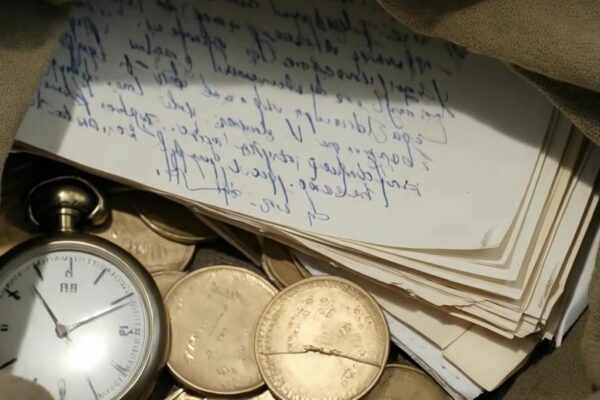
Inside the card was not money, not a plea, not the sort of complaint Warren was used to receiving through lawyers. It was a tassel—old, slightly faded, the thread worn soft with years—taped beside a handwritten message. Warren recognized the tassel before he read the words. His throat tightened as though an invisible hand had found it. The message was in a woman’s looping script, the ink pressed deep: For my first son, if I’m not there.
Warren’s breath grew shallow. The stadium lights seemed to brighten, harsh and clinical. He saw, with the terrible clarity of returning memories, a summer night far from this manicured field: a cheap apartment, a girl with paint under her nails, his own graduation cap tossed carelessly onto a chair. He’d left in a hurry back then, told himself he was doing what was necessary, what his family demanded. He’d told himself there were no consequences he couldn’t bury under scholarships and charity dinners. But the tassel—his tassel—had not been buried. It had been saved.
He looked down at the boy again. The child’s face was a portrait of forced courage, the kind that comes from practice. “Where did you get this?” Warren asked, and the question sounded wrong coming from him—too raw, too human.
“She kept it,” the boy whispered. “In a box. With your letters.”
Warren’s fingers tightened until the card creased. In his peripheral vision he saw Lila’s smile freeze, saw the guard’s confusion, saw a cluster of parents leaning forward as if the drama were part of the program. On the stage, the principal raised a hand, ready to begin calling names. Camden shifted in line, glancing toward the donor section again, waiting for his father’s proud nod.
Warren lowered his voice, but there was danger in the quiet. “What did she tell you?”
The boy swallowed. He looked toward the stage, where Camden’s shoulders squared as if bracing for the moment. Then the boy looked back at Warren, eyes shining, chin lifted by sheer stubbornness. “She said,” he breathed, “the son you came to cheer tonight is your second one.”
Warren’s jaw slackened. The air around him seemed to tilt. In his hand, the card bent further, paper surrendering to the pressure of his grip. Somewhere behind him, someone let out a small gasp. The band fell silent as if a conductor had lowered his baton on the whole field. Warren stared at the boy—the first son, standing in ripped clothes on a track that carried everyone forward—and for the first time in years, Warren Crowell couldn’t purchase the next moment. He could only live it, exposed under stadium lights, as the first name on the list began to rise toward the microphone.