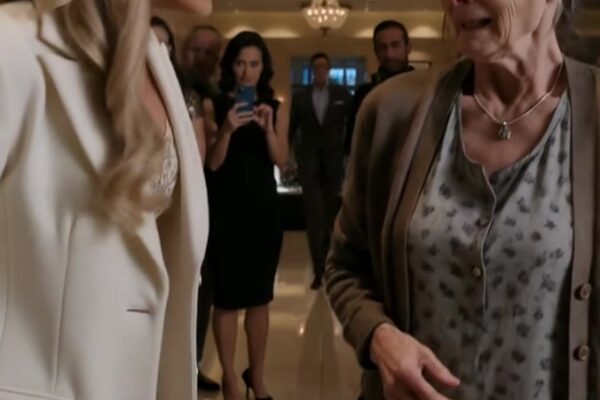
The hall was too beautiful for a child who looked like he’d learned early not to touch anything that could shatter.
Warm light poured from chandeliers the size of small moons, pooling on marble floors polished to a mirror sheen. Every footstep in this place sounded like a confession. The walls carried old portraits—stern faces in oil paint staring down at the living as if to weigh their worth.
At the center of it all waited a grand piano, black as still water, lid propped open like a dark wing. It didn’t belong to the room; the room belonged to it.
On the bench sat a boy in a gray hoodie and blue jeans faded at the knees. His shoes were scuffed so badly the white rubber at the toes looked peeled. He couldn’t have been more than eight, though the set of his jaw had the exhaustion of someone older.
His hands hovered above the keys without touching. Fingers spread, trembling, as if the space between skin and ivory were a cliff edge. He stared at the piano the way hungry children stare at bakery windows—half longing, half bracing for disappointment.
Behind him stood a tall man in a tailored navy suit. Elias Crowne, the name whispered in this city like a weather warning. His posture was quiet, controlled, but his eyes were not the eyes of a man admiring art. They were the eyes of a man taking inventory.
People lingered in the distance—two staff members holding their breath near a doorway, a social worker clutching a folder like a shield, and a woman from the foundation who had insisted this wasn’t a spectacle even as she’d arranged it like one. The boy had been delivered to the estate that afternoon with a note: FOUND AT STATION. NO FAMILY LISTED. PLAYS FOR COINS.
Elias had listened to the story without blinking. Then he’d asked only one question.
“Does he really play?”
Now the boy sat under the weight of that question, his shoulders tight, his chin tucked.
Elias stepped closer, the soles of his shoes making no sound on the polished floor. When he spoke, the room seemed to shrink to fit his voice.
“If you can play,” he said, low and steady, “you can stay.”
The boy turned so fast his hood slipped back, revealing hair cut unevenly, as if someone had tried to fix it with kitchen scissors. His eyes were a sharp, wary brown. They flicked across Elias’s face, searching for the usual seams of a lie—too-bright smile, impatient gaze, the impatience adults had when they offered hope like a toy they could snatch away.
“You mean… here?” the boy asked. His voice scraped, as if he hadn’t used it in a while. “For real?”
Elias’s mouth tightened, the smallest movement. He nodded once.
“For real. Go ahead.”
The silence that followed was not ordinary silence. It was the silence of a locked door waiting to hear whether the key had turned.
The boy faced the piano again. He swallowed. His fingers hovered, shook, lowered. For a moment he seemed to decide he couldn’t, and then—like someone stepping off a ledge and trusting the air to become water—he let his hands fall onto the keys.
The first notes did not burst out. They slid into the room like a slow exhale.
Not flawless, not loud, but deliberate. A melody with a fragile spine. A lullaby shaped from simple intervals, the kind a tired parent hums into the dark. The boy didn’t look at anyone. He didn’t perform; he remembered.
Elias froze.
His body, which had lived years in command of itself—boardrooms, courtrooms, funerals—betrayed him. The color drained from his face so quickly it seemed the light itself had been stolen. He took one step, then another, as if pulled by the sound.
Because he knew that melody.
He hadn’t heard it in seven years, not since the night Anna lay in their bed with a fever and an exhausted smile, pressing a newborn to her chest and singing to keep her own fear from filling the room. She’d made the lullaby herself, a stitched thing—four notes that rose, then fell, then rose again like a hand smoothing a child’s hair. Elias had learned it only because he’d been terrified he might forget the sound of their life.
Only three people had ever known it.
Elias. Anna. And the baby boy who had vanished from the hospital in the dawn hours, taken so cleanly the cameras caught only a shadow and a nurse’s startled turn. The police called it an abduction. The tabloids called it a curse. Elias called it the moment his world began to rot from the inside out.
The boy played on, careful and soft, as if any wrong note might bring punishment. His shoulders lifted with each phrase. His hands were small but certain, guided by something beyond lesson books.
Elias’s breathing turned shallow. He was close enough now to see the boy’s knuckles, the tiny scars along the back of his left hand. Old wounds, poorly healed. His throat tightened as if the notes were threading through it, pulling it closed.
When the boy reached the familiar turn in the melody—where the fourth note hesitates before it resolves—Elias felt the room tilt. That hesitation was Anna. That hesitation was her laugh caught in her own throat, the way she’d always sung as if the song might break her heart.
The final phrase began. The boy’s right hand trembled. He slowed, like someone walking toward a cliff edge he can’t see.
Without lifting his gaze from the keys, he whispered, barely audible.
“My mom used to sing this when I got sick.”
The words struck Elias harder than any shouted accusation.
His hand rose, not to touch the child, but as if to steady himself against air. He stared at the back of the boy’s hoodie where it bunched at the collar. The fabric looked new against everything else the child wore, as if it had been given recently by someone trying to make him presentable. And there, half hidden where the seam met the tag, something pale gleamed.
Stitching.
Two tiny initials embroidered inside the collar in careful thread: A.C.
Elias’s heart stuttered, then slammed against his ribs with violent insistence. Those letters weren’t decoration. They weren’t a brand label. Elias had stitched those same initials with his own clumsy hands into a baby blanket years ago because Anna had laughed at how crooked they were. He’d insisted on doing it anyway. He’d wanted his son wrapped in proof that his father had tried.
The boy lifted his hands from the keys, the lullaby ending in a final note that hung in the air like an unanswered question. He sat very still, waiting for judgment.
Elias stood over him, the estate’s vastness suddenly irrelevant, the chandeliers meaningless. In the distance, the social worker shifted, sensing the change in the room but not understanding it.
“Where did you learn that song?” Elias asked. His voice was not steady now. It was a blade that had begun to tremble.
The boy shrugged, too small a movement for the enormity of what it carried. “I don’t know. I just… know it.” He hesitated, then added, “She—my mom—she said it was special. She said it would keep bad dreams away.”
“Your mother,” Elias repeated, tasting the word as if it might burn. “What was her name?”
The boy’s eyes flicked up at last. In them was fear, hunger, and that stubborn shard of hope he didn’t trust. “She told me not to say,” he murmured. “She said people would take me if I did.”
Elias’s hands curled into fists at his sides, not with anger at the child, but at the invisible hands that had shaped this life in secret. “No one is taking you,” he said, each word forced into place. “Not from here.”
The boy’s lips parted, disbelief written plainly. “You said if I could play I could stay,” he said, as if reminding Elias of a rule, as if rules had ever been safe before. “I played.”
Elias leaned down, slowly, carefully, as though approaching a frightened animal—or a miracle.
“You played,” he agreed. His eyes fixed on the stitched initials like a lighthouse in a storm. “And you are staying.”
Behind them, somewhere deep in the house, a clock chimed the hour. The sound rang through the hall like a verdict.
The boy stared at Elias, trying to read what kind of promise this was. Elias held the gaze despite the ache building behind his eyes, despite the sudden terror of hope—hope that could be smashed again if he was wrong.
Then Elias reached out and, with two fingers, touched the edge of the hoodie collar where the initials hid, as if confirming the fabric was real. His hand trembled.
“What’s your name?” he asked.
The boy hesitated. For a moment he looked toward the distant doorway, as if expecting someone to yank him away for answering. Then, quietly, he said, “I’m… Milo. That’s what they call me.”
Elias swallowed. The name was not the one he’d given his son. That meant nothing and it meant everything.
“Milo,” Elias said, letting it settle in the air like a temporary bridge. “Come with me.”
The boy flinched at the words, old instincts kicking. But Elias did not grab him, did not loom. He simply held out a hand, palm up, an offer rather than a command.
The boy looked at the hand as if it might bite. Then he looked back at the piano—at the only thing in this room that had spoken for him.
Slowly, as if the motion might make the spell break, he slid off the bench and placed his small, scarred fingers into Elias’s trembling palm.
The hall remained beautiful. The light remained warm. But the air had changed, thick with the beginning of a reckoning.
Because a lullaby had returned to a house that had been mourning in silence. And a man who had built his life around control had just heard proof that something he’d buried alive was still breathing.
Play, and you can stay.
Elias tightened his grip just enough to be sure the boy was real. “You’re safe,” he said, though he didn’t know yet how many people he would have to fight to make it true. “I’m going to find out who took you. And why.”
The boy didn’t answer. He simply held on, like someone learning what it feels like not to fall.
And as they walked away from the piano, the last note of the lullaby seemed to follow them, a thin, relentless thread pulling the past into the present—tightening, tightening—until something had to break.