The Hale Conservatory wore its wealth like armor. The glass roof caught the city’s lights and fractured them into a thousand trembling stars, and beneath it Victor Hale’s guests moved in practiced, glittering orbits—old money beside new, political smiles beside philanthropic speeches. Chandeliers hung over the grand hall like captured suns. Even the air smelled expensive, a blend of lilies and chilled champagne.
Victor stood at the podium as if it had been built around his spine. The black lectern was sleek, modern, and theatrical, with a glowing touchscreen at its base that looked more like a luxury device than a lock. He laughed into the microphone, the sound polished and measured, a man who had learned the shape of applause and trained crowds to deliver it on cue.
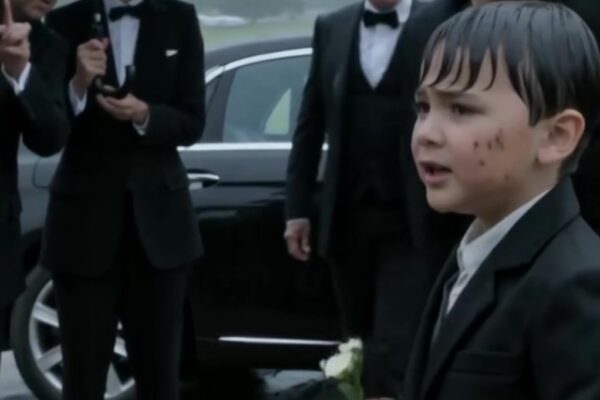
Along the edges of the room, the staff stood in obedient lines—servers in crisp black, cleaners in discreet gray. Near the back, Marisol Reyes held a silver tray so tightly her wrists quivered. Her son stood beside her, too tall for his age, too thin for the tailored world around him. A gray hoodie. A red scrape on one cheekbone, fresh enough to still sting. He didn’t belong under chandeliers, but he didn’t shrink from them either.
Marisol had begged him to stay in the service corridor. She had whispered that Victor Hale’s parties were not places for children, not places for truth. But Nico had looked at her with that quiet, unsettling steadiness he’d carried since he was small, the steadiness that had begun the day he discovered that his birth certificate didn’t match the name she called him in the kitchen.
Victor’s voice rolled over the crowd. “Tonight, we celebrate legacy,” he said, letting the word hang like a jewel. “The Hale Foundation will expand its work—” He paused, eyes sliding past the front row, past the donors, past the mayor’s wife, until they landed on Marisol and the boy beside her.
The pause drew attention the way blood draws sharks.
“We should also recognize those who make evenings like this possible,” Victor continued, bright with false generosity. “Our staff. Our invisible hands.” A few people chuckled politely. “Come forward.”
Marisol’s stomach dropped. She stepped back instinctively, but Nico moved instead. He walked out into the open space, his sneakers whispering over polished wood. Heads turned. A few brows lifted in mild disgust. A few mouths curved with amusement at the sight of a boy dressed like a shadow in a room of satin.
Nico stopped at the base of the podium and looked up. The touchscreen lock glowed a calm, inviting blue.
“Open it,” Nico said. Not loud, not pleading—flat, deliberate, as if he were naming an appointment.
The room reacted in ripples. Confusion first, then laughter from someone who thought it was a joke. Marisol’s tray dipped. “Nico,” she hissed under her breath, panic tightening her throat. “Please. Don’t.”
Victor’s smile widened, not with kindness but with appetite. He leaned toward the microphone. “Is this part of your mother’s gratitude?” His tone turned honeyed and sharp. “What are you doing, kid?”
Nico didn’t look away from the lock. “You know what I’m doing.”
Victor blinked once. Then he recovered, savoring the audience. “Fine,” he said, as if indulging a pet. “Open it.” He tapped the podium with his fingers. “Go ahead. Show everyone how clever you are.”
Marisol’s knees softened. She wanted to run, to pull Nico back into the shadows, to disappear before Victor’s cruelty sharpened into something permanent. She had seen him ruin people with a sentence, end livelihoods with a laugh. He did it because he could. He did it because no one stopped him.
Victor’s voice dropped, amplified into authority. “If you can’t open it,” he said, “your mother is out of a job before dessert.”
Silence fell, thick and suddenly intimate. A few guests shifted uncomfortably, eyes avoiding Marisol’s face. Most stared with the detached interest reserved for public humiliation—safe because it was happening to someone else.
Nico exhaled once, slowly. He stepped closer. The touchscreen reflected in his eyes like a small, cold moon.
Tap. Tap. Tap.
Numbers lit under his fingertips. Not frantic. Not random. He moved with the calm focus of someone following a map he’d memorized in darkness. Marisol watched him as if he were walking across a cliff edge, terrified of the moment the stone crumbled.
Victor crossed one arm over his chest, amusement returning as the crowd leaned in. “See?” he murmured into the mic. “Everyone needs a hobby.”
Nico paused with one digit left. He lifted his gaze to Victor, and for the first time Victor’s expression faltered—not fully, not enough for most to notice. But Marisol saw it. Fear, swift as a knife flash.
“Are you sure,” Nico asked, voice quiet but carrying, “you want it opened in front of everyone?”
A few people laughed uncertainly. Victor’s jaw tightened. “Open it,” he said, louder. “Or she’s gone.”
Nico nodded once. Then he entered the final digit.
The lock answered with a clean, electronic beep. A hard metallic click followed—too loud in the hush, like a gun’s chamber closing.
The panel at the base of the podium sprang free.
Gasps fluttered through the hall, half disbelief, half delight. Victor’s hand moved forward, instinctive, too late. The safe was meant for his sealed speech and a ceremonial estate announcement. A prop for power. Not a vulnerability.
Nico reached inside. He ignored the envelope visible at the front, thick with official stationery. He slid his hand behind it and pulled out a second bundle, hidden flat against the inner wall—older paper bound in red string, corners worn from being handled and re-hidden over and over.
Marisol went so pale she looked carved from wax. The tray trembled. She whispered his name again, but it came out like a broken prayer.
Victor lunged around the podium, microphone screeching as it shifted. “That doesn’t belong—” he started, but the sentence died when Nico untied the string with practiced fingers.
On the first page, in stark black type, a heading sat like a verdict.
Nico read it aloud, not shouting—simply letting the words exist in the air Victor had always controlled. “Birth Transfer Authorization.”
The phrase meant nothing to some, and everything to others. A woman in the front row stiffened, eyes narrowing as recognition scraped across her face. A man near the bar stopped mid-sip. Someone’s laugh choked into a cough.
Victor’s face drained of its easy color. “You don’t understand what you’re holding,” he said, voice suddenly too human. “Put it back.”
Nico flipped the page. There were signatures. Seals. Dates. A line item for “custodial reassignment.” Another for “non-disclosure compensation.” A final note—cold, bureaucratic—about a child relocated “for the preservation of legacy.”
Nico lifted his eyes. They weren’t angry in the way Victor expected. They were steadier than anger, older than fear.
“So this is where you hid it,” Nico said, and the hall seemed to shrink around the words. “The paper that says you bought me.”
Victor’s lips parted. No sound came at first, as if the room had stolen his practiced language. Marisol took a step forward, tray forgotten, her hands reaching as if she could pull the truth back into her chest and keep it from tearing the night apart.
Nico held the document up higher, letting the chandeliers light the embossed seal. “You wanted a show,” he continued, voice gaining strength. “You wanted everyone to watch me fail so they’d laugh and forget. But I didn’t come to open your speech.”
He glanced down at the envelope Victor had planned to read from, then back to the faces staring at him—donors, politicians, friends who weren’t friends, all the people who had eaten from Victor’s hand and called it charity.
“I came to open what you buried,” Nico said.
Victor’s eyes darted around, searching for loyalty in the crowd the way a drowning man searches for air. “This is private,” he managed. “This is—fabricated. It’s stolen property.”
A woman near the mayor rose slowly from her chair. “Victor,” she said, voice tight with shock. “What is that?”
Nico didn’t wait for Victor to answer. He turned the page again, revealing the name beneath the official language—his name, and the name he’d been born with, and beside it the name Victor Hale had paid to erase.
Marisol’s breath broke into a quiet sob. Not because the secret was exposed—she had lived with it like a thorn for years—but because Nico had done what she never could: he had dragged it into light where it could no longer fester in silence.
Victor stepped toward him, hands raised as if to snatch the file back. Security at the doors hesitated, unsure whether to protect their employer or the illusion of decorum. Cameras appeared in guests’ hands like weapons drawn.
Nico took one step back, keeping the papers out of reach. “You said you’d fire my mother,” he said softly. “So do it. Say it into the microphone. Let them hear what you are.”
Victor froze. The microphone waited at his mouth, but the words that once came so easily had turned to ash.
In that suspended moment, Marisol realized something frightening and beautiful: Victor Hale’s power had always depended on everyone agreeing not to look too closely. Nico had forced them to look.
The chandeliers still glittered. The crystal still shimmered. But the hall no longer felt like a celebration. It felt like a courtroom, and Victor Hale—smiling tyrant of a thousand parties—stood at the podium with his secrets spilled open at his feet, while the servant’s son held the proof like a blade made of paper and light.