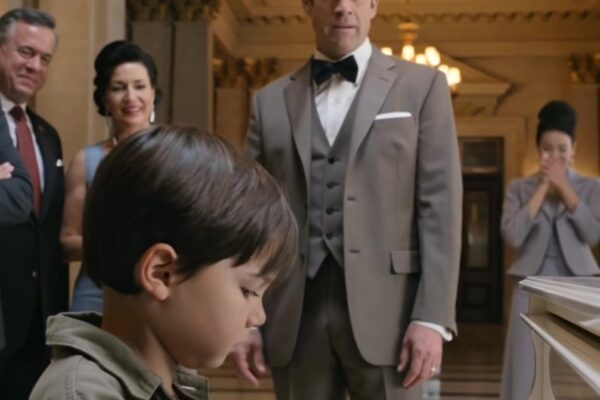
The auditorium smelled of floor polish and rain-damp coats. Rows of parents and teachers murmured under the banner that read ANNUAL SCHOLARSHIP HEARING, though it might as well have read TRIAL. Onstage, a long table waited with three microphones and a line of nametags, each one upright as a judgment.
At the edge of the curtain, Jonah Kline held an envelope in both hands as if it might bite. The paper was cheap, the kind that crumpled too easily, and his palms had already softened its corners. Someone backstage—an older student in a volunteer sash—whispered, “You sure you’re on the list?” like it was a courtesy, but the words landed like a shove.
When Jonah stepped forward, the spotlight found him with an unforgiving snap. It bleached the freckles across his nose and made the envelope glow. His shoes—too big, hand-me-downs—squeaked on the stage. He stood at the lone podium meant for applicants and looked out at the crowd as if he’d wandered onto the wrong planet.
One of the judges leaned toward her microphone, peering over glasses. “Name?” she asked, in the careful tone adults used when they were already prepared for a no.
“Jonah Kline,” he managed. His voice fluttered thinly, a bird caught in a hallway. A few heads turned. A man in the second row—sharp suit, sharper smile—tilted his chin and whispered to the woman beside him. Jonah didn’t need to hear the words to feel them: wrong kid, wrong place.
Judge Halvorsen, the principal, glanced at a folder and frowned. “Jonah Kline… I don’t have your application in the packet.” He lifted an empty hand, palm up, like the stage itself should produce proof. “Are you certain you were invited?”
Jonah swallowed. The envelope trembled harder, as if it had its own heartbeat. “I wasn’t,” he said. “Not exactly.”
The crowd shifted, a collective tightening. Someone coughed a laugh that died halfway. The principal’s eyes narrowed in that way that made students sit straighter. “Then why are you here?”
Jonah stared at the judges, then at the audience, and then down at his hands. “Because… I have something that belongs to the board,” he said. “And I didn’t know where else to bring it.”
There it was: the suspicion. It lifted like a curtain of its own. A teacher at the aisle reached for her phone, thumb ready. The suited man in the second row leaned back, pleased, as though he’d been waiting for the boy to stumble into a public mistake.
Judge Sato, the district representative, spoke softly. “You interrupted a formal hearing. If this is a prank—”
“It isn’t,” Jonah cut in, surprising himself with the sudden steel in his voice. He looked toward the wings, where the volunteer stood frozen. “I found it under the bleachers behind the gym. It was raining. It was… taped to the underside of the second bench.”
The principal’s mouth tightened. “Found what?”
Jonah held up the envelope. It wasn’t sealed with glue. It had been folded and refolded until the crease lines were white. Across the front, in block letters, someone had written: TO THE SCHOLARSHIP COMMITTEE — DO NOT OPEN UNTIL HEARING.
“That’s not official stationery,” Judge Halvorsen said immediately, relief flickering in his voice—as if unofficial meant harmless.
Jonah nodded, because that much was true. “I know. But my mom used to work nights cleaning this building,” he said, and he felt every eye on him now, sharp and hungry. “She taught me that if someone hides something where it could get soaked, it means they’re afraid it’ll be found. So I… I kept it dry.”
“Your mother,” someone whispered. Not kindly. Jonah heard the shape of the word—janitor—and saw how it moved through the audience like smoke.
Judge Sato tapped her pen. “Young man, you can turn it over to security after—”
Jonah’s hands clenched until his knuckles ached. “If I give it to security, it disappears,” he said, and he hated the tremor that returned to his voice. “It’s supposed to be opened now. That’s why it says that.”
The suited man in the second row raised his hand in a lazy half-gesture. “This is ridiculous,” he called out. “My daughter and every applicant here followed procedure. If this boy has a letter, it can wait.” His smile sharpened. “Or perhaps someone should ask how he got into the building.”
A ripple of agreement moved through a cluster of parents. Jonah felt the stage tilt. For a moment he saw himself from above—small, exposed, a child trying to hold back a storm with paper.
Then he remembered the rain.
He remembered the way the envelope had been pressed into shadow, the tape still sticky, as if whoever put it there planned to come back. He remembered the smear of mud on the edge that looked like a thumbprint.
“Please,” Jonah said, and the word cracked, not from weakness but from effort. “Open it. If I’m wrong, I’ll leave. I’ll never come back.”
Judge Halvorsen hesitated, the room balancing on his decision. He reached out at last, pinching the envelope with two fingers as if it might stain him. “Fine,” he said. “For the sake of ending this.”
He tore it open. A single sheet slid out, followed by something heavier that clinked against the podium—a small flash drive, scuffed and plain. The principal’s brow furrowed. He scanned the letter first, lips moving silently. The color drained from his face with each line.
Judge Sato leaned in. “What is it?”
Halvorsen’s hands shook now, mirroring Jonah’s earlier tremor as though the envelope had passed its fear to him. He pushed the letter toward the other judges. “This… this claims—”
“Read it,” Judge Sato said, sharper.
The principal cleared his throat, but the sound came out thin. “It states that scholarship deliberations have been… influenced. That donations were offered contingent upon selecting certain students.” He swallowed hard. “It names—”
The suited man in the second row straightened, the smile falling clean off his face. “That’s absurd,” he said, too quickly.
Judge Sato reached for the flash drive. “Does it have evidence?”
Jonah leaned closer, compelled by something beyond courage. “The letter said the recordings are on the drive,” he whispered. “It said to play them in public, so no one can bury it.”
For a heartbeat, the auditorium held its breath. Then Judge Sato nodded once, grim. She motioned to the tech coordinator near the sound booth. “Bring a laptop. Now.”
Suddenly the hearing was no longer a ceremony. It was a rupture. People sat up, elbows off armrests. Whispers became urgent threads pulling at the seams of the room. Jonah watched the suited man’s hands clench on his knees, his gaze flicking toward exits as if measuring distance.
The laptop arrived, cables snaking across the stage like veins. The flash drive clicked into place. A file opened. A pause—then a voice filled the speakers, muffled but unmistakable.
“We’re not funding a new lab unless your committee understands what we expect,” the recording said. “My daughter’s name is non-negotiable.”
A murmur rose into a shocked roar. The suited man went rigid, face flushing with sudden heat. The recording continued, another voice answering—one the students knew from announcements and pep rallies, warm and practiced, now cold with calculation.
“Consider it done,” the second voice said. “We’ll adjust the scoring rubric. No one will question it.”
Judge Halvorsen jerked back as if struck. The voice was his.
Everything that followed happened too fast and not fast enough. Phones appeared like a field of small bright eyes. Parents stood. A teacher near the aisle whispered, “Oh my God,” over and over as if saying it could make the sound untrue. Judge Sato slammed her hand on the table. “Stop the hearing,” she said into the microphone. “No one leaves. We are contacting the superintendent and the police.”
Amid the chaos, Jonah stood motionless, his hands suddenly empty, his skin buzzing as though he’d stepped too close to a power line. He had imagined this moment a hundred different ways—being laughed offstage, being hauled out by security, being punished for trespassing where his mother used to mop in silence.
He hadn’t imagined the room turning inside out.
He hadn’t imagined that telling the truth could sound like an explosion.
Judge Sato looked at him then, really looked, as if she was seeing him for the first time. Her expression wasn’t soft, but it was honest. “Jonah,” she said, voice steadying the air, “how did you know to bring this here?”
Jonah’s throat tightened. He thought of his mother, her tired hands wringing out a mop, the way she used to hum to herself in empty hallways. He thought of the little lessons no one applauded: how to listen, how to notice, how to do the right thing even when your knees shook.
“Because people like me,” he said quietly, “are usually invisible. And whoever hid that envelope was counting on that.”
Silence fell—not the comfortable kind, but the kind that makes room for something new. The suited man stared at the floor. Judge Halvorsen’s shoulders sagged under the weight of his own voice echoing from the speakers. Somewhere in the audience, a student began to cry, not from fear but from the relief of seeing the rules finally apply to someone powerful.
Jonah turned as if to leave, instinctively trying to shrink back into the wings where he belonged. But Judge Sato raised a hand. “Stay,” she said. “You did not interrupt this hearing. You corrected it.”
Jonah hesitated, then nodded once. The spotlight still burned hot on his face, but it no longer felt like an interrogation lamp. It felt, strangely, like daylight—uncomfortable, unavoidable, and real.
And in that harsh, honest light, the envelope that had seemed so small had managed to crack open an entire town’s carefully painted story.