The city looked washed clean by rain, every streetlight smeared into gold on the pavement. In the back seat of a midnight-blue sedan, Adrian Vale stared at his hands as if they belonged to someone else—hands that had signed deals, held champagne flutes, cut ribbons, waved from stages. Tonight, those same hands trembled.
On the seat beside him lay a slim black folder stamped with the crest of the Hartwell Foundation. Inside it was a single sheet of paper and a fountain pen. A pledge. Ten million dollars. Public. Irrevocable. The kind of number that made headlines and changed careers. The kind of moment that could rewrite the only story about Adrian Vale anyone seemed to remember.
“Five minutes,” his driver, Thomas, said, eyes on the road. “We’re going to make it, sir.”
Adrian exhaled sharply, trying to believe him. The gala at Hartwell was not simply a charity event; it was a battlefield of reputations, and he had chosen to show up unarmored. A year ago, a factory he’d bought and promised to modernize had burned down in a night of freak electrical failure. No one died, but the images—smoke, chaos, workers crying—had branded him as a man who profited from ruin. He could tell himself he’d done nothing wrong. He could hire lawyers to say it louder. None of it mattered. The only thing that might matter was what he did tonight.
The sedan turned onto a narrower street, hemmed in by shuttered shops and dripping awnings. Adrian’s phone buzzed—three missed calls from Hartwell’s director, two texts from his assistant asking where he was, and a final message that made his stomach tighten: They’re moving you up in the program. Donors are restless.
Thomas eased off the accelerator. “That’s odd.”
“What?” Adrian leaned forward.
“Temperature warning,” Thomas muttered, glancing down. “We were just serviced.” He tapped the dashboard, as if reprimanding it. The car gave an answering shudder, a sudden sputter that sounded like a cough from deep in its throat.
Adrian’s fingers closed around the folder. “Don’t do this,” he whispered, though he wasn’t sure if he meant the car, the city, or his own luck.
The sedan rolled another twenty yards and died at the curb with a soft finality, like a candle pinched out. Silence rushed in, thick and humiliating.
Thomas tried the ignition again. The engine clicked once, then refused. “I’m—” He swallowed. “I’m sorry, sir.”
Adrian stared out at the street. Rain fell in fine needles. A few pedestrians hurried under umbrellas, indifferent to the man stranded in a luxury car. Somewhere downtown, a room full of people was waiting for him to prove that he could be more than his headlines.
“How far are we?” Adrian asked.
Thomas checked the navigation. “A little under two miles. But with traffic—”
“Two miles isn’t far,” Adrian said, already reaching for the door handle. The chill hit him as he stepped out. Rain found the collar of his coat immediately.
Thomas climbed out as well, popping the hood and frowning into the steaming machinery. “Radiator hose looks cracked,” he said. “We can’t drive it like this.”
Adrian’s eyes lifted toward the hazy glow of downtown. He imagined the stage, the director’s tight smile, the murmurs. He imagined the empty space where he was supposed to stand. Ten million dollars would still be ten million dollars even if he arrived late, he told himself. But the moment—his moment—would be gone. People didn’t wait for redemption. They watched it happen or they moved on.
A thin voice cut through the rain. “Mister? You need help?”
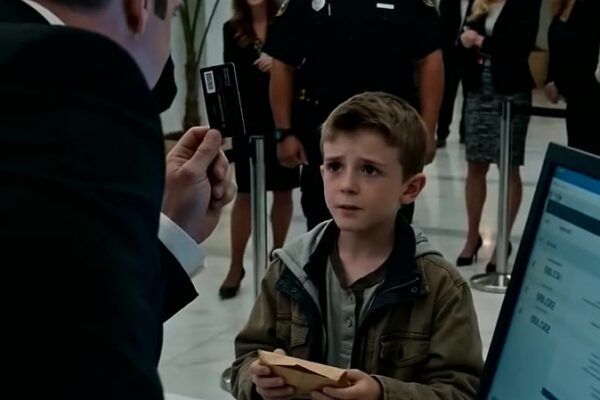
Adrian turned. A boy stood beneath the awning of a closed corner store, half-hidden behind a metal grate. He looked about twelve, maybe thirteen, with a backpack that seemed too heavy and a hood pulled low over his brow. His sneakers were soaked. He held a battered smartphone in one hand like a lifeline.
Thomas started to wave him off, but Adrian raised a hand. “We do,” Adrian said. “Our car broke down. We’re trying to get to the Hartwell building.”
The boy’s eyes widened. “The gala?”
Adrian’s jaw tightened. “Yes.”
“That’s by Riverfront,” the boy said, as if confirming a mental map. He glanced down the street, calculating. Then he pointed. “There’s a service alley behind this block. It cuts to the bike path along the canal. Bikes go faster than cars there. No traffic. You can get to Riverfront in… ten minutes if you hustle.”
Adrian blinked. “Bikes?”
The boy shrugged. “My uncle runs deliveries. He keeps two scooters in the back of the store.” He nodded toward the darkened shop. “Electric ones. I got the key.”
Thomas bristled. “Sir, we can’t—”
Adrian’s mind raced. A billionaire climbing onto a delivery scooter in the rain was a disaster waiting to become a viral clip. But then another thought followed, quieter and heavier: letting pride keep him from showing up at all would be worse. Tonight was supposed to be about showing up.
He looked at the boy. “What’s your name?”
“Eli,” the boy said. “Eli Mercer.”
“Eli,” Adrian said, making the name an anchor, “if you can get us there, I’ll make sure you’re not sorry you offered.”
Eli’s face didn’t change the way Adrian expected. There was no greedy spark, no eager grin. Just a quick, serious nod, as if helping was a job he had already decided to do. He ducked under the awning, slipped a key into a side door Adrian hadn’t noticed, and disappeared inside. A moment later, he returned pushing two narrow electric scooters with scuffed decks and taped handlebars.
“Helmets?” Thomas asked automatically.
Eli pulled two from his backpack, wrinkled and mismatched. “I bring them for my little sister. She doesn’t always listen.”
Adrian stared at the helmets, then at the rain, and felt something crack in him that had nothing to do with the radiator hose. He took one and strapped it on, feeling ridiculous and strangely light. “Lead the way,” he said.
Eli shot forward first, tires hissing on wet pavement. Adrian followed, Thomas close behind. They slipped into the alley Eli had mentioned, a ribbon of shadow between brick walls tagged with graffiti. Puddles reflected their headlights like broken mirrors. The alley opened onto the canal path, where the city’s noise dulled and the air smelled like water and metal.
Adrian gripped the handlebars tightly, suit pants clinging to his legs. He had spent years moving through places where everything was polished and permissioned. Here, he was just another figure in the rain, trying to arrive on time.
Eli navigated with uncanny confidence, dodging a trash bin, calling out potholes, signaling turns with his free hand. “Stay near the center!” he yelled over his shoulder. “The edges are slick!”
They passed under a bridge where the sound of rain multiplied. Adrian’s phone buzzed again, a call from the director. He ignored it, focusing on Eli’s back, on the boy’s steady trajectory through the wet dark.
As they neared Riverfront, the buildings grew taller and brighter. The Hartwell Foundation’s headquarters rose ahead, its glass façade glowing like a lantern. Outside, valet attendants hurried beneath umbrellas. A cluster of cameras pointed toward the entrance, hungry for arriving celebrities.
Eli slowed near a side street. “Front is crowded,” he said quickly. “If you go around—there’s a service entrance. My uncle delivers there sometimes.” He pointed to a narrow driveway that curved behind the building.
Adrian’s heart thudded. “Show me.”
They glided down the driveway, passing a row of dumpsters and a guarded door. Eli hopped off, ran to the keypad, and pressed the call button. “Delivery,” he said into the speaker with a confidence that didn’t belong to his age. “Urgent.”
A pause. Then the door clicked open.
Thomas exhaled in disbelief. Adrian stepped forward, clutching his folder. He turned back to Eli, who stood dripping under the building’s overhang, helmet askew, backpack straps cutting into his shoulders.
“Eli,” Adrian said, voice catching. “You just—”
“It’s fine,” Eli replied, as if it truly was. He glanced toward the bright lobby beyond the door. “You’re supposed to be in there.”
Adrian felt the weight of that sentence settle on him. Not the money. Not the cameras. The idea that a place had been waiting for him—and that a boy who owned nothing but a backpack and a key had decided he should not miss it.
He pulled out his wallet, then stopped. The gesture felt wrong, too small, too transactional. Instead, he opened the black folder and tore out a blank note sheet tucked behind the pledge. With the fountain pen, he wrote quickly, ink dark and decisive.
“This is my direct number,” he said, handing the paper to Eli. “And this is my promise: if you call me, I will answer. Whatever you need—school, your sister, your uncle’s store—call.”
Eli stared at the paper as though it might dissolve. “Why?” he asked, suspicion flickering at last.
Adrian swallowed. The rain tapped the metal overhang like impatient fingers. “Because you didn’t have to help,” he said. “And you did. Because you got me here when my own world failed me. And because I think… I think I’ve spent too long believing people only move when there’s something in it for them.”
Eli folded the paper carefully and tucked it into his pocket like it was valuable. “Okay,” he said, and it was the closest thing to gratitude he allowed himself.
From inside, a voice called, “Mr. Vale? Mr. Vale, is that you?”
Adrian turned and stepped through the door. Warmth rushed over him—light, perfume, the hush of carpet. The director stood there, eyes wide, relief spilling across his features. “You’re on in thirty seconds,” she whispered, grabbing his sleeve. “They moved you up.”
Adrian’s stomach clenched, but he nodded. As he was guided toward the stage, he glanced back through the glass. Eli was already pushing the scooters away, vanishing into rain and shadow as quickly as he’d appeared.
Adrian walked onto the stage to a swell of applause that sounded like a tide. Faces turned toward him—curious, skeptical, eager to judge. Cameras lifted.
He took his place at the podium, water still dripping from the edge of his coat. He didn’t wipe it away. Let them see the rain. Let them see the scramble. Let them see that he had arrived the hard way.
He opened the folder and found the pledge. His voice steadied as he spoke, not as a man defending himself, but as a man finally choosing something. “Tonight,” he said, “I’m here to make a commitment. Not just with money, but with presence. Because the truth is—I almost didn’t make it.”
A ripple of polite laughter moved through the room. Adrian paused, thinking of a boy with a backpack and two helmets.
“But someone helped me,” he continued, gaze sweeping the crowd. “Someone who had every reason to keep walking.” He signed his name with a firm stroke, ink sealing the promise. “And I’m going to spend the rest of my life trying to deserve that kind of help.”
Applause rose again, louder this time. Yet Adrian’s chest tightened—not from pride, but from the sharp, humbling knowledge of how close he’d come to missing it all. Outside, in the rain, Eli Mercer rode a scuffed scooter into the night, unaware that he had not only saved a millionaire’s biggest moment, but had quietly rewritten the kind of man that millionaire could become.