Rain hit the penthouse like it had a personal grudge. The glass walls trembled under each gust, turning the entire view of Paris into a smeared watercolor—Eiffel Tower lights bleeding into the river, headlights stretched into glowing worms. Inside, though, the Laurent family had engineered perfect weather: soft jazz, candlelight, and champagne that tasted like it had never met a budget.
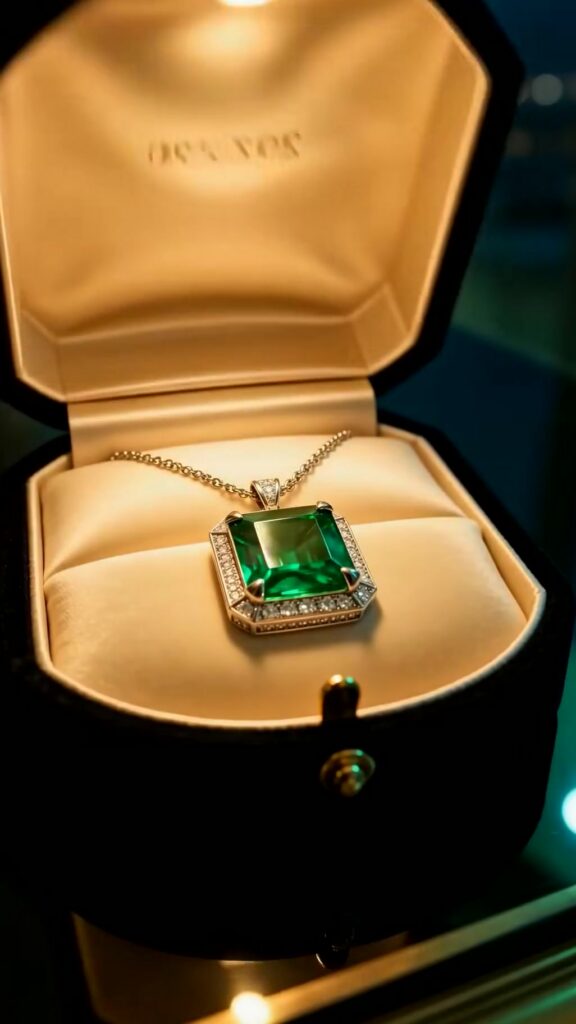
Sophia Laurent stood at the base of the grand staircase as if the marble had been carved around her. The staircase curled upward in two elegant arms, designed to make entrances look effortless and exits look tragic. She wore a black gown that could’ve started a war and an emerald necklace that usually ended them—one bright green stone on a chain fine enough to be a rumor.
Every camera drifted toward her. She didn’t even need to try. She had that kind of gravity. She smiled, kissed cheeks, let donors feel like they were helping save the world while secretly hoping they’d be invited to her next party. All the usual gala stuff: diamonds that blinked, laughter that never reached eyes, charity auctions where people bid like they were buying forgiveness.
“Sophia, darling,” purred Madame Besson from the museum board, “you look… radiant.”
Sophia gave the appropriate half-laugh. “It’s the lighting. We paid extra for benevolent lighting.”
Behind Madame Besson, servers floated through the room with trays of tiny edible sculptures. Everything was curated down to the last garnish. Even the rain felt expensive.
Then Sophia saw the maid.
Not a familiar face from the staff—a new girl, maybe. She moved like she was trying not to exist: shoulders tucked, chin down, eyes flicking from one guest to another like she expected someone to shout at her for breathing incorrectly. She wore the standard black dress, the kind of uniform designed to say, You may look at me but you may not remember me.
The girl carried a silver tray of champagne flutes. Her hands were steady but her expression wasn’t. She was young, early twenties at most.
And around her neck—
Sophia’s smile snapped off her face as if someone had cut the string.
The same emerald.
For a second, her brain refused to translate what her eyes were seeing. It was like spotting your own reflection across a crowded room, except the reflection didn’t move when you did.
The wine glass in Sophia’s hand slipped. It hit the marble and burst into sparkling shrapnel. The sound was sharp enough to slice the jazz in half.
Musicians stalled. Conversation wobbled. Every head turned toward the staircase. Cameras, always hungry, tilted for drama.
Sophia didn’t feel her feet move, but suddenly she was crossing the ballroom, her heels striking like punctuation.
“Where did you get that?” Her voice cracked across the silence.
The maid froze mid-step. A champagne flute trembled on the tray.
“Madame?” The girl’s accent wasn’t quite Parisian. Something softer. Rural. Or maybe just nervous.
“The necklace,” Sophia hissed, pointing as if pointing might make it stop being real. “That necklace. Who gave it to you?”
The maid stepped back, eyes wide. “I—I don’t know what you mean.”
Sophia reached for it without thinking, fingers closing around the chain at the girl’s throat. The maid flinched so hard the tray clinked. A few guests inhaled like it was their job.
“This is mine,” Sophia said, even though the words sounded wrong the moment they left her mouth. Because it wasn’t hers. Not in the way she’d always believed. It was a family piece. A story. A legacy. A thing that had been placed on her neck and told to mean destiny.
The girl’s eyes filled, tears swelling fast like she’d been holding them back for years. “It’s the only thing my parents left me,” she whispered. “I’ve had it my whole life.”
That should’ve been impossible. Sophia’s throat went tight.
People started whispering, the way the wealthy do when they can’t look away but want to pretend they’re above it. Someone’s phone rose slightly. Someone else lowered theirs, realizing Laurent security would eat it.
Sophia released the chain as if it burned. The maid sucked in a shaky breath, one hand flying up to protect the stone.
Sophia’s gaze darted toward the balcony doors where rain smacked glass. She didn’t see Paris anymore; she saw memory. A room with heavy curtains. A scent of lilies. A voice—her father’s voice—telling her she was the miracle that remained.
“Stay here,” Sophia said, not to the maid exactly, but to the air. Then she turned and went up the grand staircase like she was climbing out of a nightmare.
She moved fast. Too fast for someone who spent her life looking composed. Her gown snagged slightly on the carved banister; she yanked it free like it was an enemy.
Upstairs, the hallway was hushed and plush. She pushed through her bedroom doors and headed straight to the safe hidden behind a framed photograph. Her fingers shook so hard she almost mistyped the code. She could hear the gala below, muffled now—a swarm of curiosity.
The safe clicked open. Inside, rows of velvet and diamonds waited like obedient soldiers. Sophia grabbed a black velvet box and nearly dropped it.
When she returned downstairs, the crowd had formed a loose circle around the maid, who looked like she wanted to vanish through the marble floor. The musicians had stopped completely; even the rain sounded quieter, like it was listening.
Sophia stepped into the circle and held up the box.
“Everyone,” she said, voice low, “you’re about to think this is a trick.”
She set the box on the tray the maid still held, because it was the only flat surface that didn’t feel like surrender. Sophia flipped it open.
Click.
Inside lay an emerald necklace.
Identical.
Gasps rippled through the room. Madame Besson made a tiny noise like she’d swallowed a pearl. Someone whispered, “Mon Dieu.”
The maid stared as if her eyes couldn’t decide what to focus on: the jewelry, Sophia, or the sudden possibility that her entire life had been built on a lie.
“That’s not possible,” the girl said. Her voice sounded smaller than before, like it had stepped backward inside her throat. “I’ve never seen another one.”
Sophia’s hands trembled as she reached up and unhooked her own necklace. The emerald swung briefly like a pendulum deciding someone’s fate. She turned it over.
On the back of the pendant, tiny but clear, was an engraved date.
October 17, 2003.
Sophia swallowed hard and looked at the maid. “Turn yours over,” she said, almost gently now.
The maid’s fingers fumbled with the chain. She flipped the pendant, and her face drained of color.
Same date. Same fine engraving.
The room seemed to tilt. Sophia’s heartbeat became loud enough to compete with the rain.
“I was raised in a convent outside Limoges,” the maid said slowly, like she was reading words carved into her bones. “The sisters told me… I was left at their door as a baby. No note. No name.”
Sophia’s mouth opened but nothing came out.
“One nun,” the girl continued, voice shaking, “said the necklace was meant to be half a promise. She told me if I ever found the second one… I should ask why my mother’s grave is empty.”
Silence collapsed over the gala. Even the cameras stopped clicking, as if technology had manners for once.
Sophia felt the blood leave her face. Her father, Henri Laurent, stood near the staircase, watching with the stillness of a man trapped in his own portrait. His tuxedo was perfect; his expression was not.
The maid looked past Sophia, eyes landing on Henri as if guided by instinct. “Do you know what she meant?” she asked, barely above a whisper.
Henri’s hand tightened around his champagne flute. For a second, it looked like he might answer with one of his practiced speeches—something about misunderstanding, about appearances, about propriety.
Instead, the glass slipped from his fingers.
It hit the marble and shattered, echoing Sophia’s earlier accident like the room was keeping score.
Henri stared at the broken pieces, then at the two emerald necklaces lying side by side on the tray like matched evidence. His face didn’t just show fear; it showed recognition. The kind you can’t fake, because it comes from a place you’ve been trying not to visit for years.
“Papa,” Sophia said, her voice suddenly thin. “What is this?”
Henri’s throat worked. His eyes flicked to the crowd—board members, journalists, politicians, donors—then back to the maid, who looked like she might fall over if someone breathed too hard.
“We shouldn’t do this here,” he murmured, but it wasn’t denial. It was a plea for better timing. A plea for the truth to wait.
Sophia took a step toward him. “Tell me,” she said, the words edged with something sharper than anger. “Now.”
The maid’s hands clenched around the tray. “My name is Camille,” she said quietly, as if introducing herself might keep her from disappearing. “That’s what the sisters called me.”
Camille. Sophia repeated it in her mind and felt it settle in a place names didn’t usually go.
Henri’s eyes closed for a brief moment, like he was bracing for impact. When he opened them, they were wet.
“Because your mother…” he began, then stopped, as though the next word might bring the ceiling down. He looked at Sophia first. Then at Camille. Then at the two identical dates etched into emerald and metal, mocking him with precision.
Outside, the rain kept hammering the glass walls, relentless and loud, like the night itself was trying to break in and witness what the Laurents had hidden.
Henri drew a breath that sounded like surrender.
“The grave,” he said, voice cracking. “It’s empty because… she never stayed in it.”
And in the frozen hush of the glittering penthouse, with diamonds and fake smiles suddenly feeling like costumes, Sophia realized the charity gala wasn’t the event of the night anymore.
The real auction was about to begin.
And what was up for bid was the truth.