“Let go of me! You’re not my dad!”
The words sliced straight through the mall’s background noise like someone had yanked the volume knob to max. The fountain in the center kept burbling, the pop song from a clothing store kept thumping, but for a second the whole place felt like it held its breath.
Maya froze halfway out of the pretzel line, salt on her fingers, cinnamon sugar smell in her face. She’d been debating whether to get the big one or the one filled with cheese, which is a very serious decision until a little girl is screaming like the floor has turned to lava.
A man in a gray hoodie had the girl by the wrist. Not a normal “we’re late for soccer practice” hold. His grip looked like a handcuff. The kid—maybe seven, eight—was twisting and pulling and trying to plant her sneakers on the shiny tile like she could root herself into it. She couldn’t. He dragged her anyway, fast, too fast.
“Stop! Stop!” she shouted, voice cracking on the second stop like she’d run out of air and hope at the same time.
The man didn’t even look stressed. That was what made it weirder. He threw a quick smile over his shoulder, like the mall was an audience and he’d done this scene before. “She’s fine,” he called out. “Tantrum. You know kids.”
People did that thing people do. They looked. Then they decided they didn’t want the responsibility of what they’d just seen. A guy with a smoothie stared at his shoes. A couple pushing a stroller veered around like they’d come across spilled soda. Phones came out, because recording is safer than intervening, apparently.
Maya’s throat went dry. Her first thought was stupid: Maybe it is her dad. Her second thought was less stupid: Then why is she saying he isn’t?
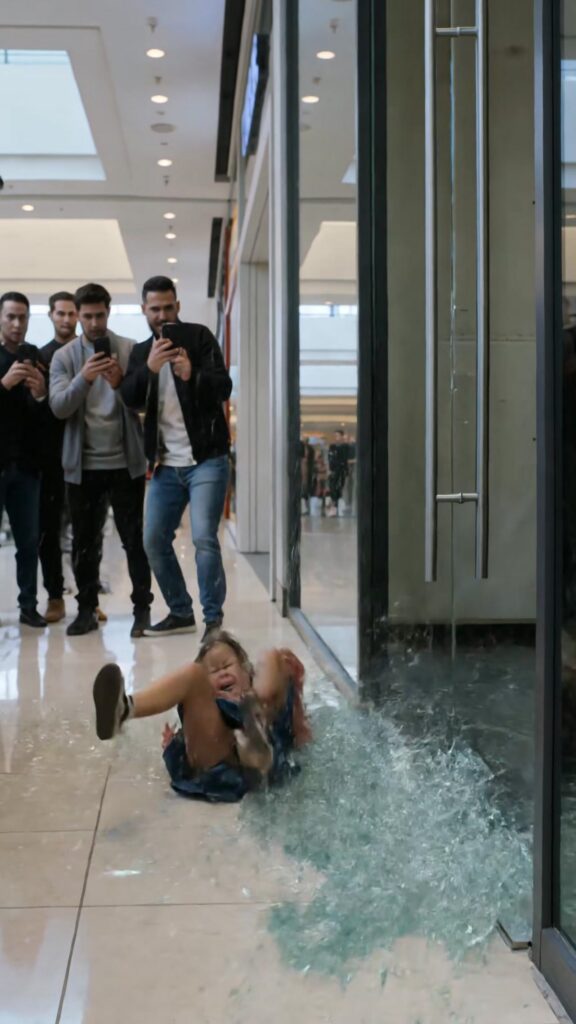
The girl tried to yank her arm back and stumbled sideways. Her shoulder clipped a glass storefront—one of those kiosk-style boutiques with walls made entirely of shiny, breakable confidence. The man yanked harder. The girl’s body hit the glass with a sound that made Maya flinch before the shatter even happened.
It went off like a thin, ugly explosion. Glass glittered across the tile in jagged confetti. Somebody gasped. Somebody screamed. Somebody laughed—an awful, nervous little bark that didn’t belong anywhere near a child in danger.
The man cursed under his breath, kept his grip, and leaned in as if lowering his voice could erase the scene. “Come on,” he hissed. “We’re going.”
“You’re not my dad!” the girl screamed again, louder now, rawer. Her free hand reached out, fingers splayed toward strangers who suddenly had very important appointments with the air above their heads.
Maya finally moved. Not hero-style. More like her body got tired of watching her brain argue with itself. She stepped out of line, pretzel forgotten, and started walking toward them.
And then she noticed someone else doing the same thing.
He came from near the escalators, moving like he had all day. Mid-forties, plain jacket, jeans, tired sneakers. The kind of guy you’d assume was here to return a phone case that didn’t fit. But his eyes were locked on the man in the hoodie like nothing else existed.
He didn’t rush. That was what made the air change. You could feel it. A quiet pressure. Like when thunder is still far away but the hair on your arms starts to lift anyway.
The hoodie guy noticed him too. His shoulders tightened. His head turned just slightly, as if he was checking exits without admitting he was checking exits.
The approaching man stopped close—close enough that the hoodie guy had to tilt his chin up to keep eye contact. Not aggressive. Just… planted.
“Take your hand off her,” he said.
Not loud. Not dramatic. The kind of voice that didn’t need volume because it assumed compliance.
The mall around them dipped into a hush. Even the music felt quieter, like the speakers were embarrassed.
“Mind your business,” the hoodie guy snapped, but the words came out with a wobble. He tightened his grip again, as if he could squeeze the moment back into control.
The man in the plain jacket didn’t blink. He reached into his own jacket slowly, the way you do when you’re trying to keep a situation from tipping into chaos. For a heartbeat Maya’s stomach dropped—because you never know what someone’s pulling out. Phone? Weapon? A random receipt? Anything can change the temperature in a room.
He pulled out a wallet. Flipped it open. A badge flashed under the overhead lights.
The hoodie guy’s color drained so fast it looked like someone had switched him to grayscale. His mouth opened, closed, opened again, and nothing intelligent made it out.
The little girl, mid-sob, froze. Her eyes locked on the badge like it was the first solid thing in a world that had turned slippery.
“…He found me,” she whispered, like she couldn’t believe it was real.
The man with the badge angled his body subtly between the hoodie guy and the girl, like a shield that didn’t have to announce itself. “Sir,” he said, calm as ordering coffee, “let her go. Now.”
The hoodie guy tried one last performance smile, but it came out crooked. “This is my kid. She’s—she’s acting up. Ask her—”
“What’s her name?” the badge man asked.
The hoodie guy blinked too many times. “Uh. Lily.”
The girl shook her head violently. “No! I’m Mia! I’m Mia!”
“Wrong,” Maya heard herself say, and realized she’d spoken out loud. Her voice sounded tiny compared to everything else, but it felt like dropping a pebble into a still pond. Other pebbles followed.
“Yeah, that’s not her,” someone else muttered. “My niece is named Lily and she doesn’t look like—”
“Call security,” a woman said sharply, like she’d just remembered she had a spine.
“I already did,” said a man with his phone up, still recording, but at least now his thumb was moving.
The badge man didn’t take his eyes off the hoodie guy. “You’re going to release her wrist,” he said. “Then you’re going to put your hands where I can see them.”
“You can’t tell me—” hoodie guy started, but the badge man’s stare cut the sentence in half.
Behind them, footsteps pounded. Mall security came running, radios crackling, faces suddenly serious in that late-to-the-party way.
For half a second, Maya thought the hoodie guy might bolt. But he was boxed in by people who’d finally decided to exist. A crowd had formed—not a circle of distance anymore, but a wall.
His fingers loosened. The girl’s arm slipped free. She stumbled backward and the badge man caught her gently by the shoulders, guiding her away from the glittering glass shards.
She looked up at him with wet cheeks and a shaking chin. “Are you… are you really—”
“I’m Officer Reyes,” he said, softer now. “And you’re safe.” He glanced toward Maya and the others. “Can someone grab a jacket? Something to wrap around her?”
Maya shrugged off her cardigan without thinking and stepped forward. Her hands trembled as she draped it around the girl’s small shoulders. The kid clutched it like it was armor.
Security grabbed the hoodie guy. He started yelling again—different lines now. That it was a misunderstanding. That people were crazy. That he was being harassed. The words sounded empty, like a script he hadn’t practiced enough.
Maya watched his face while he talked and realized something that made her stomach twist: he wasn’t angry because he’d been caught. He was angry because it hadn’t worked.
Officer Reyes crouched to the girl’s level. “Mia,” he said, using her name like it mattered, like it anchored her. “Where’s your mom? Who were you here with?”
She swallowed hard. “My mom was… buying shoes. I was at the fountain. I dropped my bracelet and—” Her voice wobbled. “And he said he knew her. He said she told him to get me.”
Reyes nodded once, like he’d heard versions of this lie too many times. He touched his radio. “We’ve got a child separated from parent. Start a lockdown. Find mom near footwear.” Then, to Mia, “You did the right thing. You were loud. You fought.”
Mia blinked at him, still shaking. “Nobody… nobody helped at first.”
The sentence hung there, uncomfortable and true. Maya felt heat crawl up her neck.
Reyes didn’t shame her, or anyone. He just said, “I’m sorry. But you being loud made it harder for him. It bought time.” He looked up at the crowd, voice steady. “If you see something like this, don’t just film. Make noise. Ask a question. Get security. Stand close. Predators hate attention.”
Sirens began to wail faintly outside, getting closer. The mall lights kept shining like nothing had happened, but everything had changed anyway. The crowd that had looked away minutes ago now stood too close, offering tissues, offering water, offering shaky apologies that didn’t quite fit.
Maya stayed beside Mia, cardigan still around her, and thought about how thin normal life was. How fast it could crack like glass.
Mia lifted her chin, still trembling, and repeated the sentence that had started it all—quietly this time, not as a scream but as a promise to herself.
“You’re not my dad.”