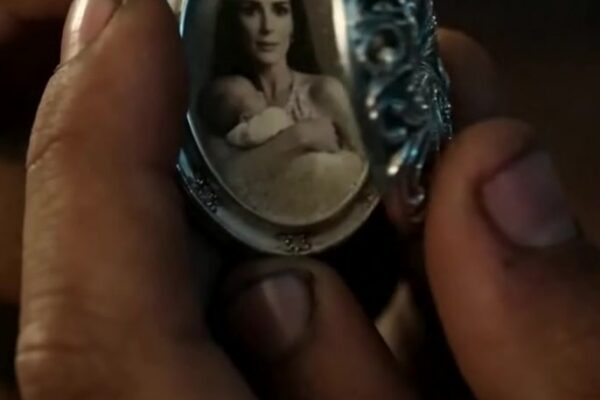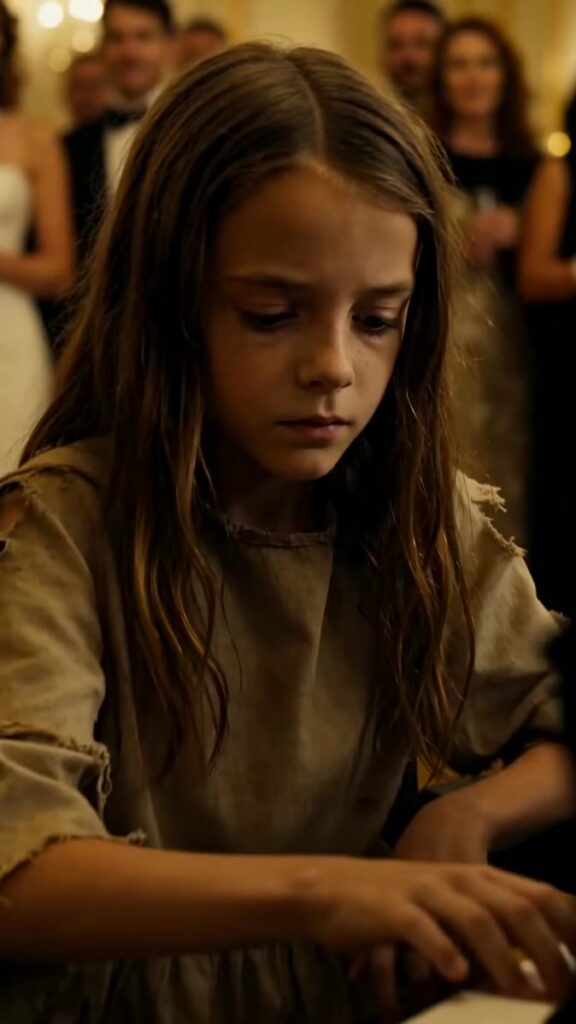
The ballroom was still frozen in that impossible silence. Not the polite kind that follows a performance, where people hold their applause for half a second so they can look classy. This silence had weight. It pressed down on the champagne flutes and the velvet drapes and the giant chandelier that looked like it had opinions.
The last note from the piano was still technically in the air, but somehow it felt like it had landed. Like it had decided to sit on everyone’s shoulders and stare.
At the front of the room, inches from the glossy black grand piano, Adrian Vale—yes, that Adrian Vale, the finance guy with the grin that could sell sand to a beach—stood with one hand braced on the instrument’s edge. His tux was perfect. His hair was perfect. His face was not.
It wasn’t just surprise. It was that hollowed-out look people get when a memory they’ve buried digs itself back out and stands right in front of them, wearing a nice dress.
The girl at the piano didn’t move. She sat in her wheelchair like she’d been carved there on purpose. Her fingers hovered a few inches above the keys, not trembling, not relaxed either—just suspended, as if gravity was negotiating with her.
The crowd was a blur of diamonds and cufflinks and expensive perfume. People who normally breathed like the world owed them oxygen were holding their lungs tight. Even the hired string quartet at the side had forgotten how to look casually employed.
Adrian’s voice came out thin, like it had to squeeze past something stuck in his throat.
“What is your mother’s name?” he asked.
That question was a match in a room full of gas. You could feel everybody lean forward without meaning to. Someone’s bracelet clinked. Someone else’s laugh died halfway through being born.
The girl lowered her hands slowly. Her black gloves made her look like she belonged to the piano, like she’d been part of it for years. She turned her head just enough to look at him—straight, quiet, and totally uninterested in playing his game.
“She never told me your name was worth remembering,” she said.
Adrian flinched. It wasn’t dramatic, but it was real. The confident posture cracked. The easy charm vanished like it had been switched off. For the first time all evening, he looked less like the host and more like a man caught in a photo he didn’t know was being taken.
The night had started as a charity gala—an auction, a dance, a performance. The kind of event where people donate money and get applauded for it, which is basically capitalism’s love language.
The girl had been introduced as “our special guest performer,” like she was a garnish on the evening. A prodigy, they said. A scholarship student from the city conservatory. A miracle. Adrian had smiled widely while saying her name, like he personally invented generosity.
“Mira Sato,” the emcee had announced. “A gifted pianist with an extraordinary story.”
Mira had rolled onto the stage alone, no assistant, no fuss. The room had clapped because they were supposed to clap. Then she’d placed her fingers on the keys and made the whole place forget how to pretend.
Her piece wasn’t the usual elegant background music. It had sharp turns and sudden drops, like the sound of running down a stairwell in the dark. At first it seemed chaotic, then it started to feel… familiar. Like a melody from a childhood Adrian didn’t want to admit he had.
Now, with the music ended and the question asked, that familiarity was standing in the open with nowhere to hide.
Adrian swallowed. His eyes flicked to the crowd, then back to her, as if searching for an exit nobody else could see.
“Who are you?” he asked, and it came out rougher than he meant.
Mira’s expression didn’t change. She didn’t look angry. That was the weird part. She looked focused, like she’d practiced this moment more than the music.
“I’m the kid who grew up with a lullaby that didn’t match any record,” she said. “The kid who watched her mom close her eyes when a certain name showed up on the news.”
A few people in the crowd shifted. A woman in a silver gown fanned herself too fast. Someone whispered “Oh my god” like it was a reflex.
Adrian tried to laugh, but it sounded like he’d forgotten the mechanics. “This is… this is inappropriate,” he said. “This is a fundraiser.”
“I know,” Mira replied. “That’s why I’m here.”
She reached into the side pocket of her wheelchair and pulled out a folded program. Not the glossy one from tonight, but a cheap paper pamphlet, creased and softened from being handled too many times. She held it up just enough for Adrian to see, then set it on the piano’s lid like she was placing a verdict.
Adrian’s eyes locked on it. He didn’t touch it. He didn’t have to. Whatever was printed there had already punched him in the memory.
“My mom played at a hotel lounge,” Mira said. “Before I was born. She wasn’t famous. She didn’t have a stage with chandeliers. She had a corner by the bar and a tip jar.”
Her voice stayed soft, but every word landed clean. It didn’t need volume. The room was giving her everything.
“One night,” she continued, “a man came in. Too much cologne. Too much confidence. He asked for a song. Then he asked for her time. Then he asked for things he thought money could buy.”
Adrian’s jaw tightened. His hand slid off the piano, as if the instrument suddenly burned.
“She said no,” Mira said. “So he smiled and told her he loved strong women. And later he told her he could make sure she never played in that city again.”
The crowd made a noise—a collective inhale that didn’t quite become a gasp. People were looking at Adrian now like he was a painting they’d just realized was counterfeit.
He tried to step closer, to lower his voice like he was about to handle this privately. Mira’s gaze stopped him. Not with anger. With certainty. It made him hesitate the way people do at the edge of a ledge.
“This isn’t true,” he said, but his eyes betrayed him. They looked like they recognized the story too well.
Mira shrugged slightly. “Maybe. Maybe my mom was lying to herself when she blamed one man for everything that happened after. Maybe it was just bad luck that she lost her job. Maybe it was a coincidence she couldn’t get hired anywhere within a hundred miles.”
She tapped one finger on the piano lid, gentle as a metronome. “Or maybe someone made a phone call.”
Adrian’s mouth opened, then shut again. He glanced toward the back of the room where his security team stood, but they weren’t moving. Not because they couldn’t. Because they didn’t know how without looking like villains.
Mira continued, calm as rain. “She never wanted revenge. She wanted me to be safe. She taught me to keep my head down. She taught me to play like nobody was watching.”
Her eyes held his. “Then she got sick. And when you’re in a hospital room at three in the morning, listening to machines breathe for someone you love, you start thinking about all the parts of your life that were stolen. You start wondering who took them.”
Adrian’s voice cracked. “What do you want?”
Mira’s answer was immediate. “I want you to hear it.”
She placed her hands back on the keys. The room flinched like it expected an explosion. But the notes that came out were quiet, almost simple—an old melody dressed in new clothes. It sounded like a lullaby trying to pretend it wasn’t sad.
Adrian’s face changed with every bar. Recognition wasn’t a gentle thing. It arrived like a storm. His eyes shone, and for a second he looked young in the worst way, like he’d been dragged back into a version of himself he’d spent years paying to forget.
“She wrote that,” Mira said over the music, not stopping. “My mom. She played it for me when I couldn’t sleep. She said it was for the part of her that kept going even when she didn’t want to.”
She hit a chord that rang through the room like a bell. “You asked her for a song that night, didn’t you?”
Adrian’s breath hitched. The silence around them didn’t break; it sharpened. Phones were out now, held low but recording anyway, because people couldn’t help themselves. Exposure had its own gravity.
Mira finished the piece with a final note that didn’t resolve. It just hung there, unfinished on purpose.
Then she looked at Adrian and said, “Now you know her name is the one that matters.”
Adrian stared at her like he’d been waiting his whole life to be confronted and never believed it would actually happen. The host of the gala. The man who bought applause. The man who thought money was insulation.
In that impossible silence, the ballroom finally understood the shift. This wasn’t entertainment anymore. This wasn’t a performance to make donors feel generous.
This was a ledger being opened in front of everyone.
And the first entry had just been read out loud.