The street looked like something out of a dream, like somebody had dialed the saturation up on reality and then sprinkled it with petals just to be rude about it. Spring was doing the absolute most. Pink blossoms overflowed from balcony planters like frosting, and a soft wind kept knocking loose little confetti flurries that spun through the gold, late-day sunlight. The cobblestones held warmth in their cracks, and somewhere a window was open with music drifting out—old jazz, the kind that makes you think of a movie even if you’ve never watched it.
I’d only come down here for bread. That was the plan. Bread, maybe a coffee if I felt fancy, then back to my tiny apartment where the radiator hissed like it had personal beef with me. But when I turned the corner onto Via dei Lirici, everything felt… tilted. Not in a dizzy way. In a “you’ve stepped into a memory you don’t own” way.
People had gathered in a loose half-circle without anyone announcing anything. They stood with that hesitant posture you get when you’re not sure if you’re allowed to be there. Nobody was talking much. Even the kids weren’t shrieking. You could hear shoes scuffing softly, the occasional cough, the hush of petals landing on coats.
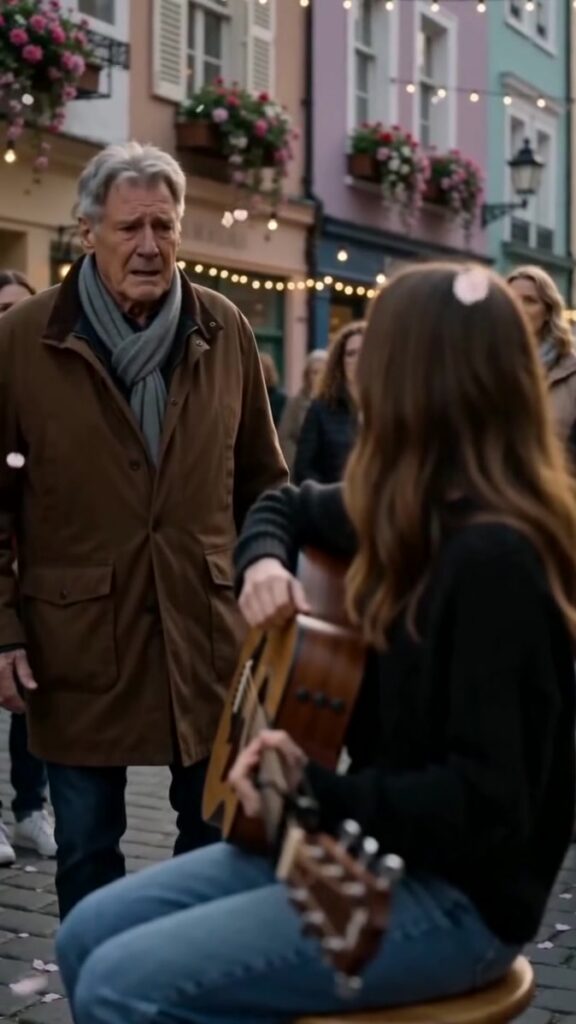
In the center sat a young woman on a plain wooden stool, the kind cafés keep stacked in the back. She wore a black sweater that looked borrowed from someone taller, sleeves sliding down her hands. An acoustic guitar rested against her like it was the only solid thing in the world. A small microphone on a stand leaned toward her mouth. Her eyes were closed, lashes dark against her cheeks, and her face was calm in the way you get when you’re somewhere else entirely.
Her voice wasn’t big. It wasn’t trying to impress anybody. It was fragile, almost like she was singing around a crack in herself and hoping it wouldn’t split wider. The melody moved through the street and caught on the stone, the balconies, the open windows. It threaded between people’s ribs. I felt it in my teeth.
Then she reached the last line. She held it so softly it barely qualified as sound, like she was leaving it for whoever needed it most.
“Come back home to me…”
She let it go, and the line didn’t so much end as hover. The silence afterward had weight. A few people clapped, carefully, like they were testing whether the moment would shatter. Someone whispered, “Brava,” but even that felt too loud.
The woman opened her eyes slowly. She smiled the way you do when you’re tired but trying to be polite anyway, then leaned toward the microphone. “Thank you,” she said. One simple word, and she sounded more awake.
And then she froze.
I didn’t notice the man at first. He was at the edge of the crowd, half in shadow, like he’d been painted in later. Older, still as a statue. Brown coat that looked like it had seen decades, gray scarf wrapped high even though the air was mild. He wasn’t clapping. He wasn’t smiling. He stared at the singer like she was a ghost who’d just spoken his name.
His eyes shimmered. Not dramatic-movie shimmering either—more like he was losing a fight he’d been winning for a long time.
He moved. Slowly. Like each step cost him a memory.
The crowd parted without anyone saying a word. It was weird how automatic it was, like the street itself made room for him. Even the open-window jazz seemed to fade, as if whoever was inside turned the volume down out of instinct.
He stopped right in front of the singer. Up close, his face looked carved by weather—lines around his mouth, a crease between his brows that didn’t relax. His hands hung at his sides, fingers trembling like they wanted to reach and didn’t dare.
For a long moment, neither of them spoke. She sat very still with her guitar, shoulders tight. He swallowed so hard I saw it.
“I’m sorry,” he whispered. His voice scraped, unused. “That song… where did you learn it?”
Her fingers tightened around the neck of the guitar. “My mother used to sing it,” she said. Her voice was steady, but her eyes were suddenly sharp, alert in a way they hadn’t been during the song.
Something in the man’s face broke. Not loud. Not messy. Just a crack that let everything through. His breath hitched.
He stepped closer. “What was her name?”
The street went quiet in a way that made my ears ring. I realized I was holding my bread bag so hard it was crinkling like a warning.
The woman’s lips trembled. “Her name was Eliana,” she said finally, and the name came out careful, like it was fragile too. “But everyone called her Eli.”
The man’s eyes shut for a second, as if the name physically hurt. When he opened them, they were wet. “Eli,” he repeated, and it sounded like he’d been carrying it in his mouth for years, afraid to say it out loud.
The woman—Eli’s daughter—tilted her head. “Do you… know her?”
He laughed once, but it was hollow. “I knew her,” he said. “I was supposed to keep knowing her.” He looked at the guitar like it might explain things. “That song was ours. Not like—” He waved a hand awkwardly. “Not like ownership. Like… it was a promise.”
A few people shifted, uncomfortable, but nobody left. It felt like leaving would be wrong. Like the street had turned into a little theater and we’d all been assigned roles as witnesses.
The singer swallowed. “She told me the song came from ‘someone who didn’t come back,’” she said. She tried for casual, but it didn’t land. “She never said his name. She didn’t talk about him much. Just—” Her shoulders lifted and fell. “Just that he liked cinnamon coffee and couldn’t stand the sound of bells.”
The man flinched. “Bells,” he murmured, and stared down at his hands. “That’s me.”
He took a breath, then another, like he was trying to pull words from the bottom of a well. “My name is Matteo,” he said. “I—” He stopped, and for a second I thought he might leave, might crumble, might do anything except finish. But he forced it out. “I left the city the year she got pregnant. Not because I wanted to. I was… stupid. Angry. Certain I knew how the world worked.”
The singer didn’t blink. “She said you chose the world over her,” she replied, and the way she said it made the sentence heavy with years of listening to the same story.
Matteo nodded, like he deserved it. “That’s what it looked like,” he said softly. “The truth is less romantic. My father got sick. I had debts. I took work far away. I told myself I’d come back in a month. Then a month turned into…” He spread his hands, helpless. “Time. Shame. A habit of not returning.”
She stared at him, and I watched anger and curiosity battle across her face. “Why now?” she asked. “Why show up on a random street while I’m singing?”
Matteo’s eyes lifted to hers. “Because I didn’t know you existed,” he said, and his voice cracked. “Not for sure. I heard rumors once, years ago, and I couldn’t… I couldn’t face the idea that I’d hurt her that badly. But last week, I walked by this street and heard you rehearsing through a window. Just a few notes. And it was like someone hooked a finger into my chest and pulled.”
The singer’s throat moved. “My mom died two winters ago,” she said. The words came out blunt, like she’d said them a hundred times and still didn’t believe them. “She didn’t leave a lot. Just a box of letters she never sent.”
Matteo’s eyes widened. “Letters,” he breathed.
She nodded once. “All addressed to Matteo Ricci.”
The man’s hands flew up to cover his mouth, and for the first time he looked small. The crowd made a collective, quiet sound—nothing specific, just the human reaction to a truth landing hard.
The singer exhaled, shaky. “I didn’t open them for a long time,” she admitted. “It felt like reading someone else’s heartbeat. But eventually I did. And I found the song in there too. She wrote the lyrics on the back of a café receipt. She said it was the only thing that made her believe you might return.”
Matteo’s eyes squeezed shut. “Eli,” he said again, like a prayer.
The singer looked down at her guitar, then up at him. “I’m not sure what you want from me,” she said. “I don’t know you. I grew up with her and her stories and her silences. You’re… a stranger in a brown coat.”
He nodded slowly, accepting the label like a punishment. “I don’t want forgiveness,” he said. “I don’t even know if I deserve to ask. I just—” He swallowed. “I want to hear about her. And if you ever want to know about me, I’ll tell you. I’ll answer anything. I’ll sit on this street every day if that’s what it takes.”
The singer held his gaze. For a second, she looked exactly like her mother must have looked, the same stubborn line in the mouth, the same soft eyes that didn’t give in easily.
“My name is Lucia,” she said at last. “And if you’re lying to me, I swear I’ll write a song about it so embarrassing you’ll never recover.”
A few people laughed, relieved to have permission to breathe again. Matteo’s mouth trembled into something like a smile, damp with tears. “Fair,” he said. “I deserve that too.”
Lucia shifted on the stool. “Sit,” she told him, pointing to the low stone planter by the café. “And don’t interrupt. I’m going to sing it again. Not for the crowd.” Her fingers found the strings. “For her.”
Matteo sat like he’d been ordered by a judge. The crowd stayed, but it felt different now—less like an audience, more like a wall of quiet protection around something raw.
Lucia closed her eyes. The first chord rang out warm and familiar, and the dream-street seemed to lean in closer. Petals drifted down, slow as snowfall. The sun slid lower, setting the cobblestones on fire.
And when Lucia sang, Matteo didn’t clap. He didn’t smile. He just listened as if the song was a door and he’d finally found the courage to step through.
Somewhere, in the hush between notes, it felt like someone did come home.