The woman looked like the rain had been chasing her for days. Not the normal kind of “oops, I got caught in it” rain, either. This was the kind that felt personal, like the clouds had a grudge and she’d been losing arguments with the sky since Monday.
She pushed into Rafi’s Jewelry & Repair with a shoulder, because both hands were busy keeping her hoodie from dripping all over the display case. The bell over the door gave a tired little chime. The shop smelled like metal polish, old velvet, and the cinnamon tea Rafi always forgot until it turned lukewarm and bitter.
Rafi didn’t look up right away. He was squinting through a magnifier at a ring that had lost a stone, hands steady the way they had to be when you made tiny things matter. Outside, the rain hammered the window like it was trying to get in and finish the job.
“We’re closing in fifteen,” he said, still not looking.
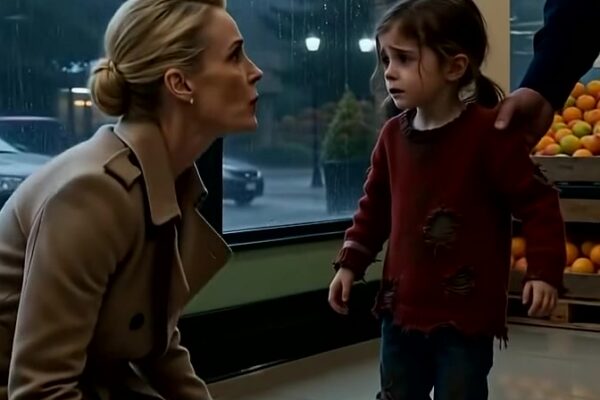
The woman stepped closer. She had torn jeans, mud at her knees, and that hollowed-out look that people wear when they’ve been awake too long for reasons that don’t include parties. Her hair was plastered to her cheeks. She didn’t sit. She didn’t browse. She moved like someone who had already had the “maybe” beaten out of them.
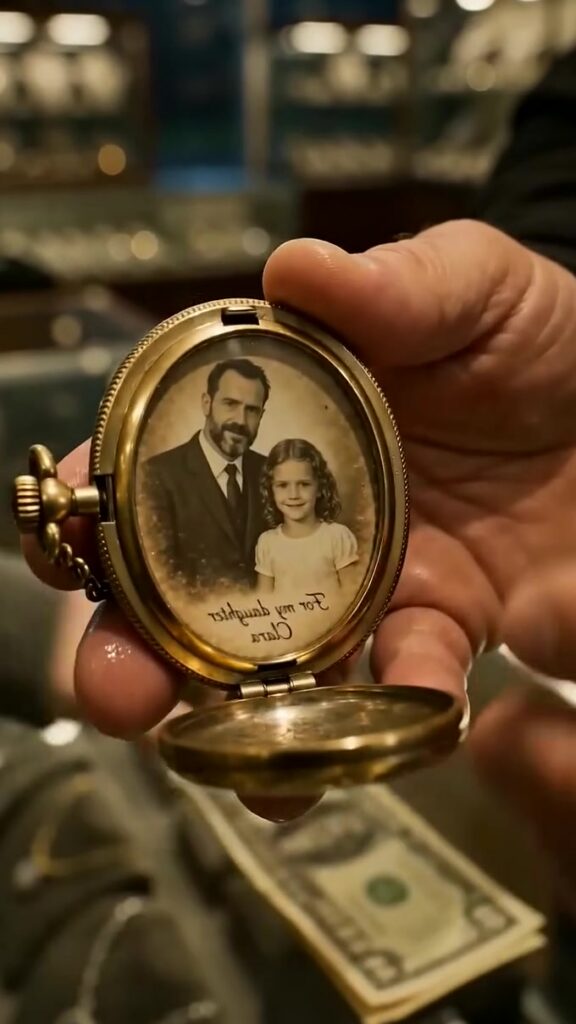
She set something on the glass. A gold necklace, the chain fine and clean despite everything else about her. At the center hung a locket—old-fashioned, oval, the kind you see in family pictures or in movie scenes where someone dies dramatically. It landed with a soft, decisive clink.
“How much?” she asked.
Rafi finally raised his eyes. His first thought, mean and automatic, was that it was stolen. His second thought, quieter and worse, was that he’d still buy it because rent didn’t care about moral dilemmas. He’d heard sob stories from liars and sincere confessions from people he wished had lied. Desperation was common currency.
He picked up the necklace, turning it between thumb and forefinger. The hinge on the locket was worn but not loose. The gold had that warm, heavy glow that didn’t come from plating. Real.
“Fifty,” he said, without letting himself feel anything. “That’s my offer.”
Her mouth twitched like she might argue, but she didn’t have the strength for it. She swallowed. “Okay,” she said. “Deal.”
He reached under the counter for the cash box. His hand already knew the motion: open drawer, count bills, slide them out like a magic trick no one clapped for. He set the money on the glass.
She took it so fast it was almost rude, then seemed to remember manners were a thing people with time could afford. “Thanks,” she muttered. Not looking at him, not looking at the necklace either.
Rafi held the locket a second longer. Something about it wouldn’t let go of his attention. It wasn’t guilt. It was familiarity in the bones, like a song you can’t name but you know you’ve cried to.
He clicked it open.
The shop went strangely quiet, like even the rain paused to listen. Inside was a photo, aged and slightly faded: a man holding a little girl on his shoulders. The girl’s grin was enormous, the kind that makes you believe the world is safe. The man—older, beard scruffy in a soft way—had laugh lines he didn’t wear anymore.
Rafi’s lungs forgot what they were doing. He knew that picture because he’d taken it. Years ago at the pier, his daughter shrieking with joy as gulls tried to steal her fries.
Beneath the photo, on the inner rim of the locket, an engraving ran in tiny letters: For my daughter Clara.
He heard himself make a small sound, like someone stepping on a floorboard in a dark room. His fingers tightened around the locket so hard the edges bit his skin.
“Hey,” he said, but his voice was wrong—thin, rough, like it belonged to a stranger. “Wait.”
The woman was already turning toward the door. Rain flashed white in the streetlights outside.
Rafi slapped the counter aside and rushed around it, nearly tripping on the old rug he always meant to tape down. He yanked the door open and the rain hit him like a punishment.
“That necklace,” he shouted over the storm. “It belongs to my daughter. My missing daughter.”
The woman stopped in the doorway, half in the shop’s warm light, half in the cold wet night. Her shoulders went rigid as if she’d been grabbed.
For a moment she didn’t turn. Rafi could see water streaming off her sleeves in steady lines, like she was melting.
When she finally faced him, her eyes were wide and terrified, but not confused. She looked like she had expected this moment the way people expect an overdue bill.
“If Clara is your daughter,” she said, each word careful like she was stepping around broken glass, “then why did she make me promise never to bring this back to you?”
Rafi’s heart punched against his ribs. “What are you talking about?”
The woman glanced up and down the street as if she expected headlights to swing around the corner at any second. “I can’t—” She pressed her knuckles to her mouth. Rain kept hitting her face, but she didn’t blink it away. “I didn’t steal it. She gave it to me.”
Rafi’s throat tightened. He hated how much he wanted to believe her. Hope was a drug you relapsed on without noticing.
“Where is she?” he demanded, and then, softer, because his voice cracked: “Is she alive?”
“Yes,” the woman said immediately, too quickly. “Yes. She’s alive.”
Rafi’s knees threatened to fold. He grabbed the doorframe to stay upright. The shop’s bell tinkled behind him in the wind, bright and useless.
“Then take me to her,” he said.
“I can’t,” the woman whispered, and her eyes filled, not with rain this time. “You don’t understand. She doesn’t want you to find her.”
Rafi laughed once, sharp and ugly. “She was nine when she disappeared. Nine-year-olds don’t just decide to vanish.”
The woman flinched at the word disappeared, like it was a slap. “She didn’t vanish,” she said. “Someone took her. And then… someone kept her.”
Rafi’s mouth went dry. He felt the old years of searching—flyers, police stations, false tips, late-night phone calls that turned into nothing—rise up like a tide trying to drown him again.
“Who?” he asked, already knowing the answer would break him.
“A man who called himself your friend,” she said, voice shaking. “She said you trusted him. She said you still might. That’s why she made me promise.”
Rafi’s mind sprinted through faces: customers, neighbors, the guys from the pier, the people who’d patted his shoulder and said they were praying. One name surfaced with a sickening clarity—Eddie, who’d helped hang the missing posters, who’d brought casseroles to the shop, who’d offered to “check around.”
“No,” Rafi breathed, and it came out like a plea to the sky. “No, no, no.”
The woman’s jaw clenched. “She’s not a kid anymore,” she said. “She’s… she’s Clara, but she’s different. She has rules. She has plans. And she told me, very clearly, that if I ever brought that locket back to you, you’d get hurt. Or she would.”
Rafi stared at the locket in his hand. The photo of Clara’s grin felt like a ghost trying to bite him. “Who are you?” he asked. “Why would she trust you?”
“Because I was her way out,” the woman said. She pulled her soaked hoodie tighter, as if it could armor her. “I used to clean houses for people with too much money and not enough conscience. I met her in one of those houses. She wasn’t supposed to exist there.”
Rafi’s stomach turned.
“She waited until the cameras were down,” the woman continued, “and she slipped me this locket like it was a key. She said, ‘If you ever have to choose between eating and telling the truth, sell it. But don’t give it back to him.’” She swallowed. “I didn’t understand. I still don’t. But I’ve seen what happens when people ask the wrong questions in the wrong places.”
Rafi stepped into the rain fully, ignoring how it soaked through his shirt in seconds. “I’m her father,” he said, the words raw. “My whole life—everything—I’ve been looking. You’re telling me she’s alive and you won’t take me to her?”
The woman’s eyes flashed with something like anger, something like mercy. “I’m telling you she’s alive and she’s scared of you finding her the wrong way,” she said. “Because you’ll go to the police. You’ll go to the man who helped you hang posters. You’ll announce it to the world like it’s a happy ending. And then she’ll be gone again—only this time for good.”
The rain ran down Rafi’s face and he couldn’t tell where it ended and the tears began. “Then what do I do?” he asked, and it was the first honest question he’d asked in years.
The woman hesitated, then made a decision. She reached into her pocket and pulled out a crumpled receipt—his own store’s logo faint on the back, like she’d grabbed whatever paper she could. She took the pen Rafi kept clipped to a string by the door and scribbled an address, then a time.
“There’s a laundromat on Grove,” she said, shoving the paper toward him. “Behind it is an alley with a metal gate. Tomorrow. Noon. Come alone. No cops. No friends. Nobody.”
“And Clara?” Rafi asked, voice barely holding together.
The woman backed away into the rain, already vanishing into the blur of streetlights and water. “If she wants you to see her,” she called, “she’ll be there.”
Rafi stood frozen, clutching the locket in one hand and the soggy paper in the other, while the rain kept coming like it had never learned to stop. Through the glass of his shop, the warm lights looked suddenly fake, like a stage set.
He stared down at Clara’s photo, her old smile shining up at him from a different lifetime, and realized something he’d never let himself consider: finding her wasn’t the finish line.
It was the beginning of whatever came after the truth.