The rooftop always looked like it had been edited before it reached your eyes. Not filtered exactly—more like the whole place had agreed to behave. The sun slid toward the skyline in slow motion, turning the glass towers honey-gold and making every polished surface glow as if it had its own inner light. Down on the street, the city sounded like a distant machine. Up here, it was soft jazz and cutlery and the whisper of money not having to raise its voice.
I was a junior server, which is a fancy way of saying I carried plates like they were secrets and tried not to breathe too loudly. The manager called it “service theater.” I called it “don’t spill the truffle foam or you’ll be emotionally destroyed.” We wore black, we smiled like it was part of our job description, and we floated between tables where guests laughed quietly, the way people laugh when they don’t want strangers to hear the exact shape of their happiness.
Table One—the main table, the one with the best view and the best regulars—had a guy named Marcus who always tipped like he was paying for an experience, not a meal. He was mid-forties, tan in a way that suggested time in places with private beaches, and he talked like nothing had ever surprised him. He leaned back in his chair with that relaxed confidence rich people grow in their bones. “You know what I love about this city?” he said, loud enough for his friends, not loud enough for the other tables. “Up here, it feels like there’s no mess.”
The bartender, Lina, rolled her eyes when she heard him. I caught her glance and she mouthed, no mess, like it was a joke only we understood. I smiled back, but my stomach did the thing it did whenever the rooftop made me feel like I was standing on a lie.
We were in the middle of the golden hour rush when the first crack happened—not the dramatic kind, not yet. Just a small awkward moment: the elevator doors opened again, when they shouldn’t have, and a gust of heat rushed out as if the city below had sent up a breath.
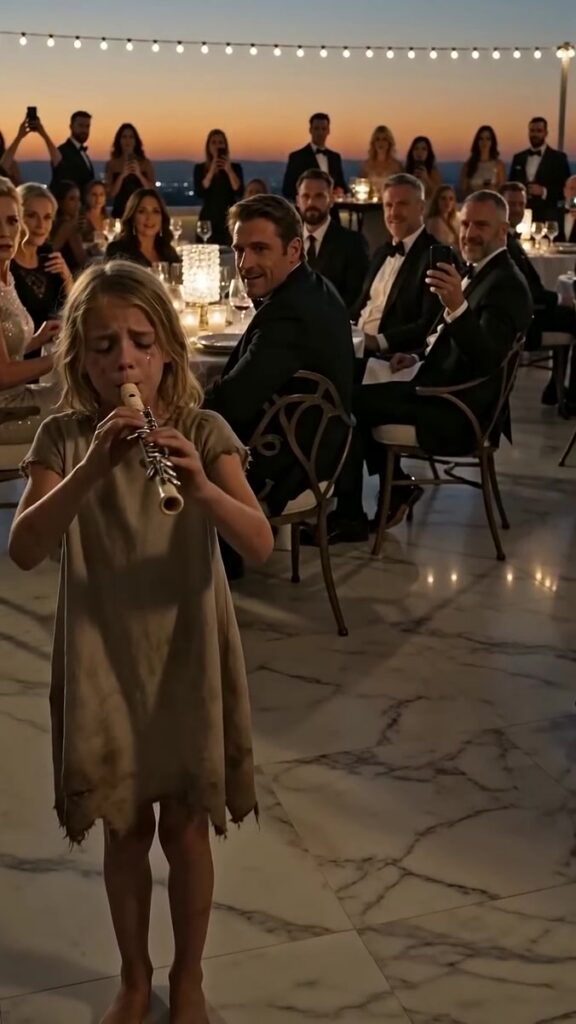
At first I thought someone had missed dress code. It happens. A tourist in flip-flops, a guy with a loud shirt who doesn’t get the memo. But then I saw the feet. Bare. Small. Dusty. And the body attached to them was even smaller, a little girl in clothes that had once been bright and now looked like they’d been washed in bad luck. Her hair was tied back with something that might have been a shoelace. She held a small flute—wooden, scuffed, the kind you’d find in a school music room if the school had run out of everything else.
She stepped onto the terrace like she expected to be pushed back immediately. Her shoulders were tense, her chin lifted in the way people lift it when they’re trying not to cry. Then she opened her mouth and the sound that came out wasn’t a polite request. It was raw and loud, like it had been building up for days.
“Please!” she shouted, voice cracking. “I just need money for food—please!”
The jazz from the speakers kept playing for a second, then Lina must’ve killed it because the music cut mid-note. The rooftop became a photograph. Forks paused. Someone’s laugh died awkwardly. A wine glass stopped halfway to a mouth. And then, like a switch, the phones started to rise. Not everyone, but enough. The shiny rectangles reflected the sunset and made it look like a bunch of tiny portals had opened in people’s hands.
I took a half-step toward her without thinking. The manager’s voice snapped in my ear from across the room: “Don’t. Let security handle it.” As if security was a vacuum you could turn on to remove human problems.
Two tables away, a woman in a white dress leaned toward her friend and whispered something with a smile that didn’t reach her eyes. Another guy muttered, “This place is going downhill,” like the rooftop itself had made a bad business decision by allowing a child to exist.
Marcus at Table One looked delighted. Not in a cartoon-villain way—worse, in a casual, entertained way, the way people look when a street performer surprises them on vacation. He tipped his head, took in the girl like she was a new appetizer option, then leaned back in his chair and called out, “If you want money…” He paused, letting the air hold it. “…impress us.”
There was a soft ripple of laughter. Not loud. Not cruel enough to sound cruel, if you wanted to tell yourself a story where you were still a good person. The girl’s hands tightened around the flute. She looked down at the tiles, glossy and clean, like they’d never been stepped on by bare feet. Her knees wobbled. For a second, she looked like she might bolt—like her body had finally decided this was too much and survival meant disappearing.
I found myself remembering the back stairwell, the one that smelled like bleach and old onions. A few weeks earlier I’d found her there, curled against the wall by the service entrance, hidden behind a stack of linen bags. She hadn’t begged then. She’d been asleep, clutching the flute like it was a stuffed animal. When she woke, she’d stared at me like I was a threat and said, “Don’t tell.” Her voice had been small, but the way she said it sounded like she’d made that request a thousand times and it had never worked.
I hadn’t told. I’d brought her a roll from the kitchen and a small carton of juice. She’d eaten without taking her eyes off me, fast and careful. “My brother plays,” she’d said, nodding at the flute. “He taught me. He’s… not here right now.” The pause was the whole story. I’d asked her name and she’d hesitated like names were dangerous. “Mara,” she’d said finally, and I wasn’t sure if it was true.
Now Mara stood in the center of the terrace, surrounded by perfume and money and a hundred eyes that didn’t know what to do with her except turn her into content. Her fingers hovered above the flute’s holes, unsure if they still remembered the patterns.
“Come on,” someone whispered, not kindly. “Play something.”
Mara swallowed. Her lips pressed into a line. She lifted the flute, slow like she was raising a flag in enemy territory. The wood looked too fragile for all the attention poured onto it. Her hands shook so much I thought she’d drop it. One of the security guards finally started walking over, late to the moment like he was waiting to see how it played out first.
Marcus leaned forward a fraction, elbow on the table, amused and patient. He was holding court now, whether he meant to or not. The whole rooftop had shifted around his mood.
I wanted to say something—anything—to break the spell, but my throat was tight. Part of me was afraid of getting fired. Part of me was afraid that if I spoke, I’d become another spectacle. And part of me, the part I hated, waited to see what Mara would do, as if I was no better than the phones.
Mara closed her eyes. For a heartbeat, the golden hour light touched her face and made her look younger, softer, like she belonged somewhere safe. Then she took a breath that sounded like it came from the bottom of a well.
The flute met her lips.
And right before she played, she opened her eyes again—not at Marcus, not at the guests, but past all of them, toward the edge of the rooftop where the city dropped away. Her gaze locked onto the horizon like she was asking it for permission.
Then she began.
The first note didn’t come out clean. It wavered, thin and trembling, like a bird trying to fly with wet wings. A couple of guests smirked, and one phone angled in closer, hungry for failure. Mara’s cheeks flushed. Her fingers slipped, corrected. She drew in another breath.
The second note steadied. The third found its place. The sound started to stretch out across the terrace, threading itself between crystal glasses and designer watches and quiet laughter that had nowhere to go anymore. It wasn’t a fancy melody. It wasn’t the kind of thing you’d hear in a concert hall. It was simple, stubborn, and aching—like a lullaby someone had hummed in a dark room to keep fear away.
I watched Marcus’s smile fade by degrees, not because he suddenly grew a conscience, but because the rooftop was no longer obeying him. The music—Mara’s music—was changing the air. It wasn’t entertainment. It was a reminder. A crack in the untouchable surface.
The security guard stopped walking. Lina behind the bar had gone still, her hands frozen on a glass. People lowered their phones without realizing it, their screens dimming as their attention shifted from capturing to listening. Even the city noise below seemed to tilt its head.
Mara played with her whole body, like she was pouring out whatever she had left. And in that moment, something in the restaurant—something in all of us—started to break. Not the furniture, not the rooftop itself. The story we’d been sitting inside.
Her final note hung there, trembling in the warm air.
Then the world went quiet again, but it wasn’t the same silence as before.
It was the kind of silence that comes right before people decide what they really are.
And that’s when everything finally broke.
CUT TO BLACK.