The cemetery was quiet in the way only military cemeteries are. Not silent exactly—there was wind, and the faint click of a flagpole rope somewhere, and the occasional far-off cough—but the noise felt like it knew the rules. It stayed low. It stayed respectful. Rows of white markers lined up with the kind of precision that made you stand straighter without realizing you were doing it.
Laila moved between them like she was afraid to disturb the geometry. Her shoes sank slightly into the damp grass, and the cold made her nose sting. She kept adjusting the baby on her shoulder, not because he needed it—he was bundled so tight he looked like a little comet of blankets—but because her arms felt too empty when she wasn’t doing something.
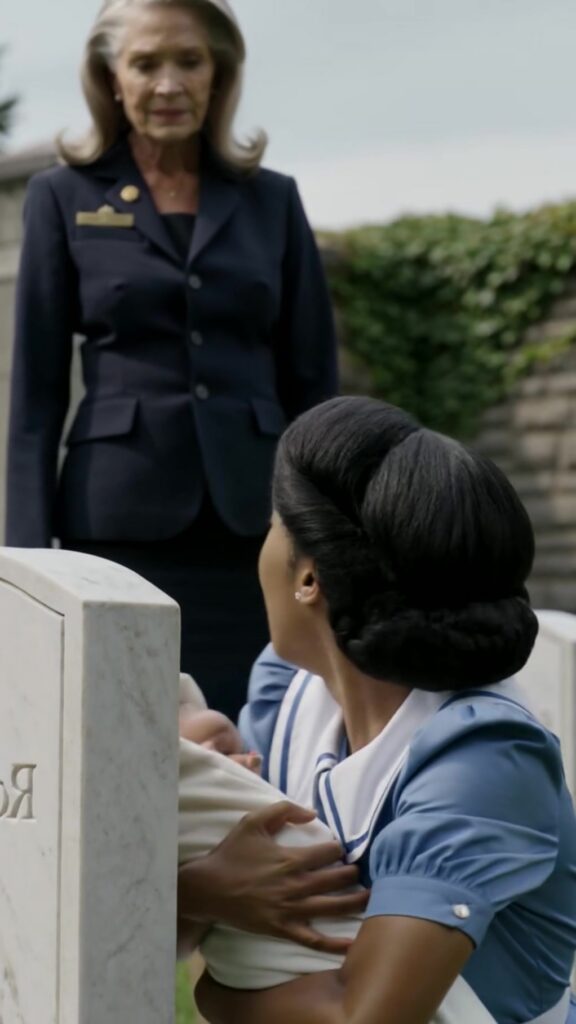
She found the stone without checking the section map. She’d been here enough times now that her feet knew the route. The headstone was clean, sharp-edged, the letters cut deep as if the world wanted the name to last forever. She dropped to her knees, careful not to let the baby’s head wobble, and she leaned close enough that her breath fogged the marble.
“Hey,” she whispered, like she was arriving late to a movie. The word came out cracked. She swallowed hard and tried again, softer. “I brought him. Like I said I would.”
The baby—Jonah, though Laila still sometimes stumbled over saying it out loud—made a tiny noise, an indignant squeak, then settled. Laila pressed her cheek to the stone. It was cold enough to hurt. The sting felt like proof she was still here, still capable of feeling something besides exhaustion and a dull panic that lived behind her ribs.
“I wish you could see him,” she said into the marble. It was a sentence that didn’t belong in public. It was the kind of thing you said to a person’s shoulder in a dark room, not to a grave in a place built for strangers to walk quietly past each other.
Behind her, a voice cut through the wind like someone snapping a ruler on a desk. “What are you doing here?”
Laila startled so hard her elbow slipped, and she tightened both arms around Jonah in a reflex that made her shoulders ache. She turned too fast, the world tilting—stone, grass, sky—until she found the source.
A woman stood two headstones back, as if she’d been there the whole time waiting for the moment to speak. Dark navy suit, the kind that probably cost more than Laila’s rent. Silver-blonde hair pulled back so neatly it didn’t look real. Her posture was straight in a way that made Laila think of inspection lines and clipped voices. Her face had that composed tightness people wear when they’re determined not to cry in public, except there was no softness in it. Just control.
“I’m sorry,” Laila said quickly. Her voice sounded thin. “I didn’t mean any disrespect. I—”
“Who are you?” the older woman asked, stepping closer. Her gaze flicked over Laila’s uniform—simple blue and white, hospital-issued, the kind that always smelled faintly of soap no matter how many hours it had been worn. Then her eyes pinned Laila’s face. Not curious. Appraising.
Laila forced her mouth to work. “My name is Laila.”
The air changed. It was subtle, but Laila felt it anyway, the way you feel a door open somewhere behind you. The older woman’s expression didn’t collapse into grief. It shifted into recognition, the kind that comes with a private memory you didn’t agree to share. Her eyes dropped to the headstone, read the name, then snapped back up to Laila like she was doing math.
“No,” the woman whispered, and it didn’t sound like a denial of Laila’s name. It sounded like a denial of reality. “That can’t be—” She stopped herself, jaw tightening. “How do you know him?”
Laila’s stomach rolled. “I… I don’t know what you’ve been told. I wasn’t supposed to be here when people visit. I just—”
“You weren’t supposed to be here at all,” the older woman said. She took another step, close enough that Laila could see the faint, expensive shimmer on her lipstick. “Answer the question.”
Laila looked down at Jonah as if he might offer a script. His blanket had loosened during the sudden movement, slipping open at the corner. Laila started to tuck it back, but the older woman’s eyes locked on the edge of fabric like it had shouted something.
There, stitched in blue thread, were two initials. Not fancy. Just two letters, simple and steady.
The older woman inhaled sharply. Color drained from her face so fast it was almost theatrical, except nothing about her seemed like a person who performed for attention. She stared at the stitching, then at Jonah’s sleeping face, then back at the headstone.
“Those are…,” she said, but the sentence fell apart. Her hand lifted halfway, as if she wanted to touch the blanket, then froze like she’d remembered she didn’t have permission. “Where did you get that?”
Laila’s mouth went dry. “It was his,” she said. “He… he mailed it to me. Before.” She hated that word. Before. Like everything that mattered had happened in a different universe.
The older woman’s eyes flickered—just once—with something like pain. It vanished almost immediately, replaced by a brittle sort of anger. “He didn’t mail things to strangers,” she said. “He didn’t—” She stopped again, as if she’d almost said something she didn’t want to admit. Her gaze stayed fixed on Jonah. “How old is he?”
Laila hesitated. It felt dangerous to answer, like giving away a code. “Seven weeks,” she said. “Almost eight.”
The older woman’s throat bobbed. She looked away, just for a second, toward the far rows of headstones disappearing into mist. When she looked back, her composure was still there, but it had hairline fractures.
“My son,” she said, each word placed carefully, “once wrote your name in a letter.”
Laila’s heart thudded. She hadn’t expected that. She’d expected denial. Accusations. Not that.
“He wrote it like it meant something,” the woman continued, voice quieter now, but no warmer. “Like it was… dangerous. I burned the letter. I told myself it was for his privacy. For his career. For his future.” She let out a short, humorless breath. “Turns out I was just afraid of what it meant.”
Laila’s fingers tightened around Jonah’s back. “I didn’t come to cause trouble,” she said. “I just didn’t want him to be alone here. And I didn’t want Jonah to grow up without…” Her voice caught. “Without knowing where he comes from.”
The older woman’s eyes narrowed slightly at the name. “Jonah,” she repeated, tasting it. Then, as if logic was the only thing keeping her upright, she asked, “Is he—”
Laila nodded once. It felt like stepping off a ledge. “Yes.”
The older woman closed her eyes for a moment. When she opened them, the cold calculation was back, but it couldn’t fully cover what sat underneath: shock, grief, and something rawer—regret, maybe, or fear.
“No,” she whispered again, but this time it sounded different. Not rejection. Realization. She stared at Jonah like she was seeing a ghost that had decided to become solid. “He found you.”
Laila’s laugh came out wrong—half sob, half disbelief. “He did,” she said. “And he tried to do it right. He tried so hard.”
For a long moment, neither of them moved. The cemetery held them in its disciplined quiet. The older woman looked down at the grave, then at the baby, then at Laila’s exhausted face, taking in the sleeplessness and the dried tear tracks and the way Laila’s hands shook from holding everything together.
“What’s your last name?” she asked, softer than before, like she was bracing herself for another impact.
Laila swallowed. “Not his,” she said. “Not yet. I didn’t want to… I didn’t want to claim anything I couldn’t defend. I didn’t know if you’d—”
“If I’d fight you,” the older woman finished, because of course she would. The hint of a grim smile appeared and disappeared. She looked down at Jonah again, and her voice lost its sharp edge. “May I?”
Laila’s arms hesitated on instinct, then relaxed by a fraction. She shifted Jonah carefully, angling him so the older woman could see his face without touching him. Jonah yawned in his sleep, a tiny, dramatic stretch that made his lips purse like he was offended by the whole world.
The older woman stared, and something finally broke through her composure. Not tears—she still held those back like a professional skill—but her eyes softened, and her shoulders dropped the smallest amount, as if she’d been carrying a weight for years and had just realized it had a name.
“He has his chin,” she said, almost to herself.
Laila let out a shaky breath. “Everybody says that.”
The older woman looked at Laila then, really looked, and the calculation shifted into something else: not acceptance, not yet, but attention. Like she’d been handed a complicated new mission and was finally willing to read the briefing.
“You can’t keep coming here alone,” she said. “Not with a newborn. Not in that condition.”
Laila blinked. “I’m fine,” she lied automatically.
“You’re not,” the older woman replied, flat and certain. Then, after a pause that felt like a decision being signed, she added, “And neither is he, if you collapse.” She glanced at the headstone once more, and when she spoke again, her voice had changed. Still controlled. But not cold. “Come with me. We’re going to talk. Not here.”
Laila’s throat tightened. “Are you going to take him from me?”
The older woman’s gaze snapped back, offended in a way that was almost human. “No,” she said. “I’m going to find out what my son tried to do before he ran out of time. And I’m going to make sure you both make it through what’s left.”
Laila looked down at the grave, pressing her lips to her fingertips and touching the stone once, quick and private. “Okay,” she whispered, not sure if she meant it for the older woman or the man beneath the marble. Then she stood carefully, Jonah secure in her arms, and followed the older woman down the neat rows—two strangers connected by the same unbearable absence, walking out of the disciplined quiet toward whatever came next.