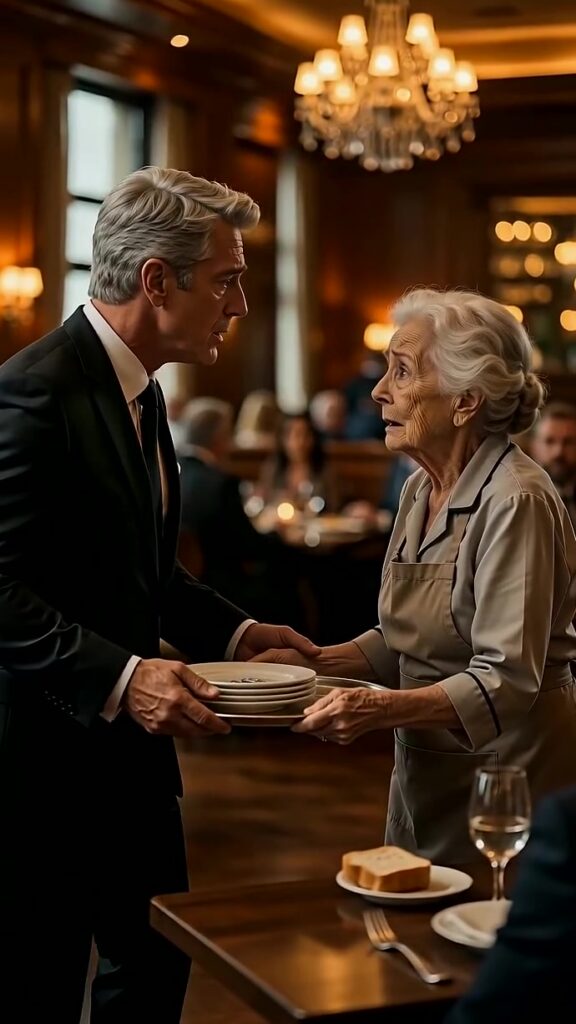
The restaurant glowed with warm amber light, crystal reflecting softly over polished wood and white tablecloths. It was the kind of place where the forks had weight, where the water glasses were always full, and where people lowered their voices automatically, like the room itself was expensive.
Mara moved through it all like a careful tide.
She was old enough now that her knees complained on every pivot and her hands had a faint tremor if she held something too long. Still, she balanced her tray like it was a promise. Soup bowls, a basket of warm rolls, tiny porcelain plates that always looked like they’d never been used. Her uniform was pressed within an inch of its life, though the fabric had thinned at the elbows over the years. Her face was calm, but there was a tiredness in it that didn’t come from one shift. It came from decades of shifts.
“Mara,” the manager whispered as she passed the host stand, “table twelve asked for you again.”
“Did they tip last time?” she whispered back, then softened it with a tiny smile. “I’m teasing. I’ll go.”
She drifted between tables, ignoring the quiet clinking, the laughter that rose and fell like music, the occasional sharp snap of someone calling for more wine. She’d worked in diners with sticky menus and she’d worked in banquet halls where the leftovers could feed a whole neighborhood. This place—Le Lumen—sat somewhere in the middle of her life now, a late chapter she hadn’t expected to be writing.
The door opened, and the room changed without anyone saying a word.
He stepped in as if the space belonged to him, not in an arrogant way, but in a practiced way. Silver hair neatly combed, black suit tailored close, cufflinks that caught the amber light like tiny mirrors. He adjusted one sleeve—just once—then paused to scan the dining room. A few heads turned. A couple of phones rose and were put away again. He wasn’t a celebrity exactly. He was the kind of man people recognized from business pages and charity gala photos.
Mara felt a ripple of curiosity she didn’t have energy for. Another important man, she thought. Another man who’d like his steak medium-rare but would send it back anyway.
She shifted her tray, aiming for the kitchen doors, when his path and hers intersected near the center aisle.
He was walking toward a reserved table near the window. She was headed the opposite direction. The restaurant’s choreography was usually predictable—servers like her learned to avoid collisions the way birds avoided midair crashes. But something made her step slightly to the left.
And there he was, closer than she expected, tall enough to cast a soft shadow over her tray.
“Excuse me, sir,” she said, gentle but firm, because she needed to pass and because she’d said those words a million times in a million rooms.
He lifted his eyes to her face.
And stopped.
For one second, the man didn’t breathe. It was visible, the way his chest simply… forgot. His expression didn’t turn dramatic. It turned blank, like someone had pulled the plug on a television show mid-scene. Then, as if his body caught up late to something his mind already knew, a tear slid down one cheek.
Mara’s grip tightened on the tray. She wasn’t new to people crying in restaurants—birthdays, breakups, proposals, bad news received under tablecloths—but this was different. This was like he’d been hit by something only he could see.
“Sir?” she asked quietly. “Are you alright?”
His mouth moved, but no sound came out at first. His eyes stayed on her like she was the only thing holding the room together.
Then the memory landed in him, hard, like a wave that didn’t care he was wearing a suit.
Cold rain. A city that smelled like wet concrete and old garbage. A narrow alley behind a closed bakery. A trash bin with the lid half off, rattling in the wind. A little boy crouched beside it, shaking so hard his teeth clicked. He pressed his hands against his stomach like he could keep it from eating him alive. He tried not to cry because crying made you noisy, and being noisy made you noticed, and being noticed wasn’t always safe.
Then a young woman had appeared, hair damp, coat too thin for the weather. She had knelt down as if the ground wasn’t filthy and her knees didn’t matter. Her eyes were tired, but they were kind. She pulled a piece of bread from inside her coat, wrapped in a napkin, and pressed it into his trembling hands.
“You eat first,” she’d whispered. “Don’t argue with me. Just eat.”
The boy had looked up at her, rain running off his eyelashes. He didn’t have the words for gratitude. He barely had the words for anything back then. But he remembered her face as if it was carved into him.
Back in Le Lumen, the man swallowed, and his lips trembled like they were trying to remember how to be human in public.
He reached out.
Mara stiffened instinctively—customers didn’t touch you unless they were rude, drunk, or both. But his hand wasn’t grabbing. It was careful, almost reverent. He slid his fingers under the edge of her tray and lifted it with surprising steadiness.
“Here,” he murmured, like he was afraid the sound of his own voice would break the spell. “Let me.”
“No, sir, it’s—” Mara started, but the tray was already transferred, lightened from her hands as if she’d been carrying more than dishes.
He whispered, barely audible, “It was you.”
Mara frowned. “I’m sorry?”
He stepped closer. The expensive scent of his cologne mixed with the smell of buttered rolls. His eyes were wet now, no longer just one accidental tear.
“That night,” he said, voice cracking in the middle, “in the alley.”
Her breath caught—not because she understood, but because something in his tone felt like a door opening to a room she’d locked a long time ago.
The tray rattled softly between them. Plates clicked. Someone at a nearby table paused mid-bite. The background chatter of the restaurant thinned, like the room leaned in without meaning to.
“Sir,” Mara said again, softer now. “I think you’ve mistaken me for—”
But he was shaking his head, a small, desperate motion. “You gave me bread. You told me to eat first.” He laughed once, a broken sound that wasn’t humor at all. “I didn’t even say thank you. I couldn’t. I just… I just ate like it was the last food in the world.”
Mara stared at him, the amber light catching the fine lines around her eyes. Something flickered there—recognition not of him, but of a place inside herself.
She remembered rain that felt like needles. She remembered walking home from her second job, stomach empty, toes numb in shoes with holes. She remembered hearing a sound that wasn’t quite a sob, not quite a cough, and turning down an alley because she couldn’t pretend she hadn’t heard it. She remembered the boy’s hands, so small and so filthy, and the way he flinched when she moved too fast.
“Oh,” Mara whispered, and the word fell out of her like a dropped glass. “Oh my… you were—”
“I was nobody,” he said. His voice tightened. “I was less than nobody. I was a kid everyone stepped around.”
Mara’s eyes shone suddenly, not with tears yet, but with the pressure of them. “I didn’t do much,” she said, and there was a stubborn practicality in her tone, like she was arguing with her own memory. “It was just bread.”
“It wasn’t,” he said. “It was the first time anyone looked at me like I mattered.”
Silence settled fully now. Even the kitchen doors seemed to pause their swinging. People were watching openly. The manager hovered near the host stand with a face that said both curiosity and panic.
The silver-haired man’s shoulders rose and fell once, like he’d been holding something down for years and it was finally pushing back up.
Then, slowly, with the tray still in his hands, he lowered it to the nearest empty service stand. His movements were careful, deliberate, as if he didn’t want any dish to clatter loudly enough to shatter the moment.
Mara’s hands hovered in the air, unsure what to do with themselves.
He took one step back, looking at her like she was a lighthouse he’d found again after a lifetime of storms.
And then—without flourish, without performance—he bent.
He went down onto both knees on the polished wood floor, the black fabric of his suit creasing at the seams. A quiet gasp moved through the restaurant, a wave of disbelief.
Mara’s eyes widened. “Sir, please,” she said urgently, reaching toward him as if she could lift him by willpower alone. “Don’t do that. Get up. People are staring.”
“Let them,” he whispered, and his voice shook like the rain in that alley. “For once, let them see.”
He looked up at her from the floor, tears finally slipping free without restraint. “I spent my whole life trying to become someone no one could ignore,” he said. “I thought that would fix it. I built companies, I bought suits, I made speeches. But I never stopped being that kid until just now.”
Mara’s throat tightened so fast it hurt. “What are you saying?”
He took a breath, and this time he didn’t forget how. “I’m saying thank you,” he said, the words simple and heavy. “I’m saying I’m sorry it took me this long to find you. And I’m saying… I want to take care of you now. If you’ll let me.”
Mara blinked hard, trying to keep her composure the way she always had to at work. “You don’t need to—”
“I do,” he said, and there was no pride in it, only a quiet insistence. “Not to repay you. You can’t repay something like that. But to honor it.”
Her hands trembled as she reached down. Instead of pulling him up immediately, she rested her palm lightly against his shoulder. The fabric was expensive, but underneath it was just a human being, shaking.
“What’s your name?” she asked, because that felt like a place to start that wasn’t money or miracles.
He exhaled a laugh that sounded like relief. “Elias,” he said. “Elias Hart.”
Mara’s brows lifted faintly. The name meant something to the world. To her, it meant a kid in the rain.
“Elias,” she repeated, tasting it like a confirmation. “My name is Mara.”
“I know,” he said softly. “I didn’t then. But I do now.”
He finally let her help him stand. As he rose, the room slowly resumed breathing. Forks clinked again, quieter than before, like everyone was trying not to ruin it. The manager started forward, then stopped, uncertain whether this was a scene to interrupt or a moment to protect.
Mara picked up the tray again with a steadiness that surprised her. Elias didn’t move away this time. He stayed at her side like he belonged there, like he’d been missing from her shift all along.
“I’m working,” she said, half warning, half habit.
“Then I’ll wait,” he replied. “I’ve waited a long time already.”
Mara looked at the dining room—at the people, the light, the white tablecloths. She’d spent years moving through other people’s celebrations like a ghost. Now something was shifting, not into a fairy tale, but into something real and inconvenient and strangely hopeful.
She nodded once. “Alright,” she said. “But if you’re going to sit here, you’re eating something. That’s how it works.”
Elias’s smile came out like sunrise, slow and disbelieving. “Yes, ma’am,” he said, and the way he said it made her laugh—an actual laugh, small but true.
As Mara headed toward the kitchen doors, Elias followed a step behind, not crowding, just present. The amber light warmed the polished wood. The crystal caught it and threw it back in little sparks. And somewhere in the space between an alley in the rain and a restaurant full of strangers, two lives that had brushed past each other in survival finally circled back into the same room.