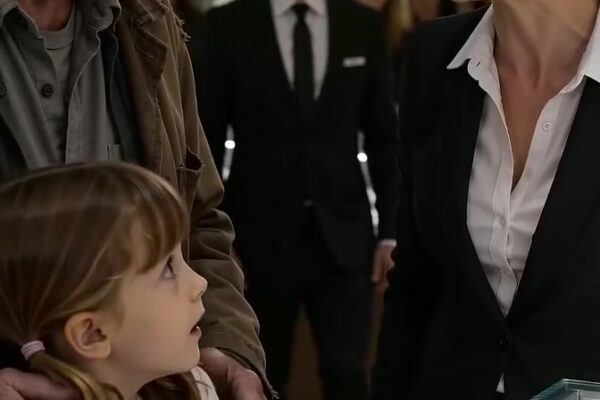
The last school bell had barely faded when he saw her, and he knew right away she wasn’t one of the usual parents. Most days, the pickup line at Alder Street Elementary looked like a soft-edged swarm: hoodies, tote bags, coffee cups, tired smiles, people checking their phones while kids ricocheted off the railings like pinballs. But this woman stood near the gate as if she’d been placed there by a stylist. Cream coat. Clean boots. Hair pinned back in a way that didn’t move even in the breeze. She wasn’t scrolling; she was waiting, still as a lighthouse. Beside her hovered a little girl with a sparkly backpack and the patient expression of someone used to adults running the show.
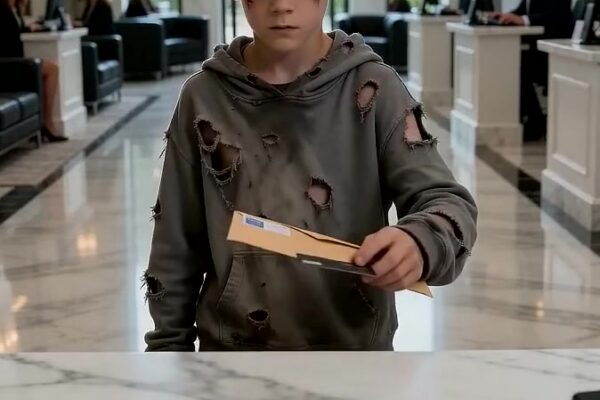
Jamie hovered at the far end of the courtyard, near the bike racks. He wasn’t supposed to be out there, not really. He’d already waved goodbye to the after-school aide, and he’d already told himself, okay, you’ll do it today. If you don’t do it today, you’ll keep doing what you always do—watching from a distance, holding the thing, walking home with it, throwing it away behind the apartment dumpster because you can’t stand the smell of your own embarrassment.
He looked down at what he’d been gripping so tightly his fingers had gone white. A small paper lunch sack—creased, stapled shut at the top, and handled like it was fragile glass. It wasn’t fancy. It wasn’t store-bought. It was what his mom could manage with what they had: two slices of bread, some peanut butter, and a note he hadn’t opened because it had his name on it in careful script that made him feel like someone believed in him.
Across the yard, the girl—Mia, he knew her name because the teacher called on her a lot—tilted her head and said something to the woman. The woman smiled, small and tidy, like she was saving her real smiles for a more important location than a public school gate. Jamie’s stomach did the slow, sinking thing it always did before he had to talk to anyone who looked like they’d never had to count coins at a corner store.
Still, he walked. His shoes scuffed against the concrete, and he hated that the sound was louder than it should be, as if the courtyard was amplifying his poverty for everyone to hear. A couple of parents glanced his way, the quick kind of glance that isn’t exactly rude, just calibrated to dismiss. Jamie tried to keep his shoulders straight anyway. His mom had said, Keep your chin up, baby. People don’t get to fold you in half unless you let them.
He stopped in front of Mia, close enough to see the glitter stickers on her backpack and the tiny scratch on her cheek that looked like a cat had gotten annoyed. He held the lunch sack out with both hands because that’s what you do when something matters.
“I made this,” he said, voice thin. He’d practiced the sentence in his head all day. He’d tried different versions—This is for you, or My mom made it, or Please don’t laugh—but he’d settled on the simplest one. “It’s for her.”
Mia’s eyes widened. She didn’t look grossed out. She looked surprised, the way someone looks when they’re handed an unexpected gift and they’re not sure what the rules are. She started to reach for it.
The woman moved faster than Jamie expected. One second she was a statue; the next she was a wall. Her hand snapped out and knocked the bag away as if it were a bug. The paper sack hit the pavement, the staple popped, and everything inside slid out like the world was eager to humiliate him.
Bread. Peanut butter. A folded piece of paper that had been smoothed flat a hundred times. The courtyard, loud a moment ago, seemed to lose its volume. Even the kids stopped yelling for half a beat, like the air itself was paying attention.
Jamie dropped to his knees so quickly his palms scraped. He barely cared about the sandwich. He grabbed for the folded paper first, because that was the part his mom had said was important. That was the part she’d pressed into his hands that morning and told him, If you get scared, remember we’re not doing this to hurt anyone. We’re doing it to stop pretending.
“Don’t,” the woman said, sharp enough to cut. “Stay away from my daughter.”
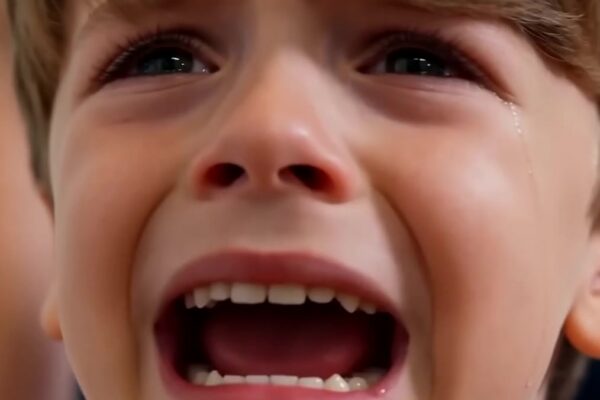
Jamie swallowed and tasted dust. “I wasn’t… I wasn’t trying to bother her.” His eyes stung, but he fought the tears the way he fought hunger most days—quietly, stubbornly, with a kind of practice that made adults uncomfortable.
From the corner of his vision he saw Ms. Patel, the young teacher who supervised pickup, stepping forward. She had that face adults get when they’re about to do a careful kind thing in public and they know it could go wrong. She crouched, gentle, and reached for the paper Jamie couldn’t quite unfold with his shaking hands.
The wind got there first.
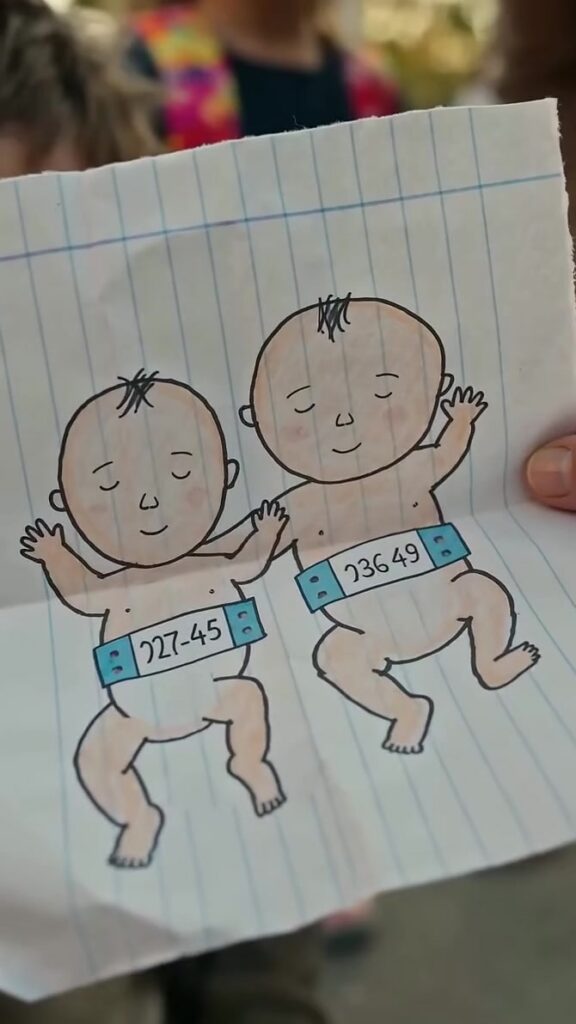
The folded paper flipped open against the concrete like it wanted to be seen. The drawing wasn’t fancy—crayon and pencil, uneven lines—but it was clear. Two tiny babies in a hospital bassinet. Two bracelets around their ankles. One bracelet had a number written in careful kid handwriting, the digits traced over again and again until they looked like they were carved into the page.
Ms. Patel froze. Not the polite kind of freeze. The real kind, where your body reacts before your brain has finished catching up.
The elegant woman’s expression changed, too. The irritation drained out of her face in stages, like someone had pulled a plug. Her lips parted. Her hand hovered over her chest as if she’d been hit.
“Who…” Her voice came out thinner than before. “Who drew this?”
Jamie looked at Mia, and for the first time Mia looked back at him like she was trying to recognize a face she’d only seen in dreams. Then he dropped his gaze to the ground because looking at her felt like staring at a bright light.
“My mom,” he whispered. “She told me to bring it. She said you’d know.”
Ms. Patel picked up the paper carefully, like it might burn her. “Jamie,” she said softly, because she knew his name—teachers always know, even when kids think they’re invisible—“why this bracelet number?”
Jamie’s throat tightened. He reached into the torn bag with fingers that didn’t feel like his and pulled out something tiny and plastic, wrapped in a square of clear tape to keep it from falling apart. A hospital bracelet. Old, faded, but not faded enough. The printing was still readable if you stared long enough. A date. A hospital name. A number that matched the one on the drawing.
The woman’s gaze locked onto it as if it were a magnet and her eyes were metal. The color drained from her face so fast Jamie thought she might fall. Her hand started shaking, and this time she didn’t hide it.
“Where did you get that?” she asked, but it didn’t sound like a question. It sounded like a memory reaching back and grabbing her by the throat.
Jamie’s voice came out small. “My mom kept it.” He hesitated, then added, because his mom had said the truth didn’t work unless you said all of it. “She said… we were switched when we were born.”
The air seemed to tilt. Ms. Patel’s hand went to her mouth. Mia took a step closer to her mother, then stopped, as if she wasn’t sure which direction was safer.
The elegant woman stared at Jamie like she was seeing the outline of a story she’d tried to forget. “That’s impossible,” she said automatically, but her eyes betrayed her. Her eyes were doing math.
Jamie nodded once, because he’d already had the “impossible” conversation in their kitchen while his mom cried into a dish towel. “My mom didn’t want to believe it either. She… she found papers. She found a picture from the nursery. And then she saw Mia at school when she started volunteering in the cafeteria.” He glanced at Mia. “She said the way her hair curls by her ear is the same as—” He stopped. He didn’t know how to say the rest without sounding like he was stealing someone’s life.
The woman’s mouth opened, closed. Her gaze flicked to Mia’s ear, just for a second. Then she looked back down at the bracelet. “What do you want?” she asked, and the question sounded like she hated herself for asking it.
Jamie’s hands balled into fists in his lap. “I don’t want your money. I don’t want… I don’t want to take her.” His voice cracked on the last word. “My mom said you’re still her mom, because you’ve been her mom every day. She just… she wants the truth. She wants to know where the hospital sent her baby. She wants to know if you—”
“If I raised your child,” the woman finished, and it hit the ground between them with a soft, ugly thud.
Ms. Patel stood, suddenly practical, suddenly adult in a way that didn’t allow drama. “We shouldn’t do this at the gate,” she said. “Let’s move into the office. Please.”
The elegant woman looked around, and only then seemed to realize the courtyard had grown eyes. Parents were pretending not to stare. Kids were whispering. Somebody’s phone was probably already out. The woman’s spine straightened, but her face stayed cracked open with shock.
Mia tugged her sleeve. “Mom?” she asked, voice tiny. “Who is he?”
The woman looked down at her daughter—maybe her daughter, maybe not, but definitely the child she’d loved for years—and her eyes filled in a way that made her look suddenly human, not distant at all. She knelt, smoothing Mia’s hair with a trembling hand. “He’s… he’s a boy from your class,” she said, like she needed the simplest words to keep herself from falling apart. Then she looked at Jamie, and her voice softened by a fraction. “And we’re going to talk. All of us. Okay?”
Jamie didn’t know if “talk” meant apologies or lawyers or tests or doors slamming. He didn’t know if he’d just thrown a match into someone’s perfect life. But as Ms. Patel guided them toward the office, and as the late sun turned the pavement gold, Jamie realized something else: the sandwich lay forgotten on the ground, but the drawing was safe in Ms. Patel’s hands. The truth, for better or worse, had been picked up.
Behind them, the school bell had faded completely, swallowed by the normal noise of the street. Ahead of them was a hallway that smelled like pencil shavings and floor wax, and a door that clicked shut like the beginning of a different kind of story.