The stamp hit the counter so hard the whole bus station seemed to flinch, like the building had nerves and the clerk had just poked one. The thud echoed off the high, grimy windows and came back softer, swallowed by the wheeze of the heater that never quite worked and the constant shuffling of people trying to look like they weren’t stranded.
The teenage girl didn’t even blink. She just watched the clerk’s hand move with the bored precision of someone who’d been saying no all day. The ticket window had a little half-circle cut-out at the bottom, and through it the clerk slid three dull coins back across the counter. They scraped along the chipped wood, stopped, then one kept going like it had its own plan and rolled right off the edge.
It spun in a slow, wobbly circle on the dirty tile and came to rest beside the thin blanket in the girl’s arms.
She tightened her hold, more out of instinct than strength. The baby was asleep—too asleep, the heavy kind where you keep checking the rise and fall of the chest just to reassure yourself. His cheeks were red from the cold, and the tip of his nose had that pale shine like a small candle flame about to go out.
“Not enough,” the ticket clerk said, flat and final, already angling his stamp toward the next passenger’s papers. “Next.”
The line shifted behind her. A couple of coughs. Someone sighed like this was somehow her fault. A man somewhere laughed once, sharp and humorless, then stopped as if he’d realized it wasn’t funny.
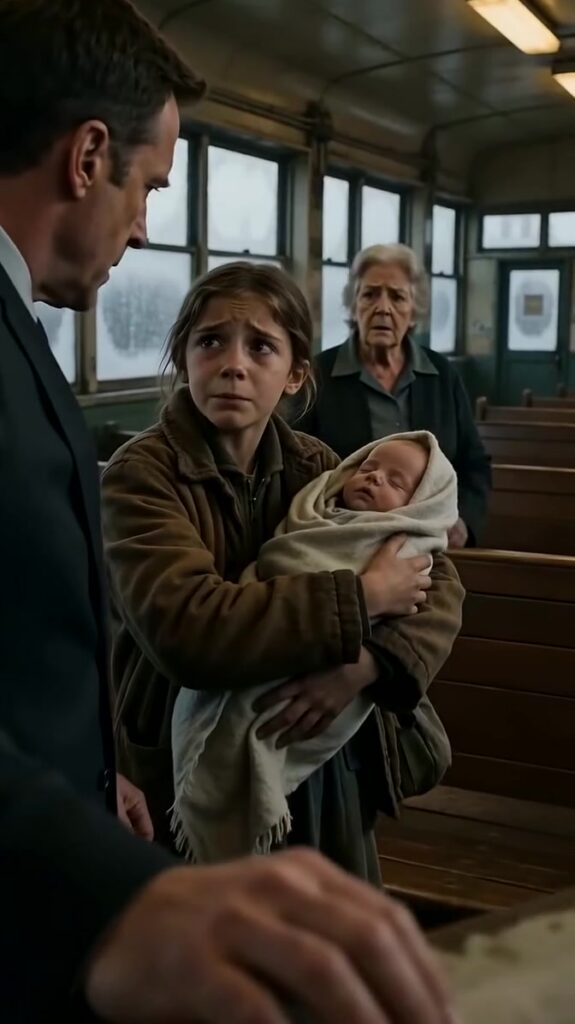
The girl didn’t move. Her coat was brown and too big in the shoulders, the kind you inherit when nobody has money for the right size. The sleeves covered her knuckles, but her fingers were still numb. Her lips had turned a faint bluish color that made her look more like a drawing than a person.
“Please,” she said, and it came out smaller than she meant. “He’s cold.”
Through the glass, the clerk’s eyes flicked to the baby and back. His face didn’t change. “You can wait till you have the rest.”
The girl swallowed. Waiting meant hours. Waiting meant another night of the station’s lights that never dimmed and the benches that smelled like wet wool and tired bodies. Waiting meant the baby’s little hands turning into ice even inside her coat.
A few passengers looked up from their phones or their cups of station coffee. They took in the scene—the girl, the baby, the pleading—and then did what people did best in places like this: they turned their attention away, as if eye contact might make them responsible.
Except for one man standing a few steps back, near the vending machines. He wore a dark coat that fit perfectly, and he held a leather suitcase like it was part of his arm. At first he looked annoyed, the way people get when they’re sure they’re about to miss something important because someone else’s life is falling apart too close to their schedule.
He’d been about to step around her, to become another person who didn’t see.
Then the baby shifted.
It was a tiny movement—just a sleepy wriggle—but it loosened the blanket enough for something to catch the station’s weak yellow light. A little flash, bright and precise, like a wink in the gloom.
A silver pin.
The businessman froze mid-step. His face changed so fast it was like watching a door slam open. The annoyance drained away, replaced by something raw and startled that didn’t belong on a man in a tailored coat.
He took two steps forward without seeming to decide to.
“Where is his mother?” he asked.
The girl’s shoulders tensed. She pulled the blanket tighter, shielding the baby like a small animal protecting its only warmth. Her eyes were wide, tired, and wary in a way that said she’d already been threatened a few times today just by existing.
“She left him with me,” the girl said, voice shaking at the edges. “She said she’d be back.”
“When?” The man’s voice came out rougher than he intended.
“Last night.” The girl glanced down at the baby, then back up, trying to read the man’s face. “At the church steps. She… she didn’t even come in. She just handed him over.”
Even the cleaning woman paused. She was old and wiry, with gray hair tucked under a knit cap, and she’d been pushing her broom like it was the only thing keeping her upright. Now she leaned on it, listening.
The businessman set his suitcase down slowly, like it was suddenly too heavy. His hand hovered near the silver pin but didn’t touch it. The pin was simple, just a little circle with a tiny etched design—two intertwined letters. He stared like it had become a living thing.
“Did she say where she was going?” he asked, quieter.
The girl shook her head. “She just cried. Like she couldn’t breathe. She kept saying she was sorry.”
Her voice broke on the last word, and she clenched her jaw hard, determined not to be another sad story for strangers to step around.
The man’s throat bobbed. He blinked too quickly. “Did she leave… anything?”
The girl hesitated, then shifted the baby carefully and dug into the inside pocket of her coat with numb fingers. She pulled out a folded note, the paper wrinkled and darkened in spots where rain had soaked through. The edges were soft from being held too long.
“She said this is for you,” the girl whispered, as if speaking louder might break something.
He took it like it might burn him, like it might bite. His hands trembled, just barely, but the tremor was there, a crack in the polished surface of him. He opened the first fold, then the second, and on the third his breath caught so sharply it sounded painful.
He knew the handwriting immediately. You don’t forget a person’s handwriting when you spent years memorizing it, even if you tried to forget the person attached to it.
The girl watched his face fall apart. It wasn’t dramatic. It was worse than dramatic—it was quiet, the way a building collapses from the inside. His eyes went glassy. His jaw tightened. A muscle in his cheek jumped as if he was trying to hold himself together by force.
“She said only you would know the—” the girl began, then stopped because he wasn’t listening anymore.
He was staring at the baby.
At the small nose. The tiny mouth, pursed like it had been practicing sadness even in sleep. At the dark lashes, too long to be fair, and the eyes that fluttered open for a second as if the baby sensed being watched.
The baby’s gaze landed on the businessman with that unfocused newborn seriousness. And something in the man’s face cracked wide open.
For the first time in years, the businessman looked like a man who had just seen a ghost—except it wasn’t a ghost. It was a consequence. It was a beginning he hadn’t known he’d helped create.
He looked back down at the note, and his lips moved as he read, silently at first. Then one sentence seemed to hit him like a physical blow. He pressed his knuckles to his mouth, hard, as if to keep a sound from getting out.
The cleaning woman made the sign of the cross under her breath. The ticket clerk’s stamp hovered above the counter, forgotten. Even the line behind the girl had stopped pretending this was none of their business.
The businessman lowered the note and took a long, uneven breath. When he spoke, his voice was different—still controlled, but barely. “Her name,” he said to the girl. “What’s her name?”
The girl swallowed. “Mara,” she said. “She told me to call her Mara.”
He closed his eyes for a moment, and it wasn’t the blink of a tired man. It was the pause of someone trying to survive a memory. When he opened them again, they were wet.
“I’m going to get you both out of here,” he said, and it sounded like a promise and a confession all at once.
The girl didn’t trust promises. Her life had been stacked with them, all broken. Still, her grip loosened a fraction, because desperation will accept almost anything if it comes wrapped in warmth.
He reached into his coat and pulled out a wallet thick enough to make the clerk’s eyes sharpen. He placed bills on the counter, more than enough, and the stamp came down again—this time not out of irritation, but out of habit trying to pretend this was still a normal transaction.
As the clerk slid the tickets forward, the businessman didn’t take his eyes off the baby. He leaned closer, careful, like approaching a skittish creature, and finally—very gently—he touched the edge of the silver pin with one finger.
“I gave this to her,” he murmured, mostly to himself. “I told her it meant forever.”
The girl’s eyes flicked between him and the baby. “Are you… are you his—?”
The businessman’s throat tightened. He looked at the note again, then at the baby’s face, then at the girl, as if he was deciding whether he deserved to say the word out loud.
“I don’t know what I am yet,” he said honestly. “But I’m not walking away.”
The baby made a small sound, half sigh and half protest, and the girl instinctively rocked him. The businessman watched, then slowly picked up his suitcase with his free hand, like he was making room in his life.
Outside the tall windows, snow began to fall in soft, hesitant flakes, as if even the weather was unsure whether it was allowed to be gentle. Inside, the station kept humming—announcements, footsteps, the distant cough of an engine starting—but something had shifted at the ticket counter. The flinch had passed, and in its place was a strange, fragile stillness.
The girl tucked the tickets into her pocket. She didn’t cry. Not yet. She just nodded once, like someone accepting an offer without fully believing it.
“Okay,” she said, voice thin but steady. “Then let’s go before he wakes up all the way.”
The businessman stepped aside to let her lead, like he understood that whatever came next, she’d been carrying the most important part of it all along.
And as they walked toward the gate, the folded note—creased, damp, and heavy with years—stayed clenched in his hand, the ink inside it doing what the stamp on the counter had done: making something official that could no longer be undone.