The first thing I noticed was the smell: coffee that’d been burnt so many times it had developed its own personality. The second thing I noticed was the old man sitting by himself in the last booth like he’d reserved the corner of the universe.
It was a nothing diner off Route 9—one of those places with cracked vinyl seats, a pie case that tried its best, and a neon “OPEN” sign that flickered like it was thinking about quitting. I’d only stopped because my phone was dead and my gas gauge was flirting with “E.”
I slid onto a stool and nodded at Marlene, the waitress, who looked like she could balance five plates and a grudge at the same time. “Coffee?” she asked without waiting for an answer, already pouring.
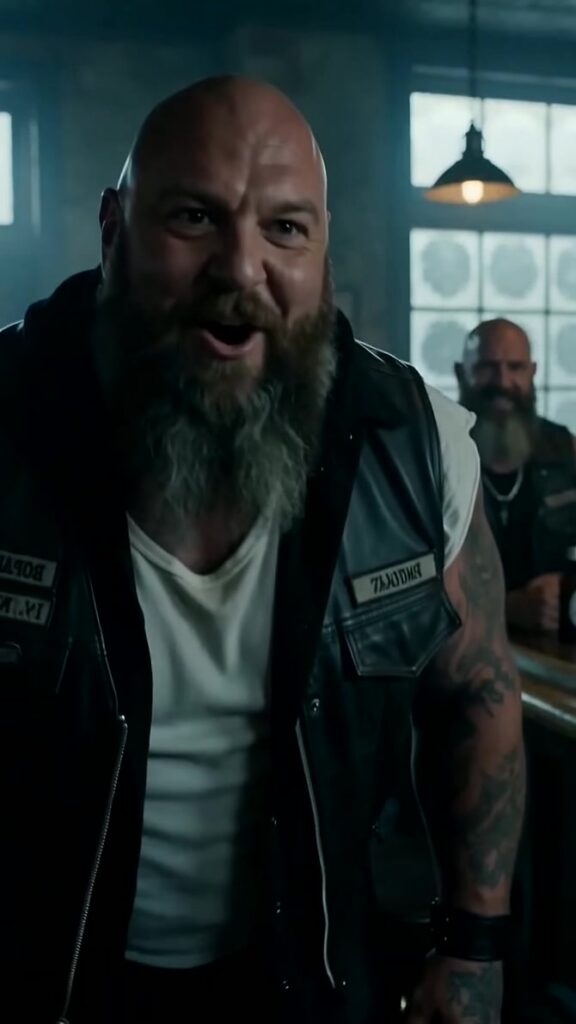
Behind me, the door chime jingled, and the air changed. Leather and cold wind and trouble walked in, in the shape of six bikers. They didn’t have to announce themselves. The room went quieter the way animals go quiet when a shadow passes overhead.
Their leader—big enough to make the doorway look apologetic—spotted the old man right away. That seemed to be the point. He smiled like he’d discovered a game no one else knew they were playing.
“Well, well,” he said, loud enough to be heard by the kitchen and possibly the next county. “Look at this. A museum exhibit.”
The old man didn’t glance up. He was stirring his coffee slowly, watching the spiral like it contained answers. He wore a plain gray coat and a watch that looked expensive in a way that didn’t beg for attention. His cane leaned against the booth, polished wood with a silver cap that caught the light when he moved.
The bikers surrounded the booth like a pack deciding how close they could get without getting bitten. Marlene took a half-step forward, then stopped. Her mouth tightened. You could see her doing the math: six of them, one of her, no security, and a manager who would be “in the back” if asked.
“Hey, Grandpa,” the leader said, and reached down with a hand like a shovel.
It happened so quickly it almost didn’t register as violence. One second the cane existed as part of the old man’s silhouette; the next it was gone, yanked free with a snap of wood against skin. The old man’s fingers didn’t cling or chase. They simply opened, as if he’d decided, in that moment, that holding on would be boring.
The leader raised the cane and laughed, and his crew joined in, a chorus of metal-on-metal noise and throat-deep cruelty. He slammed the cane on the table like he’d just won a prize at a carnival. Coffee splashed. A spoon skittered. The old man didn’t flinch.
Someone kicked the chair at the edge of the booth and it clattered. Another biker leaned in and whistled, long and theatrical, like he was judging a talent show. The diner stopped being a diner. It became a stage, and I realized, with an uncomfortable twist in my gut, that the rest of us were the audience.
“What’s the matter?” the leader asked. “You don’t want your stick back? You gonna stand up and chase me?”
He nudged the cane with his boot, rolling it along the greasy tile until it rested near the old man’s shoes like a dare.
The old man looked at it for a beat. Then he looked up at the leader for the first time. His face wasn’t angry. It wasn’t scared. It was… mildly inconvenienced, like the biker had parked in his spot.
That’s when I heard the click.
It was tiny—plastic and metal—and it didn’t belong in the noise. It cut through the laughter like a razor through paper.
The old man raised a small black key fob to his ear. Not a phone. Not a fancy smartwatch. Just a simple remote-looking thing with one button worn smooth.
“It’s me,” he said, voice calm enough to chill the coffee.
The leader grinned wider, leaning down until his shadow swallowed the old man’s half of the booth. “Calling for help?” he murmured, like it was a joke only he understood.
The old man didn’t look away. “Bring them,” he said, quieter, and somehow it carried farther than the biker’s laughter.
Something shifted in the room. Not the air—attention. The bikers felt it too. One of them glanced toward the windows. Another stopped laughing mid-breath, like he’d suddenly remembered he left the stove on.
I didn’t know what the old man had triggered until the first pop sounded outside.
It wasn’t a gunshot. It was sharper, glassier. Like a champagne bottle failing under pressure.
Then—another. Then three in quick succession.
Every head in the diner turned. Even the cook leaned out of the kitchen, holding a spatula like it could negotiate peace.
The front window—big, square, and smudged with fingerprints—frosted over in an instant. Not fog, not condensation. Ice. It spread like a living thing, spidering across the glass in veins of white.
And then the glass didn’t just break.
It detonated.
A sheet of it burst outward into the night and inward into the diner at the same time, exploding into glittering fragments. But instead of raining down, the shards hung suspended, each piece caught midair as if the world had forgotten gravity existed. The cold rushed in after them, a hard, clean breath that made everyone’s skin pebble.
Water—where did it even come from?—froze mid-flight too, beads and arcs sparkling like scattered diamonds around the floating glass. For a surreal second, the diner looked like someone had shaken a snow globe and paused it.
People screamed. Marlene ducked behind the counter. I dropped off my stool so fast I banged my knee and didn’t even feel it.
The bikers froze in place, suddenly not so sure about their comedy routine. Their leader stepped back, eyes wide, his grin collapsing into a stunned grimace.
The old man stayed seated. He didn’t duck. He didn’t raise his arms. He just watched the suspended chaos with the bored patience of someone watching a weather report.
Outside, headlights rolled across the parking lot—silent, controlled. Not a roaring gang of motorcycles. Just dark vehicles, clean lines, no chrome. They moved into formation like they’d rehearsed it.
Then the air inside the diner hummed. Not loud, but deep—like a bass note you feel in your teeth. The floating shards trembled, each one quivering as if responding to an unseen command.
“What is this?” one biker muttered, voice cracking in a way he probably hated.
The old man finally reached down and picked up his cane from the floor. He didn’t snatch it. He retrieved it, gentle as returning a book to a shelf. “You shouldn’t take things that aren’t yours,” he said, like he was explaining etiquette to a child.
The leader tried to recover. He puffed up, shoulders wide, as if muscle could negotiate with physics. “You think you’re some kind of wizard?” he barked, but it landed wrong—too loud, too desperate.
The old man angled his head, considering the word. “No,” he said. “I’m just tired of loud men confusing attention for power.”
A knock came at the diner door. Not pounding. Not urgent. Just a polite, measured tap.
Marlene peeked up, eyes huge. The leader looked from the floating glass to the door to the old man, searching for a version of reality he could win in.
The old man pressed the key fob again. Another click.
At that sound, the suspended shards moved—slowly, deliberately—sliding away from the booths and counter, drifting toward the broken window in a neat stream. It was like watching a school of fish change direction all at once. They poured out into the night, away from skin and eyes, leaving only a few tinkling pieces that fell harmlessly to the floor like the aftermath of an ordinary accident.
Cold still lingered, but the violence of it drained away, replaced by a quiet that felt heavier than the laughter had.
The door opened. Two people stepped in, dressed in plain dark clothes, hair tied back, eyes scanning the room with calm efficiency. They didn’t look like cops. They didn’t look like bikers. They looked like people who removed problems for a living.
“Sir,” one of them said, nodding to the old man with respect that didn’t feel theatrical.
The old man stood, and for the first time I noticed he wasn’t as frail as he’d been selling. The cane was real, sure—but his posture had a straightness that wasn’t borrowed.
He nodded toward the bikers, who suddenly seemed smaller, like someone had turned down their volume and their importance at the same time. “These gentlemen were confused,” he said. “Help them out.”
The leader opened his mouth, probably to threaten, probably to posture, but no sound came. One of his crew backed away and bumped into a table, rattling plates.
The two newcomers moved with quiet speed. No dramatic punches. No cinematic brawls. Just hands on shoulders, pressure points, control. In less than a minute, the bikers were being guided—firmly, irresistibly—toward the door.
The leader tried one last look over his shoulder, like he wanted to save face by memorizing the old man’s features. “Who are you?” he spat, but it sounded weak.
The old man picked up his coffee, took a sip, and winced slightly like it was too hot. “Someone who prefers his breakfast uninterrupted,” he said.
When they were gone, the diner slowly remembered how to breathe. People moved again, shaking, whispering. Marlene stood up, smoothing her apron with hands that trembled despite her tough face.
I stayed crouched on the floor, staring at the glittery remnants near my shoe. One little shard of glass caught the light and flashed like a tiny star.
The old man slid a few bills onto the table—more than enough, tucked neatly, no drama. He looked around, eyes passing over me for half a second. Not a threat. Not a warning. More like a quick inventory: witness present, witness harmless.
He walked toward the door, cane tapping once, twice, steady and normal, as if the universe hadn’t just paused on his command.
Before he left, he glanced back at Marlene. “You might want to replace the window,” he said casually, like recommending a new brand of coffee. Then he stepped into the night and disappeared into the quiet line of dark cars.
Only after the headlights faded did I realize my coffee cup was still on the counter, untouched, steaming patiently, pretending everything was fine.
I didn’t drink it. I just sat there, listening to the neon sign buzz, and thinking about that little click—small, mechanical, final—and how sometimes the scariest power doesn’t roar.
Sometimes it taps a button and makes the world behave.