The ballroom glittered like a place where nothing ugly could exist. That was the first thing Mara noticed, even before she noticed the vault.
Gold light dripped from chandeliers like honey. The ceiling was painted with pastel clouds and heroic angels who’d never had to read an eviction notice. Dresses shimmered. Watches winked. Laughter slid across the marble floor and never seemed to hit anything sharp.
Mara wasn’t dressed for this universe. She’d borrowed a black dress from her neighbor, pinned the straps tighter, and told the doorman she was “with the foundation.” The foundation was real, technically. Tonight was a fundraiser for the Larkridge Arts Council, which was a fancy way of saying rich people got to drink vintage champagne while pretending they’d invented generosity.
She had a tray in her hands, mostly for camouflage. It held flutes of something pale and expensive and probably cursed. She drifted along the edge of the crowd, studying faces, listening for the kind of gossip that came with loose tongues and tight wallets.
That’s when she saw it: the vault.
It sat in the middle of the ballroom like an altar someone had decided would look better in gold. It was massive, glossy, ridiculous—gold-plated steel with a wheel big enough to steer a ship. A red velvet rope circled it like it might bite. A spotlight pinned it to the floor, making it less an object and more an announcement.
“A masterpiece of security,” the host was saying as Mara slid closer. He was a broad man in a velvet tuxedo the color of dark wine, with a smile that looked practiced in expensive mirrors. “Commissioned specifically for tonight. A performance, really. A symbol of protection. Of legacy.”
Mara recognized him from city council livestreams and society pages: Everett Vale. Banking heir. Philanthropy enthusiast. Man who could make a donation sound like a threat.
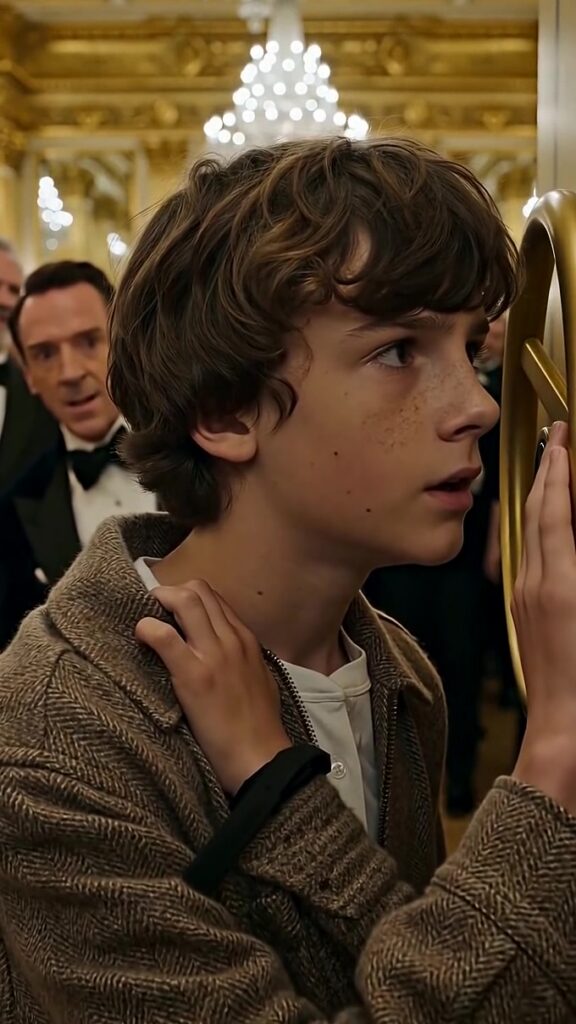
Beside the vault stood a kid in a brown tweed jacket that didn’t match the room at all. He looked like he’d wandered out of a library from a different decade. Thin, pale, hair too tidy to be fashionable. His hands were empty. His posture was calm in the way a locked door was calm.
Everett lifted his glass. “Now. We’re doing something fun. Ten thousand dollars to anyone who can open it.”
The orchestra kept playing, but the crowd’s energy shifted—the way it does when people sense a chance to watch somebody fail without consequences. Phones rose like periscopes. People leaned in. Someone laughed too loudly, eager to start the chain reaction.
Everett’s gaze landed on the kid. “You there. You look clever.”
The kid didn’t grin or flinch. He just nodded once, like he’d been asked to pass the salt.
“Go on,” Everett added, louder, playing to the cameras. “Show us what you can do.”
Mara felt the room tighten around that sentence. It wasn’t really an invitation. It was a setup. Rich people loved games where the prizes were money and the real reward was someone else’s embarrassment.
The kid walked forward. His shoes made a soft echo that somehow carried farther than it should have. Mara watched him pass through the velvet rope as if the rope respected him.
He touched the vault with his fingertips, gentle, almost familiar. Then he leaned in and pressed his ear to the lock. It was such an intimate thing to do with something so public that the room slowly quieted, like everyone had realized they were overhearing a conversation.
Click.
Mara couldn’t tell if it came from the vault or from the collective throat of the crowd. Either way, something changed. The air felt thinner. Even Everett’s smile stiffened, just a fraction.
The kid wrapped his hand around the wheel. Before turning it, he looked over his shoulder—straight at Everett.
“Are you sure?” he asked.
The question didn’t belong at a party like this. It wasn’t playful. It wasn’t nervous. It was practical, like asking whether the stove was off before leaving the house.
Everett let out a laugh that didn’t quite land. “Of course.”
The kid turned the wheel.
A deep metallic sound rolled through the ballroom—more thunder than mechanism. It wasn’t the crisp snap of a toy lock. It was the heavy finality of something deciding to move.
Everett’s eyes narrowed. “Who taught you that?” he asked, stepping forward as if to reclaim the narrative.
The kid didn’t pause. “My father built this safe.”
That sentence landed like a glass dropped on marble. It didn’t shatter, but everyone heard it hit.
Another quiet click followed, precise and deliberate. The kid’s movements were slow, almost tender, like he wasn’t defeating the vault so much as speaking its language.
Mara’s grip tightened around her tray. She studied Everett’s face, and the color was draining out of it in real time. The man looked like he’d just discovered a stain on a white shirt he couldn’t replace.
“That’s impossible,” Everett murmured, but his voice had lost its host polish.
The wheel turned again. Something shifted deep in the vault with a sound like a giant exhaling.
People started stepping back, pretending it was to get a better angle for their videos, but Mara could see the instinct behind it. Like standing too close to a cliff edge.
The kid’s hand slipped into his jacket pocket. He pulled out an old brass key, dull with age, like it had lived its life in a coffee tin full of screws.
Everett’s lips parted. “That needs two keys,” he whispered, barely audible.
The kid held the key up between finger and thumb. “You had one,” he said, not loud, not dramatic. Just factual. “You didn’t think anyone else did.”
He fitted the key into a small, nearly invisible slot and turned it. The vault door trembled and then began to swing open—not with a flourish, but with the inevitability of a truth finally being acknowledged.
Gasps rippled outward. Someone’s champagne flute tipped and spilled onto the floor, and the pale liquid looked suddenly cheap against all that glitter.
The spotlight poured into the vault’s interior.
There was no gold. No stacks of cash. No jewels. No theatrical treasure to match the room’s sparkle.
There was a single framed photograph.
The kid reached in and lifted it carefully, like it might bruise. Even from where Mara stood, she could see the image: a man in work clothes, kneeling beside the same vault in a factory setting, his hands dirty, his smile tired. Next to him stood a younger version of the kid, maybe eight or nine, holding a wrench like it was a prize. A woman sat on a crate behind them, laughing, her hair tied up in a scarf.
Below the photo, in handwriting that wasn’t trying to be pretty, were the words: FOR WHEN THEY TRY TO PRETEND WE NEVER EXISTED.
Everett made a sound that wasn’t quite a cough. “Where did you get that?” he demanded, but his voice wobbled like a poorly built stage.
The kid finally faced him fully. Up close, Mara could see he wasn’t as young as she’d first thought—maybe sixteen, maybe older, with that kind of steady gaze that came from being forced to grow up in rooms where nobody listened.
“It was in your office,” he said. “Behind the certificate wall. The one with all the awards you give yourself.”
Everett’s jaw tightened. “Security—”
“Your security doesn’t look for boys in tweed,” the kid replied, almost kindly. “They look for thieves with ski masks. You only notice the kind of ugly you expect.”
A few guests laughed nervously, like they couldn’t decide if they were watching entertainment or witnessing a lawsuit being born. The orchestra, confused, softened into a slow, wandering melody.
The kid lifted the photograph higher so cameras could catch it. “My dad built this vault years ago,” he said. “Not for you. For the company you bought and hollowed out. You kept his work, you kept his design, and you erased his name. Then you turned his craft into a party trick.”
Everett’s face twisted, trying to find a mask that fit. “This is ridiculous. This is a fundraiser.”
“Yeah,” the kid said. “Fundraising is when you take something from someone else and call it help.”
Mara felt her throat go dry. She knew that factory name. She’d written about the closure—hundreds laid off, the building sold, the neighborhood left to rot while Everett’s foundation opened a “youth creativity center” two miles away for the photo ops. She’d tried to interview workers back then. Most wouldn’t talk. Some couldn’t. She’d never had a name to hang the story on.
The kid had just carried one into the room.
He set the photograph on the vault’s lip and, with his other hand, reached deeper inside. Not for money. For paper. A slim envelope and a folded stack of documents.
Everett’s eyes widened, pure fear now. “Stop,” he said, the first honest word he’d spoken all night.
The kid didn’t raise his voice. “You said ten thousand if I open it.”
“Fine,” Everett snapped, grasping at control. “You’ve proved your point. Take your money and go.”
The kid shook his head. “Keep it. I’m not here for your prize.”
He turned, and for the first time his calm cracked just enough to show something underneath—grief, maybe, or anger that had been compressed into precision. “I’m here because you built a room that pretends nothing ugly can exist in it,” he said. “But you brought the ugly with you. You just polished it until it matched the chandeliers.”
Mara stepped forward without meaning to. Her tray dipped; a few glasses clinked. Everett’s gaze snapped to her, but she wasn’t looking at him. She was looking at the documents in the kid’s hands.
“Are those—” she started.
The kid glanced at her, quick and assessing. “You a reporter?”
“Sometimes,” Mara said. “When people let me.”
He held the envelope out. “Then don’t ask permission.”
For a beat, the ballroom held its breath. Then Mara took the envelope, her fingers brushing his, and it felt like touching something real in a room designed to be nothing but shine.
Everett lunged forward. “Give that back.”
The kid stepped aside, blocking him with nothing but posture. “You told me to open it,” he said. “So I did.”
Mara tucked the envelope against her ribs like a heartbeat. Around them, guests murmured, phones still up, but now the hunger had shifted. This wasn’t humiliation anymore. This was consequence, and the wealthy weren’t sure how to film that.
Everett’s ballroom still glittered. The chandeliers still poured their gold light. The orchestra still played, trying to stitch the night back together with music.
But now there was a photograph on a vault where everyone could see it, and a boy in tweed standing calmly in the center of the room, and the ugly thing the ballroom couldn’t keep out had finally taken its seat at the party.
Mara looked down at the envelope in her hand and realized, with a strange jolt of certainty, that the story she’d been chasing hadn’t been hiding from her.
It had been waiting for the door to open.