The first time I saw a grown man offer a kid ten grand like it was a dare, it happened under a chandelier the size of a small car.
The hotel ballroom had been dressed up to look like a game show set—black drapes, bright spotlights, a stage with a single table at the center like it was about to be sacrificed. On that table sat a safe. Not one of those boring gray office things, either. This was glossy, old-school, with a brass dial and a handle that looked like it belonged on a submarine.
People had come for the charity auction, but the auction had kind of fallen apart once Malcolm Rusk got bored. Malcolm was one of those rich guys who looked like money was his natural habitat—perfect suit, perfect teeth, perfect little laugh that made you want to check your pockets.
He tapped the safe like it was a pet. “Okay,” he announced into the mic, and the room hushed with the excited kind of silence people have right before something stupid happens. “I’ll give you ten thousand if you open it.”
The crowd laughed right on cue. It wasn’t even that funny, but Malcolm had trained rooms like this. Phones rose instantly, screens glowing like fireflies. Someone near me whispered, “Watch, he’s gonna have security tackle whoever touches it.”
Malcolm waved toward a line of adults he’d already baited. A muscley guy in a blazer tried the handle and shrugged. Another woman with a big smile and bigger confidence spun the dial like she was on a cooking show and announced, “Left, right, left?” like it was a recipe. The safe didn’t care. The safe sat there, polished and smug.
Then a kid stepped out from the crowd.
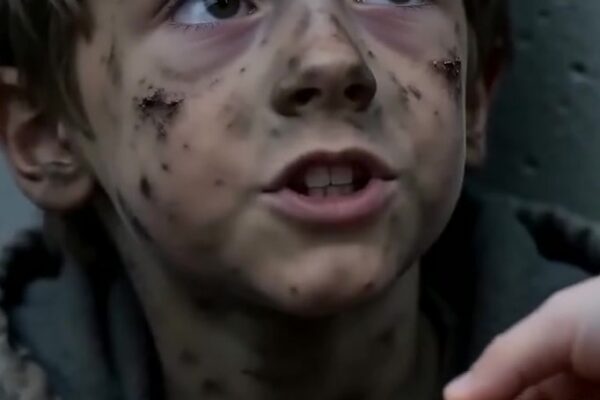
He couldn’t have been older than eight. Maybe nine if you counted the way he carried himself. He wore a worn brown tweed jacket that looked like it belonged to a museum diorama. His hair was tidy in the way kids’ hair isn’t, and his face was calm—no grin, no eager bouncing, none of the usual “look at me” energy.
Just… quiet.
He walked straight to the stage without asking permission. No one stopped him because the room assumed this was part of the entertainment now. The phones tilted, hungry.
Malcolm leaned down with that TV-host smile. “You want a shot, champ?”
The boy didn’t answer. He didn’t even look at Malcolm. He approached the table like it was familiar territory, like he’d been here before in a different life.
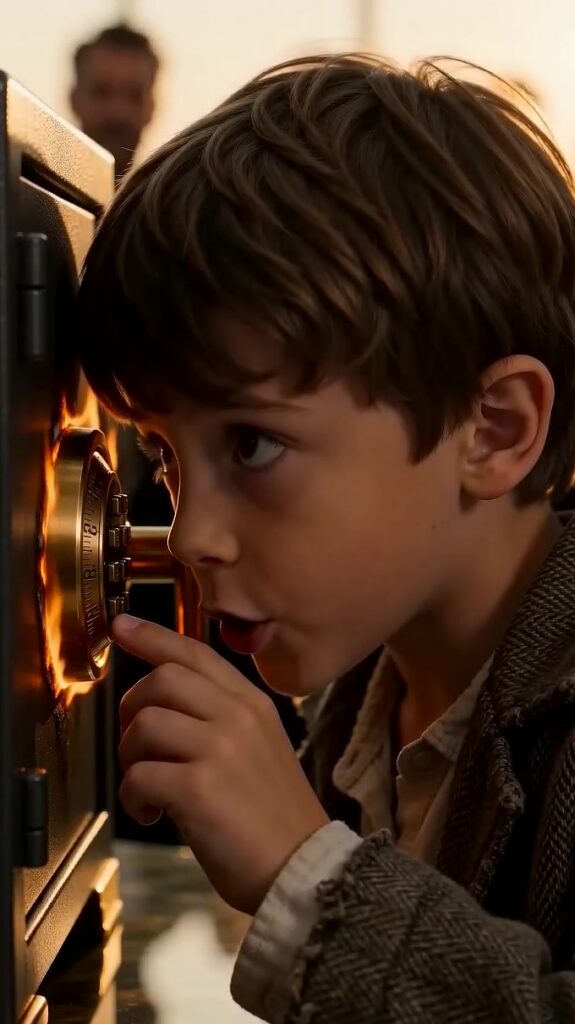
Instead of grabbing the handle, he put his fingertips on the dial. Gentle. Precise. Like he was touching something that might bite.
People laughed again, softer this time, the kind of laugh you do when you’re unsure whether you’re supposed to be laughing. Someone behind me muttered, “That kid’s gonna break his wrist.”
The boy began turning the dial.
Slowly.
Not with the frantic spinning everyone else had tried. He moved it in smooth arcs, pausing in strange places. The laughter thinned out like fog under sunlight. I could actually hear the dial now, a faint, rhythmic scrape.
He leaned in close, cheek almost to the metal. And then I realized what he was doing: he was listening.
The room, which had been buzzing with whispers and camera shutters, started to go quiet in a way that felt accidental at first. People didn’t want to be the one making noise while the kid was doing… whatever this was. Even Malcolm, still smiling, stopped chuckling for a second like he’d forgotten to.
The boy’s voice, when he finally spoke, didn’t sound shy. It sounded careful.
“Are you sure?” he asked, barely above a whisper.
Malcolm snorted. “Am I sure I want you to try? Absolutely. Open it.”
He said it like he was granting a wish. But there was something in his eyes—like he’d just remembered there were rules he didn’t fully understand.
The boy kept turning the dial.
Click.
It was tiny, but in that silence it landed like a pebble in a pond. The kid paused. Adjusted his grip. Turned again. Stopped again. Like he was counting heartbeats.
Malcolm’s smile had started doing that thing where it’s still there, technically, but it’s working too hard to stay. “Hey,” he said, trying for casual. “Where’d you learn that?”
The boy didn’t look up. “My father built this safe.”
You could feel the reaction move through the room like a wave hitting a seawall. A bunch of people gasped at different times, which made it worse somehow. Malcolm straightened. His hand tightened on the microphone.
“That’s… that’s not possible,” Malcolm said. He tried to laugh again, but it came out clipped. “This is a Rusk private vault. Custom.”
The boy made another small adjustment on the dial, then rested his ear against the safe like he was listening for a distant train. “It’s possible,” he said. “He told me where the soft parts are.”
That line should’ve sounded like kid nonsense. It didn’t. It landed cold.
He turned the dial a final time.
One loud metallic click echoed through the ballroom.
The safe door shifted, just enough to show a thin seam of darkness. And then something else happened—something that made every hair on my arms stand up.
A pale mist slipped out.
Not smoke exactly, not steam either. It was too heavy, too deliberate. It curled down the front of the safe like it was tasting the air. Someone in the front row actually stepped back.
Malcolm’s face went from amused to alarmed so fast it was almost funny. Almost. He moved toward the table, reaching out like he could shove the door closed with a palm. “No, no—” he started, and then stopped, like his mouth had finally caught up with his brain.
The boy’s hand stayed on the handle, but he didn’t pull it open wider. He just stood there, steady, watching the mist spill out.
“What’s in there?” someone whispered. I couldn’t tell who. Maybe it was me.
The boy finally looked up at Malcolm. His eyes were the strangest part. Not scary in a horror-movie way. Just… older than they should’ve been. Like he’d already learned the lesson the rest of us were still treating as entertainment.
“You bought it,” the boy said.
Malcolm swallowed. “Bought what?”
The kid’s voice stayed even. “My dad’s work. His blueprints. His time. Then you told people he was a nobody. You said he disappeared.”
Malcolm’s jaw flexed. The crowd’s phones were still up, but no one was laughing now. It felt like we’d all wandered into the middle of something private and sharp.
The boy tapped the edge of the safe door with one finger. “He didn’t disappear,” he said. “He walked away.”
Malcolm tried to recover. “Listen, kid. Whatever you think you know—ten thousand, okay? You did it. You opened it. Take it and go—”
“I didn’t come for your money,” the boy said.
The mist kept creeping out, rolling along the table, spilling over the edge like it was looking for the floor.
Malcolm glanced toward the side of the stage where security stood. They were hesitating, like even they weren’t sure what the correct move was. Because what do you do? Drag an eight-year-old away for opening a safe you dared people to open?
The boy pulled the door open another inch. The room seemed to exhale and freeze at the same time.
Inside wasn’t gold. No stacks of cash. No jewels.
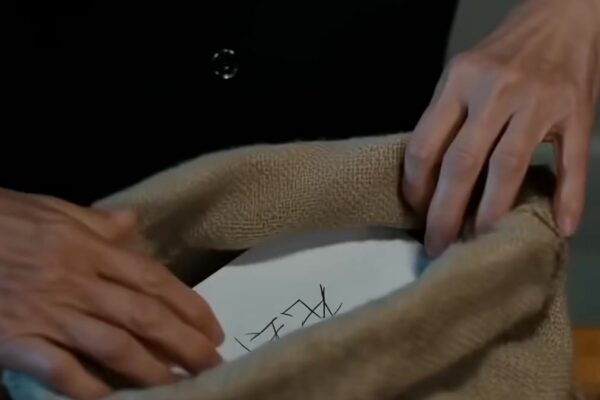
There was a smaller box, matte black, sitting in the center like a single tooth in a jaw. On top of it was an envelope, already addressed in neat handwriting. Even from where I stood, I could read the first line: MALCOLM RUSK—RETURN TO SENDER.
Malcolm’s face went gray. “That’s not—”
“It is,” the boy said. “He told me you’d keep it close. He said you’d lock it up and call it protection.”
“What is it?” Malcolm asked again, but now he sounded like he didn’t want to know.
The boy shrugged, small and adult at once. “The thing you can’t buy your way out of,” he said. Then he slid the envelope toward Malcolm with two fingers.
Malcolm didn’t touch it. His hands hovered like the paper might burn him.
The crowd stayed silent, phones still recording. Nobody seemed to breathe until the boy spoke one last time.
“You offered ten thousand if someone opened it,” he said. “So here’s your deal.”
He nodded at the envelope. “Open it.”
And for the first time all night, Malcolm Rusk looked like a man who didn’t know how to win.