The cart was older than most of the buildings on Mercer Street. Not officially, but it felt that way—paint chipped down to primer, a bell that only sometimes worked, a wheel that squeaked like it was trying to complain to the city. Milo called it “Old Faithful” in the same tone people used for a dog that had bitten them twice but still slept at their feet.
He’d parked under the same sickly streetlamp for six summers, wedged between a laundromat that smelled like burnt dryer sheets and a pawn shop that smelled like old brass and regret. The corner got foot traffic: late shifts, tired parents, teenagers pretending they didn’t want dessert. It wasn’t glamorous, but it was steady. Or it had been, back when steady was a thing.
That night, the air felt thin, like someone had skimmed the joy off the top of the city. Milo’s freezer hummed at a volume that made him worry it would quit out of spite. His cash box was a sad little rattle—quarters and a few singles arranged like they were trying to look important.
He’d counted twice. He wasn’t being dramatic; he was being careful. Between the rent he was late on and the electricity bill he was pretending not to see, he didn’t have room for mistakes. Dinner, if he could call it that, was going to be the last soft-serve in the machine—swirled tight, eaten fast, and followed by a long drink of tap water when he got home.
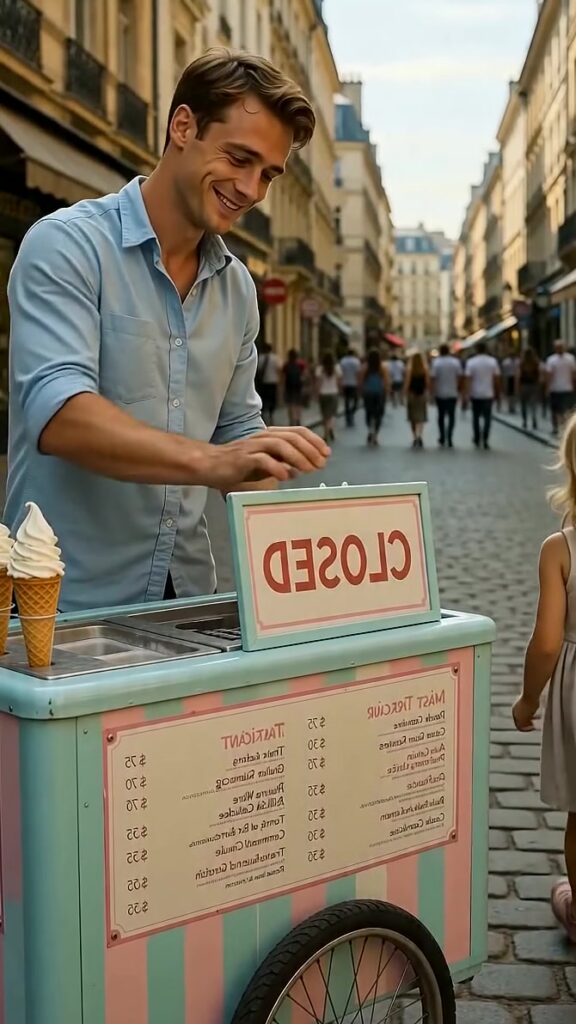
He was just about to flip the sign to CLOSED when he noticed the girl.
At first he thought she was waiting for someone. Kids waited on corners all the time, pretending they weren’t nervous. But she didn’t look around. She didn’t fidget. She stood straight in front of the cart, hands loose at her sides, eyes fixed on the soft-serve lever like it was a magic trick she’d seen once and couldn’t forget.
She wasn’t crying. She wasn’t asking. Her face had that blank, careful stillness that wasn’t calm—it was practiced. Like she’d learned that if you didn’t make noise, you wouldn’t get in trouble for existing.
People walked past her like she was a misplaced shadow. A couple brushed by, arguing about whose turn it was to buy groceries. A man in a suit stepped around her without even shifting his eyes. The city had a million ways of not seeing things, and she fit neatly into one of them.
Milo leaned forward. “Hey,” he said gently, the way you talk to a skittish cat. “You lost?”
The girl’s gaze lifted to his face. Her eyes were huge and dark and tired in a way that didn’t belong on a child. She didn’t answer. She just looked at the sign that said $3.50 CONE, then looked at his hands, then back at the machine.
It wasn’t a performance. That was what got him. There was no angle. No story about a sick brother. No fake sniffles. Just quiet need sitting in a small body.
Milo opened the cash box anyway, like there was a chance he’d missed a stack of bills hiding under the quarters. He hadn’t. It was almost empty. The last cone in the machine suddenly felt heavier, like it had become a decision instead of food.
He could’ve said no. He could’ve said, “Sorry, kid,” and shut the window and wheeled the cart home. He could’ve told himself that he couldn’t save every sad thing the city produced.
Instead he reached for a waffle cone.
“Here,” he said, forcing lightness into his voice. “This one’s on me.”
He pulled the lever, watching the pale ribbon curl into itself, building a tower that leaned just slightly to the left. He handed it out carefully, like he was passing her something fragile.
The girl took it with both hands. Not the way kids grab treats—greedy and thrilled—but the way you hold something that might disappear if you breathe wrong. Her shoulders dropped a fraction, like the world had loosened its grip on her throat.
“Thank you,” she whispered. Her voice was dry, like she didn’t use it much.
Milo smiled, because smiling was easy and cost nothing. “You’re welcome. Eat it before it melts.”
She looked down at the ice cream and then up at him again, as if she was memorizing his face. Then she said, very softly, “I’ll come back for you.”
Milo actually laughed, not unkindly. “Sure,” he said. “I’ll be right here.”
She didn’t smile back. She just nodded once, turned, and walked away with the cone held like a candle in the dark.
Milo closed early. Not out of generosity—out of emptiness. The machine wheezed, the cash box clinked, and the corner suddenly felt like it had turned its back on him. He pushed the cart home, the wheel squeaking like a warning he couldn’t translate.
That was the night everything cracked.
First, the freezer died. Not dramatically, not with sparks—just a quiet stop sometime after midnight. By morning, the last of his inventory was a soft, sweet puddle. The repairman said the compressor had been dying for a while. Milo wondered how he’d missed it. Or maybe he hadn’t missed it; maybe he’d just been too tired to hear it.
Then came the letter from the city. New permits. New fees. A new rule about where carts could park. Mercer Street was suddenly a “no-vending corridor” due to “pedestrian congestion,” which was a polite way of saying a developer had complained.
Milo tried other corners. None of them worked. He lost regulars. He lost momentum. He lost the little bits of luck that keep a person afloat when everything is already wobbly.
Within months, Old Faithful wasn’t faithful anymore. It was a burden he dragged around like an apology. Within a year, he was behind on everything and pretending he wasn’t. Within two, his apartment was gone and the cart was all he had left, parked under different streetlamps like a ghost looking for a home.
People didn’t notice him then, either. He was just another man with tired eyes and a cart that didn’t quite run right.
Years passed. The city renovated itself around him. New shops. New sidewalks. New faces that didn’t know the old streets. Milo’s hair went gray at the temples and then stopped trying. His hands stayed stained with vanilla and grease no matter how much he scrubbed them. He learned where to sit so the wind didn’t cut him in half.
On a late autumn evening, he sat beside the cart—now more rust than paint—watching leaves drag themselves along the curb. He didn’t have ice cream to sell. He barely had the cart. It was, at this point, a habit shaped like metal.
The street was quiet in that expensive way quiet streets get. He was considering whether he could trade the cart for enough cash to eat for two days when a car rolled up and stopped in front of him.
It was not the kind of car that stopped on purpose. Glossy black, windows dark, the engine whispering like it had never struggled for anything in its life. It idled smoothly, patient as a predator.
Milo sat up straighter without meaning to. His first thought was that someone important had made a wrong turn. His second thought was that he’d been in the wrong place at the wrong time again, which had become a theme.
The rear door opened.
A woman stepped out, and the street seemed to rearrange itself around her. She wore a coat that looked like it had been cut from midnight. Her hair was pulled back, sharp and clean. Her heels clicked on the pavement with the confidence of someone who didn’t apologize to the ground for standing on it.
Elegant was the first word that came to mind. The second was powerful. The third was dangerous—not because she held a weapon, but because she didn’t need one.
She didn’t look at the buildings or the street signs. She looked straight at Milo.
He felt, suddenly, the way he had that night on Mercer Street—like he was the only thing in the world that mattered for exactly one breath.
The woman walked toward him, her gaze steady, her expression unreadable. Milo stood slowly, his knees complaining. His throat went dry.
She stopped a few feet away, close enough for him to see the faint scar near her jaw, the kind you don’t get from falling off a bike.
“Milo,” she said, like she’d been saving the name for a long time.
He stared. “Yeah,” he managed. “That’s me.”
Her eyes flicked to the dying cart, then back to his face. Something softened in her expression, just for a second—like a memory trying not to show itself.
“You gave me your dinner,” she said quietly.
Milo’s mind scrambled through old corners and streetlamps and faces. The little girl. The cone held like survival. The whisper he’d laughed off.
He swallowed. “You… you’re—”
“I came back,” she said. And her voice, though richer now, still carried that same careful steadiness. “Like I promised.”
The car idled behind her, patient. The street held its breath. Milo stood there beside his cart, feeling time fold in on itself, and realized he had no idea whether what was coming was a rescue… or the bill for a kindness he’d never thought would be collected.