The air is now different—heavier. Charged. Dangerous. Margaret felt it before she could name it, the way you feel a storm in your bones even if the sky still looks polite. It happened the second the front door of The Lantern clicked shut behind the visitor, sealing them all inside like a jar.
The Lantern was the kind of bar that didn’t try to be anything. Old wood, old songs, old grudges. On most nights it smelled like fryer grease and spilled beer, but tonight the smell was metal—like a handful of coins rubbed together. Like someone had walked in carrying lightning under their coat.
She was wiping the same glass for the third time when she heard the slow shuffle of boots across the floor. Not biker boots. Those were familiar, a background rhythm in this place. These were sharp, deliberate steps, the kind that said the person wearing them never had to apologize for taking up space.
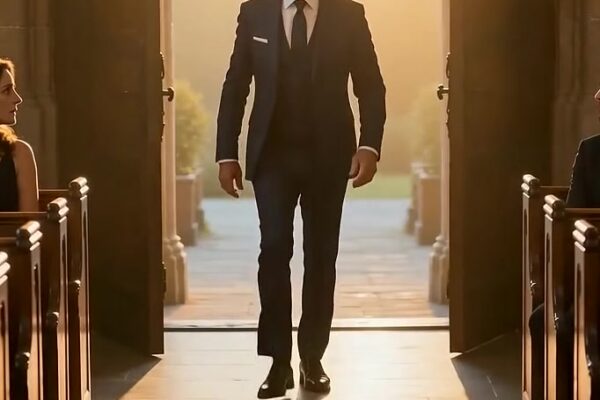
The man looked wrong in here. Suit too clean. Hair too perfect. Smile too practiced. Even the way he held his hands—empty but somehow threatening—made Margaret’s shoulders creep up toward her ears.
“Evening,” he said, like it was his bar.
No one answered. Around the room, the bikers sat in frozen silence, bodies angled toward the center like they’d been arranged that way on purpose. Leather jackets. Rings that caught the light. Faces carved by wind and choices. They didn’t reach for weapons. They didn’t need to. Their stillness was its own kind of warning.
The man’s smile twitched. It tried to stay on his face, but the room wouldn’t let it. He took one step forward, and the floorboards squeaked like they wanted to tell on him.
“You think this is some kind of joke?” he asked, voice smooth but slipping at the edges.
Margaret’s hand tightened around the glass. She didn’t look at him. She looked at the far end of the bar where the shadows were deeper, where the back hallway fed into the storage room and, beyond that, a door that led to the alley. She didn’t know why she looked there, only that something in her chest had started to hum.
Outside, through the thick front window, the streetlights glowed in blurry halos. It had been quiet when the man arrived. Too quiet. Now she heard it: a distant, low vibration, like the city itself had swallowed a growl.
Engines.
The sharply dressed man heard it too. His eyes flicked toward the window, then back to the room, searching for the person in charge. He didn’t know the rules here. He didn’t know that in some places, power didn’t announce itself with a handshake. It waited.
Then the shadows by the hallway shifted, and Bear stepped fully into the light.
Margaret’s breath caught so hard it hurt. Bear wasn’t his real name—she’d never even been sure what it was—but everyone called him that because it fit. Massive frame, shoulders like a doorframe, beard trimmed close, eyes the color of dark beer when it’s held up to a bulb. He moved slowly, not because he had to, but because he didn’t waste motion.
The whole room recalibrated around him, like a compass finding north.
Bear’s voice was calm. That was the scary part. Calm didn’t mean gentle. Calm meant controlled.
“You walked into the wrong family,” he said.
The man’s gaze darted—fast, calculating. He seemed to realize, all at once, that this wasn’t a random bar full of rough customers. This was a den. A meeting place. A living room with a liquor license.
Margaret tried to swallow and realized her mouth had gone dry. The engines outside rose louder, a low rumble that pressed against the walls. The sound wasn’t just noise; it was presence. Backup. A promise.
The suited man cleared his throat. “I’m not here for trouble,” he said, which was the kind of sentence that always arrived ten minutes too late. “I just came for her.” He nodded at Margaret without looking directly at her, like she was an item on a list.
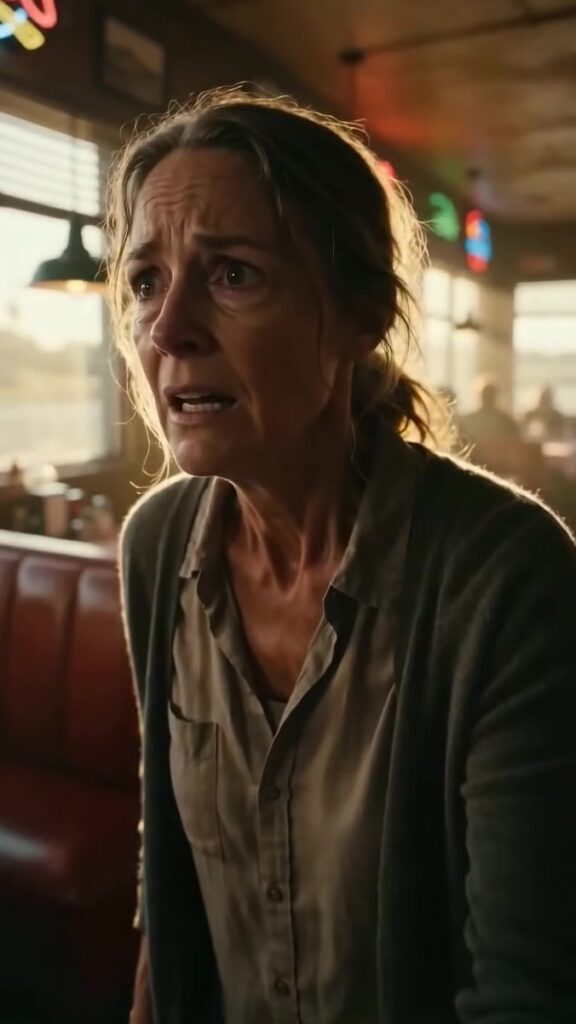
Something in Margaret’s chest snapped into focus. Not fear—she’d done fear for years. This was recognition, the slow, ugly kind that crawled out from under old memories.
The man continued, voice shifting into something almost reasonable. “She owes. People forget that debts don’t expire just because time passes.”
Bear took another step forward. He didn’t rush. He didn’t need to. The distance between them felt like it was shrinking anyway, like the air itself wanted the suited man gone.
“Then you should’ve stayed away from her son,” Bear said, and the words landed heavy, like a hammer set down softly.
Margaret’s knees threatened to fold. Son. The word hit her like a wave. Her eyes flicked to Bear’s face, trying to find the boy inside the man. The last time she’d seen him, he’d been small enough to hide behind her legs, fist clenching her apron while men argued in the kitchen. She remembered the way his eyes had watched everything, learning too fast.
She inhaled, and her breath came out trembling. “…you actually remember me?” she whispered, barely loud enough to be real.
Bear’s gaze shifted to her. For a fraction of a second, something cracked through the calm: pain, sharp and bright. Recognition. A flash of a kid’s face behind those hardened eyes. It vanished quickly, replaced by that controlled stillness, but Margaret saw it. She knew she wasn’t imagining it because her chest hurt in the exact same place it had hurt all those years ago.
The room changed again, like someone had adjusted the temperature.
Soft chaos began. Chairs scraped back. One biker stood. Then another. Slowly, deliberately, like a wave building. Leather creaked. Knuckles popped. Rings clicked as hands flexed. No one spoke, but their bodies did, a silent language that said: You’re outnumbered, and you’re out of your depth.
The suited man’s confidence began to leak away. It wasn’t dramatic at first. Just small things: his shoulders tightening, his jaw working, the way his eyes started moving too fast. He took a half-step back, then caught himself, like retreating was an insult he wasn’t used to swallowing.
The camera in Margaret’s mind—because everything felt like a movie when you were terrified—whip-tilted to the door as it opened again. More bikers entered, not loud, not rowdy, just steady. They filled the doorway, then the space behind it, a wall made of denim and leather and quiet intention. The engines outside climbed, then settled into a steady rumble, like a heartbeat keeping time.
The man licked his lips. “Look,” he said, voice thinner now. “This isn’t personal. I was hired.”
Bear didn’t blink. “It’s personal now.”
Margaret’s eyes burned. Tears gathered, not the panicked kind she’d shed in bathrooms when she thought no one could hear, but something cleaner. Truth finally coming up for air.
She remembered the night she’d run. The way she’d left with nothing but a bag and a child and a promise to herself that she’d never let anyone own her again. She remembered thinking she’d escaped the kind of men who wore suits and smiled while they ruined lives. She’d been wrong, apparently. Or maybe she’d been right—maybe you didn’t escape, you just kept moving until your past got tired of chasing you.
Bear’s voice softened, just a hair, when he spoke again, but it wasn’t for the suited man. It was for her. “You didn’t owe them anything,” he said.
Margaret let out a shaky laugh that sounded like it didn’t belong to her. “They always told me I did.”
Bear’s eyes stayed on hers. “They told you a lot of things.”
The suited man tried one last angle, a desperate little pivot. “You don’t even know what she did,” he snapped, trying to throw the past like a grenade.
Bear’s jaw tightened. “I know what they did,” he replied. “And I know what it cost her.”
Then he turned slightly, just enough to address the room without looking away from the threat. It wasn’t a command exactly. More like permission.
“Get him out,” Bear said.
Silence didn’t break. It detonated.
The bikers moved—not in a chaotic rush, but in coordinated inevitability. Two stepped in front of the suited man. Another blocked the exit. A fourth relieved him of whatever he might’ve been carrying with a quick pat-down that didn’t ask consent. The man sputtered objections that sounded ridiculous in this room, like yelling at the ocean.
Margaret watched, hands pressed flat on the bar as if she needed to anchor herself. Her tears slid down without warning. She wasn’t scared anymore. Not really. She was furious at the years she’d spent looking over her shoulder. Furious at the way she’d convinced herself she was alone.
Bear walked toward her, the room parting for him without anyone thinking about it. He stopped on the other side of the bar. Up close, she could see the faint scar at his temple, the one he’d gotten the summer he’d tried to fix a broken bike with a wrench too big for his hand. She remembered patching him up with trembling fingers, promising she’d do better. Promising she’d keep him safe.
“You’re…” Margaret’s voice failed, then returned. “You’re really him.”
Bear nodded once. Simple. Solid. “Yeah,” he said. “I’m really me.”
Behind them, the door opened again, then closed. The suited man was gone, along with the stale pressure he’d dragged into the room. The air felt lighter now, but not calm. Charged in a different way—like the moment after a lightning strike when you realize you’re still standing.
Margaret wiped her face with the back of her hand, annoyed at herself for crying in public, but too tired to care. “I didn’t think you’d ever find me,” she admitted.
Bear’s eyes didn’t soften much, but his voice did. “You didn’t leave much of a trail,” he said. Then, after a beat: “But I wasn’t looking to collect. I was looking to make sure nobody else did.”
Margaret exhaled, slow and shaky. The truth settled into her bones like warmth. Outside, the engines idled like guardians keeping watch. Inside, the family she hadn’t expected—the loud, rough, stubborn kind—held the room in a protective silence.
Bear leaned in slightly, just enough that only she could hear. “They’re not taking you,” he said. “Not ever again.”
Margaret nodded, tears still clinging, but her spine straightening. “Okay,” she whispered.
And for the first time in a long time, she believed it.