No one stopped for him. That was the strangest part—not the shouting taxis, not the motorbikes weaving like they were playing a video game, not the impatient chorus of horns that made the whole street feel like it had a heartbeat. The strange part was how a kid could stand right there, in the middle of it, and somehow become background noise.
He was maybe ten, maybe twelve. Age is hard when someone’s face has learned too much too early. He stood on the painted line between lanes like it was a balance beam. Bare feet on hot asphalt. Dusty shorts. A shirt that used to be white before the city had its way with it. His hair stuck up in uneven spikes, like he’d slept in a place without pillows—if he’d slept at all.
He wasn’t waving. Not crying. Not performing. He wasn’t even looking at anyone, really. He stared ahead, through traffic and people and the flashing crosswalk sign, as if waiting for something that had a name only he knew.
Commuters flowed around him like water around a rock. A man in a crisp shirt stepped to the side without breaking his phone call. A woman with grocery bags tightened her grip and angled away, eyes forward like ignoring him was a civic duty. A couple of tourists hesitated, then followed the crowd’s unspoken rule: don’t stop, don’t stare, don’t get involved.
He could’ve been a statue. A warning sign. A glitch in the scenery.
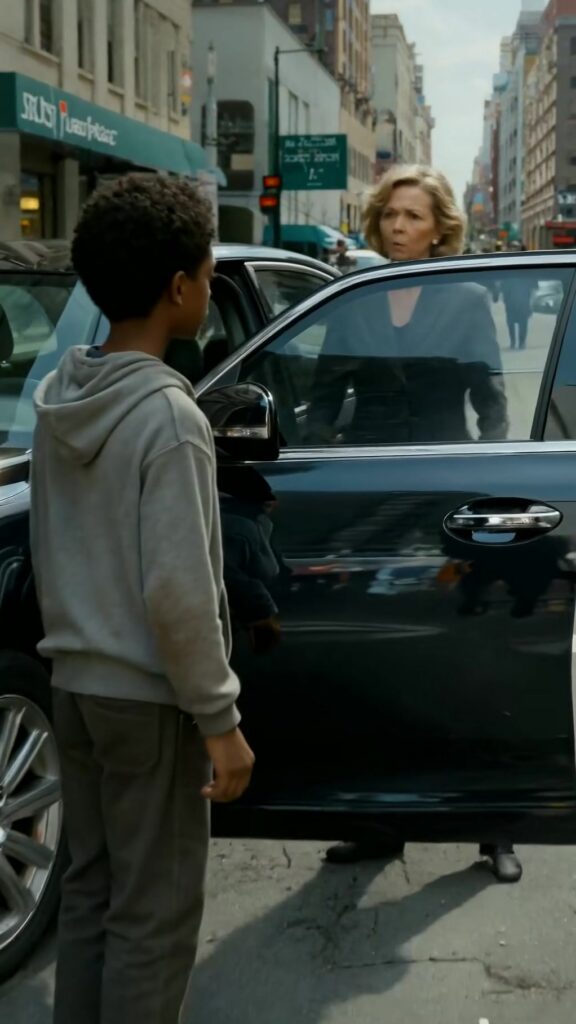
And then, right when the light flipped and the whole street lunged forward, a black luxury sedan cut through the chaos—quietly at first, then sharply, as if it had decided the rules didn’t apply to it. It glided right up to the boy and stopped so hard the tires made that short, angry squeal that turns heads.
For a second, everything did slow down. Not because the city cared about the kid, but because the city respected expensive paint and tinted windows.
The driver’s side window was up. The glass was so dark it looked like a mirror of the street itself. The boy took a step forward. People tensed—expecting a scam, a tantrum, a tragedy. Someone muttered, “Oh no,” like the kid was a storm cloud drifting into their plans.
He reached out and tapped the hood. Not a punch. Not a slam. Just a flat palm, a small, firm knock that said: I’m here. You’re here. Now we have to deal with it.
The door flew open and a woman stepped out like she’d been launched. She was tall, neat, and expensive in the way only certain people manage—tailored suit, hair pinned back, heels that made a confident click. She looked like she belonged in a building with security and a lobby that smelled like lemon.
Her face was already set in irritation, the expression of someone who had been interrupted in the middle of being important.
“What are you doing?” she snapped, voice sharp enough to cut through engines. “Are you out of your mind? You can’t just—”
She stopped. Not because he spoke—he didn’t—but because he looked at her.
It wasn’t a pleading look. It wasn’t defiance either. It was… direct. Quiet. Like he’d been waiting and he’d finally found the right person, and now all he had to do was keep his eyes steady.
Her mouth opened again, probably to scold him for being barefoot on a road full of danger and disease and other people’s problems. But the words didn’t come out right away.
The boy’s right hand lifted slowly. It trembled like it was carrying something heavier than metal. Between his fingers was a watch—old, scratched, the strap broken so it dangled, sad and loose. The face had a long crack across it, like it had taken a hard hit and never recovered. The second hand didn’t move. The numbers were faded but still readable.
The woman’s expression changed as if someone had flipped a switch behind her eyes.
First: confusion. Then recognition so sudden it was almost physical. Her irritation drained out of her like water from a punctured bottle.
“No,” she whispered, and it came out thin. “No, that’s not—”
She took a step closer, her heels forgotten. Her eyes locked on the watch like it was a photograph from a life she’d packed away. “Where did you get that?”
The boy didn’t answer. He held it out, arm extended, offering it with the solemnity of a messenger delivering a sealed letter. A bus honked behind her, and someone yelled something rude about blocking traffic, but the woman didn’t even flinch.
She stared at the watch, then at him, then back at the watch. Her hands hovered, not touching it yet, like she was afraid it would vanish.
“That belongs to…” She swallowed. The polished mask she wore in public had slipped, showing something raw underneath—shock and fear and a kind of grief that had been practiced until it sounded like silence.
The boy’s lips finally moved, just barely. “He told me to bring it,” he said, voice rough like he didn’t use it much. “He said you’d know.”
Her eyes flashed—anger, maybe, at the world, at herself, at the sentence. “Who told you?” she demanded, but it didn’t sound like she expected an easy answer.
The boy glanced toward the sidewalk, not at any person, but at a space near a closed storefront where shadows collected. “A man,” he said. “He sleeps by the river. He was cold. He had this.”
The woman’s breath hitched. The river was only a few blocks away, but it might as well have been another planet in her world.
“He was… alive?” she asked, and then the question seemed to offend her, as if she’d forgotten she was capable of hope. “No. Don’t—don’t say things just to—”
“He’s not now,” the boy said simply. There was no drama in it. Just fact. “He told me to wait here. He said you drive this way.”
Traffic was building behind the car. A delivery driver leaned out of his window to shout. A woman in a blazer stomped around them, annoyed. The city tried to keep being the city.
The well-dressed woman stood very still, looking at the broken watch like it had cracked open a locked room in her head. She finally took it from the boy. Her fingers trembled as much as his had.
On the back of the watch, faint under the scratches, was an engraving. She knew it without reading it, because she’d once traced those letters with her thumb on a different day, in a different life.
“E. & M. — Keep time together.”
She squeezed her eyes shut, a sound escaping her that wasn’t a sob exactly, more like a laugh that had nowhere to go. When she opened them again, she looked at the boy like she was seeing him for the first time—not as a problem, not as a hazard, but as a person who had carried something fragile across a brutal city just to deliver it.
“What’s your name?” she asked, softer now.
He hesitated. “Kavi,” he said.
She nodded like she needed the syllables to anchor her. “Kavi.” Then, quieter: “I’m Mara.” Her gaze darted to the river in her mind, the man she hadn’t looked for, the phone calls she hadn’t returned, the guilt she’d wrapped up in achievements and deadlines. “He… he was my brother.”
Kavi watched her carefully. “He said you wouldn’t believe me,” he said. “He said you’d be angry.”
Mara let out a breath that tasted like regret. “He wasn’t wrong,” she admitted. “I’ve been angry for years.” She looked down at Kavi’s feet—raw soles, a cut on one heel, the toes blackened from dirt and heat. Something about that small detail broke whatever stubborn wall she’d built.
She pulled off her suit jacket in one smooth motion, ignoring the expensive fabric. She crouched—actually crouched, right there on the street like she didn’t care who saw—and draped it around Kavi’s shoulders. It was too big, hanging off him like borrowed authority.
“Come with me,” she said.
Kavi stiffened. “I’m not—”
“Not what?” Mara asked, voice steady. “Not worth stopping for?”
His eyes flickered, just a little. He looked away like he didn’t trust kindness to stay.
Mara stood and turned to her car, then paused. She glanced at the people watching, at the impatient drivers, at the city that had rushed past a barefoot boy without slowing. She didn’t yell. She didn’t make a speech. She simply opened the back door, held it, and waited.
It was a small act, almost invisible compared to the noise around them. But the waiting was different now. It wasn’t the lonely kind. It was the kind that said: I see you. I’m here. I’m not moving until you’re safe.
Kavi took one step, then another. He climbed into the car like he was stepping into a story he didn’t know how to read yet.
Mara got in beside him, still holding the watch in her palm like a tiny, broken compass. She looked out at the street one last time—the same chaos, the same rushing crowd—and felt something shift inside her.
No one had stopped for him.
But she had. And now she wasn’t sure she’d ever be able to go back to pretending she didn’t see the people the city tried to erase.
The driver in the front seat, wide-eyed and confused, asked quietly, “Ma’am… where to?”
Mara stared at the cracked watch face, then at Kavi’s tired profile. “First,” she said, voice trembling but firm, “we’re going to the river.”
She tightened her grip on the watch. “Then,” she added, “we’re going somewhere warm.”
Kavi didn’t smile. Not yet. But he leaned back against the seat, jacket wrapped around him, and for the first time all day, he stopped waiting like the world had already decided his ending.
Outside, horns blared again, and traffic swallowed the moment. But inside the car, the air was different—quiet, heavy, real.
Sometimes a city doesn’t change with a grand gesture.
Sometimes it changes because one person finally stops.