Every morning, people passed him without seeing him. It wasn’t some poetic exaggeration—more like a hard skill New Yorkers had perfected. They could step around a man the way water moves around a rock, eyes forward, coffee angled like a shield, earbuds in, mind already three subway stops ahead.
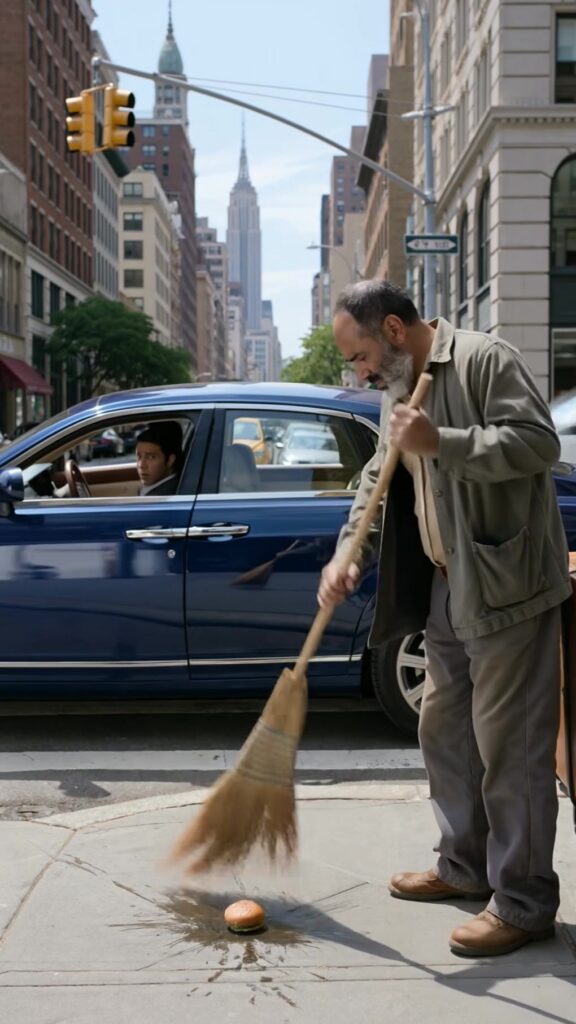
He had a spot on the sidewalk outside a glassy office building that always smelled faintly of cologne and printer paper. The building’s lobby had a fountain no one touched and a security guard who never smiled. Out on the curb, the man swept. Same old straw broom with bristles splayed like a tired paintbrush. Same jacket that had been repaired more times than it had been washed. Same careful motions: pull the grit away from the doors, chase cigarette butts out of the cracks, gather little drifts of city crumbs into a neat pile and pretend that mattered.
People treated him like part of the street—like a parking meter or a dented trash can. Some tossed him a glance that slid right off. Some didn’t even do that. Occasionally a kind person dropped a dollar into the battered tin he kept near the wall, but even that was done with a quick, guilty flick, like they were paying off a conscience instead of seeing a human being.
That afternoon the sun was bright enough to make the windows hurt your eyes. The sidewalk shimmered with heat and impatience. He was sweeping near the curb when a woman stopped in front of him. She was dressed like she’d stepped out of an ad: white designer dress, hair perfect, nails expensive, sunglasses so big they could’ve doubled as a helmet.
She took her time finishing a burger, chewing like she was bored with the concept of food. Then she looked him over with a face that said the city owed her more air than anyone else. She held the last bite like it was a prop, leaned forward, and let it fall right onto the pavement at his feet.
“That’s where trash belongs,” she said, not loudly, just clearly enough to land.
Then she turned on her heel and slid into a black luxury car that purred like it had never known a pothole. The door shut. The car peeled away. She didn’t glance back once.
The man stared at the burger for a second too long. Not because he wanted it—though he probably could’ve eaten it. It was the casualness of it, the way she’d used him as a backdrop for her little moment of cruelty. He lowered his eyes, breathed out, and started sweeping again, slow and quiet, like he could erase the feeling by pushing grit in the right direction.
A few seconds later, another car rolled up. Deep blue, polished like a mirror, the kind of sedan that looked out of place near a curb that had been scraped by a thousand delivery trucks. It stopped gently, as if even the brakes didn’t want to make noise.
Three young men stepped out. They were dressed sharp—tailored suits, clean shoes, haircuts that looked like money. The kind of guys people noticed. The kind of guys people made room for. One of them saw the burger on the ground and frowned, not at the mess, but at the disrespect. He bent down, picked it up carefully like it was evidence, and looked around as if searching for whoever had done it.
Then his gaze landed on the street cleaner’s hands. The broom. The way the fingers held the handle—steady, familiar, slightly stiff in the knuckles. The young man’s face changed so fast it was like someone had pulled a curtain from a window. He took a step closer, eyes narrowing, then widening, then going glossy.
“No,” he said under his breath. “It can’t be.”
His friend behind him went pale, like the sidewalk had tilted. The third guy—taller, with a watch that probably cost more than the cleaner’s whole year—stopped dead, staring like he’d found something he’d been dreaming about.
The first young man took another step, close enough that the cleaner could smell his expensive soap. His voice dropped to something gentler. “It’s really you.”
The broom paused mid-sweep. The older man didn’t look surprised. He looked… tired. Not just body tired, but the tired you get from carrying a name you can’t use and a past you’re not allowed to explain.
“We’ve been looking for you everywhere,” the young man said, the words spilling out like they’d been stored behind his teeth for years. “We thought you were gone. We hired people. We checked hospitals. Shelters. We—” He swallowed, hard. “We couldn’t find you.”
The cleaner finally lifted his eyes. Up close, they weren’t empty. They were sharp and clear and older than the grime on his sleeves. “You shouldn’t be here,” he said quietly.
“We shouldn’t?” The young man let out a shaky laugh, the kind that comes from panic pretending to be humor. “Sir, you saved my life.” He glanced down at the broom like it didn’t make sense. “You saved all of us. You just… disappeared.”
People were starting to notice. A couple slowed down, curious. Someone in a suit paused with a phone halfway out, sniffing at a story. The cleaner’s shoulders tightened. Attention was dangerous. Attention was exactly what he’d been avoiding.
“Not here,” the cleaner murmured.
The tall one stepped forward, voice respectful in a way that didn’t match his age. “Mr. Avery,” he said, using a name that sounded wrong on the sidewalk, like a tuxedo at a laundromat. “Please. We just want to talk.”
The cleaner’s mouth twitched at the name, not quite a smile. “That’s not my name anymore.”
“It is to us,” the first young man said. His eyes shone, angry and grateful at the same time. “You were the guy who walked into that burning warehouse like it was nothing. You pulled people out. You kept your head when the whole place was collapsing. You wouldn’t even let them put your name in the papers.” He lowered his voice. “We were interns. We didn’t even know where the emergency exits were. You told us to follow you and we did. Because you sounded like somebody who never panics.”
Across the street, a delivery bike rattled by. A cab honked. Life kept moving, impatient with sentiment. The cleaner took a breath. “And because I didn’t panic,” he said, “somebody else did. Somebody important. Somebody with enemies. And when you’re close to important people when something bad happens, you become a loose thread.”
The tall man’s jaw flexed. “So you cut yourself loose?”
“I got cut,” the cleaner corrected, not bitter, just factual. “I didn’t want a medal. I wanted to keep breathing.” He tapped the broom lightly on the concrete. “This is quiet. This is invisible. This is safe.”
The first young man stared at him like he couldn’t accept the math of it. “But you’re out here getting treated like that.” He gestured with the hand holding the burger, as if the smashed bun and sauce explained everything wrong with the world. “People don’t—” He stopped himself and exhaled. “They don’t know who you are.”
The cleaner’s eyes flicked toward where the woman’s car had vanished. “Most people don’t want to know,” he said. “It’s easier to walk past.”
A beat passed. The sidewalk noise filled it. Then the cleaner reached into his jacket and pulled out a small pair of gloves, thin and gray, the kind you buy in bulk. He offered them to the young man holding the burger.
“Throw it away properly,” he said. “Not for me. For the sidewalk.”
The young man took the gloves like they were a sacred object. He nodded quickly, wiped his eyes with the back of his wrist like he was mad at himself for doing it, and walked to the corner trash can with careful steps.
When he came back, the tall one spoke again, softer now. “You don’t have to stay like this,” he said. “We’ve got resources. Lawyers. We can keep you protected. You can have a place. A real one.”
The cleaner looked past them at the stream of strangers, each one wrapped in their own urgency. He imagined an apartment with a door that locked, a bed that didn’t smell like old rain, a kitchen where he didn’t have to count change. He imagined someone using his name again without it sounding like a trap.
Then he looked down at the broom. At the little pile of dirt he’d been gathering, the tiny mess he could actually control.
“Maybe,” he said, and the word surprised even him. “But not today.”
The first young man opened his mouth to argue, then closed it. He nodded instead, like he finally understood this wasn’t stubbornness—it was survival. “Okay,” he said. “But we’re not leaving without something.”
He reached into his wallet and pulled out a card—plain, no flashy logo, just a name and a number. He held it out. “Call us,” he said. “Anytime. Even if it’s just to tell us you’re okay.”
The cleaner hesitated, then took it and slipped it into an inner pocket, close to his chest. “I’ll think about it,” he said.
“Promise?” the young man asked, voice cracking on the word like he hated needing it.
The cleaner’s tired eyes softened. “Yeah,” he said. “I promise I’ll think.”
The three men stepped back toward their car, still watching him like they were afraid he’d evaporate. Before he got in, the first one glanced at the sidewalk, then at the broom. “Sir,” he said, “you shouldn’t have to be invisible.”
The cleaner resumed sweeping, the bristles whispering against concrete. He didn’t look up when he answered. “Some days,” he said, “invisible is exactly what keeps you alive.”
The blue sedan pulled away, quiet as a secret. The sidewalk swallowed the space it left behind. People rushed past again, eyes forward, coffee shields up, earbuds in.
But the old man’s hand was steadier now. In his pocket, the card sat like a small, warm weight. And for the first time in a long time, as he moved the dirt into a neat line, he let himself believe the city might not be done seeing him yet.