The boutique was the kind of place that made you instinctively lower your voice, even if you were only thinking about breathing. Everything gleamed. The glass cases were spotless. The lights overhead were warm and flattering, like they’d been trained to make diamonds look alive.
So when a girl in an oversized hoodie and shoes that didn’t match stepped inside, the room reacted the way expensive rooms often do: it tightened.
She was maybe ten. Maybe nine. Her hair had been brushed at some point in the last week, but the street had clearly gotten a vote. She held something in her fist like it was both a secret and a lifeline, knuckles white around a chain that had lost its shine.
A bell chimed softly over the door, and a few heads turned. Not in a friendly “Welcome!” way. More like the way people look at a fly that’s landed in their drink.
Near the center display, a woman in a sleek cream coat paused mid-sentence. Her lipstick was the kind that didn’t smudge. Her hair was pinned into a perfect twist. She had the posture of someone who’d never had to ask for anything twice.
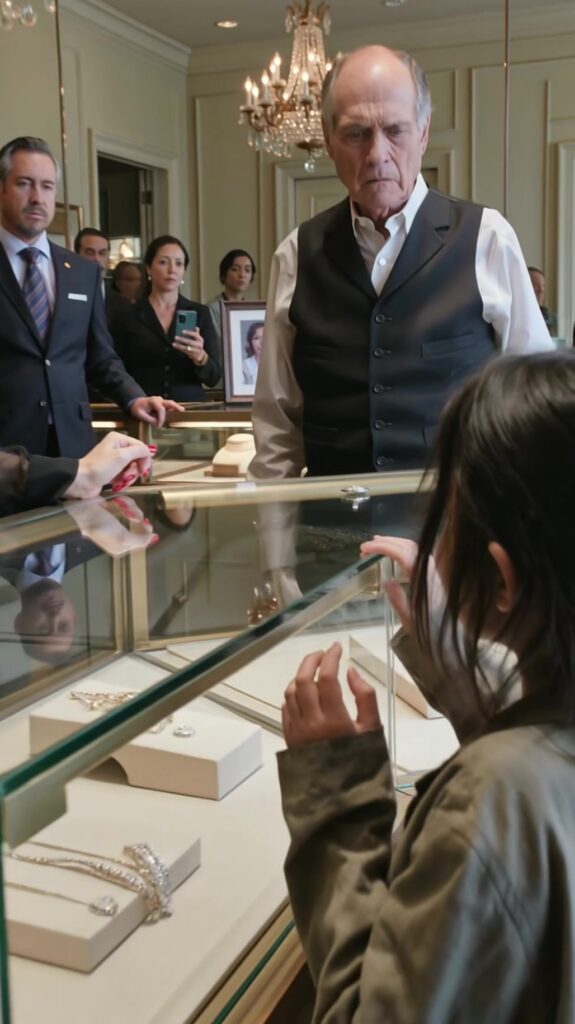
She watched the girl drift closer to the glass case with the smaller items—charms and pendants and little things that people bought when they wanted to feel sentimental without committing to a ring.
The girl didn’t touch the glass. She didn’t press her nose to it. She just stood there, staring at her own reflection tangled with sparkles.
“Excuse me,” the woman said, voice bright and sharp as a new bracelet clasp. “This isn’t a shelter.”
The girl startled. “I’m not… I’m not here to—”
“To steal?” the woman supplied, smiling like she’d made a clever joke. “Or to beg? Because both are exhausting.”
A saleswoman in black glanced up from polishing a watch, eyes flicking between them like she was deciding whether to intervene or pretend she was invisible.
The girl swallowed. “I just need to show something. To the man who— the man who made it.”
The woman’s gaze dropped to the chain slipping between the girl’s fingers. It was thin, grimy, and the pendant at the end looked like a dull pebble that had been run over by a bicycle a few times. Not precious. Not impressive. Certainly not boutique-appropriate.
“Oh,” the woman said, and her smile sharpened. “Let’s see.”
Before the girl could tuck it away, the woman reached out. One sharp movement. A practiced snatch. The chain slid through the girl’s fist, and the pendant clacked onto the counter as the woman set it down with theatrical force.
“Everyone,” she announced, loud enough to be heard over the soft background music. “Look at the treasure this little stray thinks makes her special.”
Heads turned. A man by the engagement rings froze mid-step. A couple near the bracelets stopped pretending they weren’t arguing. Someone near the diamond wall lifted a phone, not even trying to be subtle.
The girl lunged forward instantly, eyes already wet. “Please— don’t! My mom said only the man who sold the other half should see it. Please give it back.”
The woman laughed, the sound echoing under the chandelier like it belonged there. “The other half?” She picked up the pendant between two fingers, as if worried it might be contagious. “Sweetheart, this thing has seen more gutters than jewelry boxes.”
Behind the counter, the elderly jeweler finally looked up.
He hadn’t been part of the scene until now. He was just a presence in the background, a man with silver hair combed neatly back and hands that moved like they’d spent a lifetime doing careful things. He was standing in the soft pool of light behind the register, half-hidden by velvet trays and the weight of the room’s quiet rules.
His eyes landed on the pendant.
Once.
Then again, slower, like his brain had tripped and needed to re-read reality.
And something shifted.
All the color drained from his face so fast it was like someone had turned a dimmer switch on him. His mouth opened slightly. His hands—hands that had probably held diamonds worth more than houses—began to tremble.
The woman noticed, her grin faltering. “Oh, come on,” she said, still trying to sound amused. “Don’t tell me you’re buying this little performance.”
The jeweler didn’t answer her. He leaned forward, eyes fixed on the pendant like it was a live wire.
“May I,” he said quietly, not to the woman, but to the girl.
The girl nodded fast, wiping her cheeks with the back of her sleeve. “Yes. But—please be careful. It’s… it’s important.”
The jeweler reached out. Very carefully, he took the pendant from the counter as if it might crumble. It looked even worse up close—tarnished, scratched, the hinge stiff with age and grime. Not boutique-worthy. Not anyone-worthy, unless you knew the story inside it.
He thumbed the tiny clasp, and for a second it didn’t budge. His breath hitched. Then it opened with a soft click that sounded too loud in the sudden hush.
Inside was half of an old photograph.
Not a tiny printed charm photo, not a modern glossy thing. An actual old photo, browned at the edges, cut cleanly down the middle. It showed a woman’s smile—only half of it—and the corner of a baby’s blanket.
The jeweler’s face changed again, like a door opening onto a room he’d kept locked for decades.
His eyes slid upward. Not to the customers, not to the woman in the cream coat. To the back wall behind him.
There, half-hidden behind a glass cabinet that customers rarely noticed, hung a framed photograph. It wasn’t for sale. It wasn’t decorative. It was personal in a way that didn’t belong in a place designed for transactions.
Some people had asked about it over the years, but the sales staff always redirected them. The photo was old and plain compared to everything else in the shop, and it had an invisible “don’t touch” sign on it.
The jeweler’s throat bobbed as he swallowed. Then he stepped to the wall, unhooked the frame with hands that were now shaking openly, and returned to the counter.
The boutique had gone so quiet you could hear the faint buzz of the display lights.
He placed the framed photo beside the pendant and, with a reverence that made the woman’s earlier mockery feel suddenly dangerous, opened the frame.
He took out the photograph inside.
And set it down next to the torn half.
The two pieces met like they’d been waiting years for the chance.
The smiling woman in the photo became whole. The baby in the blanket suddenly had a complete face—tiny nose, closed eyes, a soft cheek. The background, a porch with climbing roses, lined up perfectly.
The jeweler’s breath left him in a thin, broken sound. His eyes filled, fast and bright.
“I made this,” he whispered, voice unsteady. “I made these as a pair… for my daughter.” He blinked hard, tears spilling anyway. “And for her newborn. Before they vanished.”
The woman in the cream coat took an involuntary step back. Her confidence cracked like a chip in fine china. “This is ridiculous,” she said, but her voice had lost its edge. “It’s probably stolen.”
“It’s not stolen,” the girl said, quieter than before, but firm in a way that surprised even her. “My mom gave it to me. She said if anything happened… I had to find the man who would recognize it.”
The jeweler looked at the girl again. Not at her clothes. Not at the dirt at the hem of her hoodie. At her face.
He stared as if he were trying to place a memory that had been blurred by grief.
The girl sniffed, cheeks wet, chin trembling. When she looked up, her eyes caught the light—an unusual gray-green that didn’t seem common in the room or anywhere else.
The jeweler froze.
It wasn’t the pendant anymore. It was her.
He raised a hand slowly, not touching her, just hovering near her temple as if he was afraid she might disappear if he moved too quickly.
“You have her eyes,” he said. It came out hoarse, like he hadn’t used that part of his voice in years. “You have Elina’s eyes.”
The girl swallowed. “My mom’s name is Lina,” she said. “Just… Lina.”
The jeweler made a sound between a laugh and a sob, and it startled everyone because it didn’t fit the polished air of the shop. He looked down at the photo again, at the young woman’s face now whole, and then back at the child standing in front of him like an answer to a question he’d given up asking.
“Where is she?” he asked, softly, like he was asking the universe instead of the girl.
The girl’s mouth wobbled. “I don’t know. She told me to run when the men came. She said she’d meet me at the library. I waited. Then… then I waited some more.” She wiped her nose on her sleeve, embarrassed and exhausted. “I’ve been trying to find someone who knows what this is.”
The saleswoman behind the counter finally moved, one hand over her mouth, eyes wide with something like shame. A customer near the rings lowered his phone, suddenly looking guilty about filming.
The woman in the cream coat stared at the pendant in the jeweler’s trembling hands as if it had turned into a snake. “I didn’t know,” she murmured, but no one made room for her apology.
The jeweler gently closed the pendant, then opened it again, as if confirming it was real. He looked at the child like she was a fragile artifact and a living person at the same time.
“What’s your name?” he asked.
“Mara,” she said.
He nodded slowly, repeating it under his breath like a prayer he’d forgotten. “Mara.” Then he straightened, drawing in a breath that tasted like decision. He slid the photo halves together again and held them carefully so the picture stayed whole. “Mara, you’re not leaving this shop alone.”
The girl’s eyes widened in fear for a second—street instincts kicking in.
He shook his head quickly. “No, no. Not like that.” He glanced around the room, and for the first time, there was something in his gaze that made the boutique feel less like a showroom and more like a place where truth could happen. “We’re going to call someone. The police, yes—but the right kind. And my lawyer. And we’re going to find your mother.”
The girl’s voice came out tiny. “You can do that?”
He swallowed, his jaw tightening. “I have spent years thinking I failed my daughter,” he said. “If that pendant brought you here, then maybe it didn’t end the way I feared. Maybe… maybe it paused the story long enough for us to catch up.”
He held out his hand, palm up, an invitation without pressure.
Mara stared at it, then at the pendant, then at the framed photo now lying open on the counter. The room was still watching, but it felt different now. Less like an audience and more like witnesses.
She placed her small hand into his.
And in a shop built for glitter and status, the dirtiest little pendant in the place did exactly what her mother promised it would do: it stopped everyone long enough for a lost family to be seen.