It was the kind of afternoon that made you forget the world had teeth.
Not a cloud, not a siren, not even a dog barking. Just sun on pavement and the soft, steady whisper of bike tires rolling over the shoulder. The road outside Oak Ridge was basically a long gray ribbon stitched between pine trees and sleepy fields, the kind of place people only drove through if they had to.
Which is why Mark liked it.
“Straight line,” he called, more out of habit than worry, watching his son pedal a few yards ahead. Ethan’s bright helmet bobbed like a little lighthouse. He was twelve, skinny and careful, and he rode like every crack in the asphalt might be a trapdoor.
“I’m straight,” Ethan shouted back, not turning around. He never turned around. Mark had taught him that one early: eyes forward, don’t wobble, don’t give anyone a reason to get close.
Mark followed on his own bike, relaxed enough to enjoy the warmth in his shoulders. He’d promised Ethan a ride all week. School had been rough. Middle school had a way of making kids feel like they were always in the wrong place, no matter where they stood.
And today was supposed to be simple. Pedal out to the old water tower. Drink a Gatorade. Pedal back. Normal.
Then the engine arrived.
At first it was just a low rumble, like thunder that couldn’t make up its mind. Mark glanced over his shoulder and saw nothing but empty road and heat shimmer. The sound grew fast, swelling into something sharp and impatient.
“Ethan!” Mark’s voice cracked without permission. “Pull right!”
Ethan drifted closer to the white line, already doing what he’d been taught. Mark’s legs pumped hard, trying to close the gap between them.
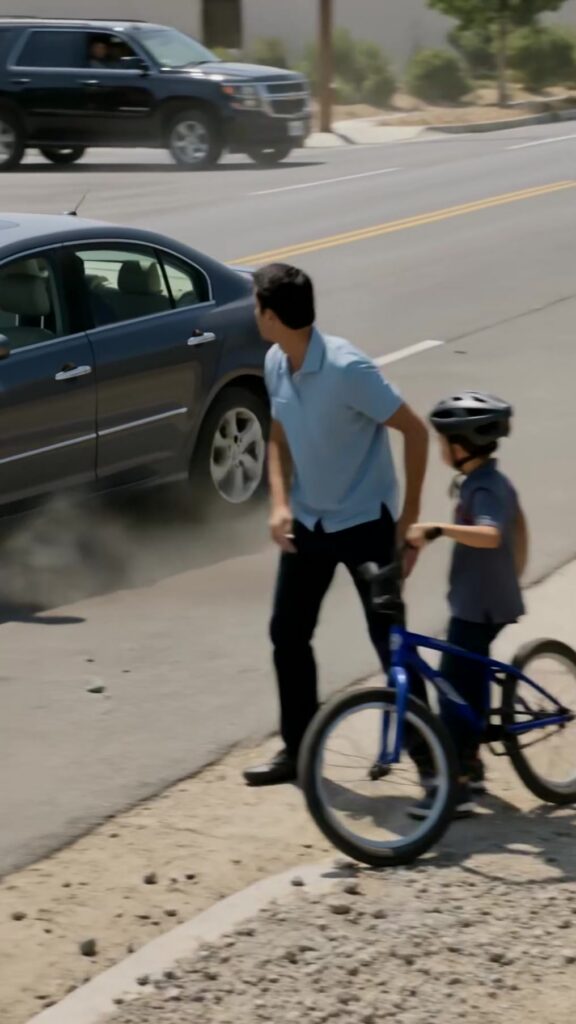
The sedan came into view like it had been fired from a cannon—dark, glossy, the kind of car that looked expensive even at a distance. It wasn’t just speeding. It was wandering, nosing toward the shoulder, then snapping back, like the driver was testing the space.
Mark felt his stomach drop as the sedan’s front end angled toward Ethan.
It wasn’t an accident kind of swerve. It had intent. A lazy cruelty.
The car slid closer. Too close. Gravel snapped under Ethan’s tires. His handlebars jerked, and for a fraction of a second Mark saw it: the wobble that becomes a fall, the fall that becomes wheels and glass and a story you never stop replaying.
“ETHAN!”
Mark launched off his pedals, abandoning any dignity, any sense of traffic rules, cutting straight toward his son. He grabbed the back of Ethan’s jersey and yanked him toward the ditch-side grass. Ethan shouted, surprised and offended, and then the sedan’s brakes screamed so hard the sound seemed to peel the air open.
The car stopped diagonally across the lane, blocking their way like it owned the road.
Ethan’s eyes were huge. “Dad—what—”
“Stay behind me,” Mark said, breathless. His heart was slamming hard enough to bruise his ribs.
The sedan idled, purring, as if it had all day.
The driver’s window rolled down with the slow confidence of someone used to getting the last word. The man behind it wasn’t old, maybe late thirties. Clean haircut. Sunglasses that hid his eyes. He wore a grin that didn’t match the situation, like he’d just told a joke in a quiet room and was waiting for applause.
“Nice reflexes,” the man said, voice easy. “But maybe you should teach your kid where he belongs.”
Mark stared at him, trying to decide which kind of danger he was looking at. Drunk? Angry? Just a bully with a car? The words landed weirdly, like they weren’t about bikes at all.
“What did you say?” Mark asked.
The man’s smile widened. “I said, he’s taking up the whole shoulder. Some people think they can just… be anywhere.” He tilted his head, as if studying Ethan like an object. “This isn’t a playground.”
Ethan made a small sound behind Mark, half fear, half confusion. Mark could feel him trembling through the air.
Mark reached into his pocket and pulled out his phone. It wasn’t a heroic gesture. It was the only thing he had that felt like leverage. “I’m calling the police,” he said, making his voice steady.
The driver laughed. Not loud, just amused. “Go ahead. Call whoever you want.”
Mark held the phone up anyway. His thumb hovered over the emergency button. He wanted to record. He wanted proof. He wanted this moment to be real in a way that didn’t rely on his shaking memory.
“Sir,” Mark said, “you almost hit a kid.”
“Almost,” the man repeated, savoring it. “Which means I didn’t.”
Mark clicked the camera on. The red recording dot appeared. He lifted the phone higher, framing the man’s face in the window.
That’s when the driver’s grin twitched, just slightly.
Not because of the phone.
Because of what was happening behind him.
Mark heard it before he saw it: tires on asphalt, not fast, not loud, but deliberate. Two engines, maybe three, moving like they were part of the same thought.
In the sedan’s rearview mirror, dark shapes grew larger. Black SUVs—boxy, clean, tinted windows—slid into view from the direction Mark and Ethan had come. At the same time, from up the road beyond the sedan’s hood, another black SUV rolled in, as quiet as a shadow.
Slow. Silent. Blocking the exits like hands closing around something small.
The man’s smile drained away as if someone pulled a plug.
He looked left, right, then forward, trying to do math that didn’t add up. The sedan idled in the middle like a stupid chess move. His fingers tightened on the steering wheel.
One SUV stopped behind him, leaving no space to reverse. Another stopped ahead, leaving no space to go forward. A third angled slightly, sealing the shoulder.
Ethan whispered, “Dad… are those cops?”
“I don’t know,” Mark whispered back, because he honestly didn’t.
The first SUV’s driver door opened. A woman stepped out, mid-forties, short hair, plain clothes, no visible badge. She moved with the kind of calm that didn’t come from bravery, but from familiarity. Like she’d done this too many times to be impressed by it.
Then another door opened. A man got out, tall, wearing a windbreaker and jeans, his face serious in a way that made Mark’s skin prickle. Not police-serious. Something else.
The driver in the sedan swallowed, visible even through the sunglasses. “What is this?” he muttered, mostly to himself.
The woman approached the driver’s window and leaned slightly, speaking in a tone Mark couldn’t hear. The man in the windbreaker stayed back, scanning, eyes sweeping the road, the trees, Mark and Ethan. He saw Mark holding his phone and gave him a single nod that somehow said: keep recording.
The driver tried to laugh again, but it came out thin. “Hey,” he said, louder now. “This is ridiculous. I didn’t do anything.”
The woman straightened. Her voice carried just enough to reach Mark. “You did plenty,” she said. “Step out of the vehicle.”
“Or what?” the driver snapped, and for a second the old arrogance flashed back. He leaned out a little, chin lifted. “You think you can block me in? You people don’t own the road.”
“No,” the woman said, still calm. “But we know what you’ve been doing on it.”
Mark’s brain tried to catch up. This wasn’t random. The SUVs weren’t an accident. Someone had been waiting. Watching. For him? For Ethan? For the sedan?
The sedan driver’s jaw worked, and Mark saw sweat appear at his temple. He glanced at Mark’s phone again, then at Ethan, then back at the SUVs like they were suddenly larger than they should be.
“Dad,” Ethan whispered, tugging the back of Mark’s shirt. “I don’t like this.”
“Me neither,” Mark murmured, sliding his free arm behind Ethan like a shield. “Stay close.”
The man in the windbreaker walked toward Mark and Ethan, stopping a respectful distance away. He didn’t smile. He didn’t need to. “Are you two okay?” he asked.
Mark swallowed. “He almost hit my son. On purpose.”
The man nodded once, like that confirmed something. “We know,” he said quietly. “You weren’t the first call today.”
Mark’s grip tightened around his phone. “Who are you?”
“People who got tired of waiting for him to hurt someone,” the man said. He glanced toward the sedan. The driver was still arguing, but his voice had dropped. “Keep your son behind you. Keep filming. And when we tell you to leave, you leave.”
Mark’s mouth went dry. “Is he—”
“He’s been using this road like a hunting lane,” the man cut in, tone flat. “He likes the quiet places. Fewer witnesses.”
The word hunting made Mark’s stomach twist.
Back at the sedan, the woman reached into her pocket and held up something small and metallic. A badge? A key fob? Mark couldn’t tell. But whatever it was, it drained the last bit of fight from the driver’s posture.
His shoulders sagged. His hands lifted, slow.
The trap had snapped shut, and the thing inside it finally understood it wasn’t the predator anymore.
Mark looked down at Ethan. His son’s face was pale, but his eyes were focused, tracking everything with a new sharpness. Middle school problems felt far away in that moment, replaced by something heavier and real.
Mark lowered the phone slightly, then lifted it again, keeping the red dot rolling. His voice came out rough. “Ethan,” he said softly, “remember this: you belong anywhere you’re allowed to be. Don’t let anyone tell you different.”
Ethan blinked hard, then nodded once.
Down the road, the man who’d smiled at nearly killing a kid stared at the black SUVs hemming him in. His sunglasses didn’t help anymore. You could see the fear through them anyway.