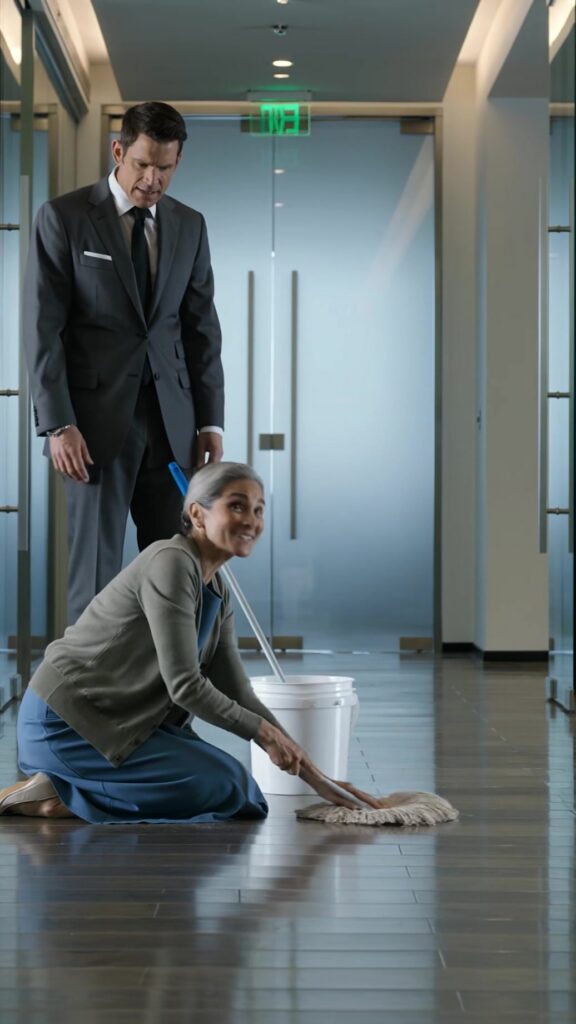
He’d crossed that hallway so often his feet could’ve found the way without him. Same mirror-shiny floor that made shoes click like punctuation. Same glass walls that kept the noise trapped inside other people’s offices. Same expensive hush that made you feel like you were supposed to whisper your thoughts. This place had been his daydream when he was twenty-two and broke, and his obsession when he was thirty-two and unstoppable.
He built it. Not alone, but with enough sleepless nights to feel like he personally laid every tile. He liked the corridor because it was predictable. Predictable meant controlled, and controlled meant safe. So when he saw someone at the far end, crouched down with a bucket and a mop, he didn’t think “problem.” He thought “inconvenience.” The cleaning crew had a schedule. There were machines for this. Nobody was supposed to be scrubbing the floor by hand in the middle of the day.
He started walking faster, irritation already rising. Then the woman lifted her head.
It took a beat for his brain to catch up to his eyes. Gray hair pulled into a simple tie. A cardigan that looked like it had lived through a thousand washes. Hands that were red from soap and cold water. And a face he knew more intimately than his own—because it was the face he’d spent his whole life running toward, running away from, trying to impress, trying not to worry.
“Mom?” The word came out like it had been pulled from him. He felt ridiculous, standing there in a tailored suit like a stranger, while his mother knelt on his polished floor. “What—what are you doing here? Why are you… cleaning?”
She gave him a small smile that didn’t reach her eyes. The kind of smile that said, it’s fine, it’s fine, don’t make a scene, even though nothing was fine. “Oh, honey. Someone said it needed doing. I didn’t want to be in the way.” She looked down and wrung the mop handle like it was a stick she could hold on to while everything else tilted. “It’s just a little work.”
He opened his mouth, ready to call Security, ready to summon HR, ready to demand a dozen explanations. Then the sound of heels arrived first, sharp and confident, like someone had ordered the hallway to pay attention. A woman stepped into the corridor wearing a white blazer cut so clean it looked like it came with its own rulebook. She was younger than him by a few years, maybe, and her expression sat somewhere between bored and entertained.
“There you are,” she said, like she’d been expecting him. Her gaze flicked to his mother and lingered there like she was appraising a piece of furniture. “She asked about openings. I told her we value initiative here. Everyone earns their keep.” She said it casually, like she was explaining how the coffee machine worked.
His chest tightened. He knew her. Mia Grayson—new head of operations, a résumé with all the right names and none of the right warmth. She’d been hired because she was brilliant with systems and ruthless with budgets. He’d told himself that was a good balance for his leadership. Now he watched her stand over his mother like the hallway was her stage.
“You knew who she was,” he said. It wasn’t a question. His voice came out quiet, which surprised him, because rage usually made him loud.
Mia’s lips curved. “I know who everyone is. It’s my job.” She tilted her head. “Unless she forgot to mention who gave her the assignment.”
His mother flinched like the words had teeth. She lowered her eyes so fast it made his stomach drop. Fear—real fear—moved through her like a shadow. “Please,” she whispered, not to Mia, but to him. “Don’t make this worse.”
That sentence cracked the hallway open. It wasn’t just a humiliating task. It was leverage. Control. Something repeated enough times that his mother had learned to shrink before it got ugly. His fists clenched hard enough to hurt, but he forced them open again. If he exploded, Mia would call him emotional. If he stayed calm, he could cut deeper.
His mother reached into her cardigan pocket with shaky fingers and pulled out a folded piece of paper. It looked like it had been opened and closed a hundred times, the edges soft with handling. “Before you say anything,” she said, her voice thin, “read what she made me sign.”
He took it carefully, like it might fall apart. The paper smelled faintly of lemon cleaner and something older—her laundry soap from home. He unfolded it and scanned the text. At the top was his company’s letterhead, crisp and official. The title was a bland little phrase: VOLUNTEER TEMPORARY ASSIGNMENT AGREEMENT. Underneath, in heavy legal language, it stated that the signer agreed to perform tasks as assigned, waived the right to compensation, and—his vision tunneled—acknowledged that failure to comply could result in “review of existing liabilities and reporting of misrepresentation.”
He read that last line again. Existing liabilities. Misrepresentation. Threats dressed up like policy. His mother’s signature sat at the bottom, slightly crooked. Next to it was a second line: Witnessed by: M. Grayson.
“What liabilities?” he asked his mother, and hated that he even had to. Hated that whatever this was, she’d been carrying it alone.
She swallowed. “It’s… it’s from years ago. After your dad left, I borrowed money. From the wrong people. I never told you because you were already working two jobs and trying to go to school.” Her eyes filled. “I paid it back, or I thought I did. But Mia—she found the old paperwork. She said if I caused trouble, she could make it look like fraud. Like I lied on forms. I don’t even understand half of it.”
Mia crossed her arms, unbothered. “I gave her options. That’s generous in corporate terms.”
Something cold settled behind his ribs. Not anger now—clarity. He’d been so proud of the fortress he built that he’d missed the cracks where people like Mia could slide in. He looked at the glass walls around them and realized how many eyes were watching without being seen.
He reached into his pocket and pulled out his phone. “You like documentation, Mia? Great.” He tapped his screen, starting a recording, and held it openly. “Say that again. That you threatened to report my mother for ‘misrepresentation’ unless she worked for free. Explain it in your generous corporate terms.”
Mia’s smirk hesitated. Just a stutter of confidence. “Recording without consent—”
“We’re in a public corridor in my building,” he said. “And I’m the CEO. Keep going. Or stop talking. Either works.” He turned slightly, angling the camera so it included his mother and the bucket. “Also, I’m calling legal right now. My legal. Not yours.”
For the first time, Mia looked around as if noticing the corridor had other doors, other people, other consequences. She lifted her chin anyway. “You’re overreacting. This is about maintaining standards.”
He nodded once, almost polite. “You’re right. Standards matter.” Then he looked at his mother. “Mom, put the mop down. Please.”
Her hands hesitated, as if she needed permission to stop being small. Then she set the mop against the wall. The simple act felt like a rebellion.
He held out his arm, and after a moment she took it. He felt how light she was, how careful, like she expected the floor to tilt if she stepped wrong. It made him furious in a new way—at himself, for not noticing her fear sooner. “You’re not in trouble,” he said softly, for her. “You never were. You’re my mother. You’re not a lever anyone gets to pull.”
He turned his gaze back to Mia. “You’re suspended effective immediately. Security will escort you to your office. IT will freeze your access. HR and legal will meet with you by end of day.” He let the words land, heavy and clean. “And if you so much as contact her again, I’ll personally file for a restraining order and make your professional life a case study in consequences.”
Mia opened her mouth, then seemed to calculate the odds and didn’t like the answer. She spun on her heel, the confident click of her shoes suddenly sounding like retreat.
The hallway breathed again. The silence didn’t feel expensive anymore. It felt ashamed.
He guided his mother toward his office, past the glass walls and the watching faces. “I should’ve called more,” he admitted. “I should’ve—”
She squeezed his arm, a small pressure that stopped him. “You built something big,” she said. “I didn’t want to be a problem in it.”
He paused at his door. “You’re not a problem,” he said. “You’re the reason.” He glanced back down the corridor, at the spotless floor that had suddenly become the ugliest thing in the building. “And I’m done walking through this place like nothing can touch me. Clearly, it can.”
Inside his office, he set the folded agreement on his desk like evidence. Then he poured his mother a glass of water and sat across from her—not behind the desk, not above her, just with her. Outside, the corridor waited, polished and quiet. But for the first time in a thousand walks, he knew he was going to slow down and see what had been happening in his own house.