No one paid attention to the little boy at first. Not the commuters glued to their phones, not the street vendors yelling about mangoes and cheap sunglasses, not the taxi drivers honking like it was a sport. He was just another kid in the city—small, dusty, hair too long, toes black from walking barefoot on hot pavement.
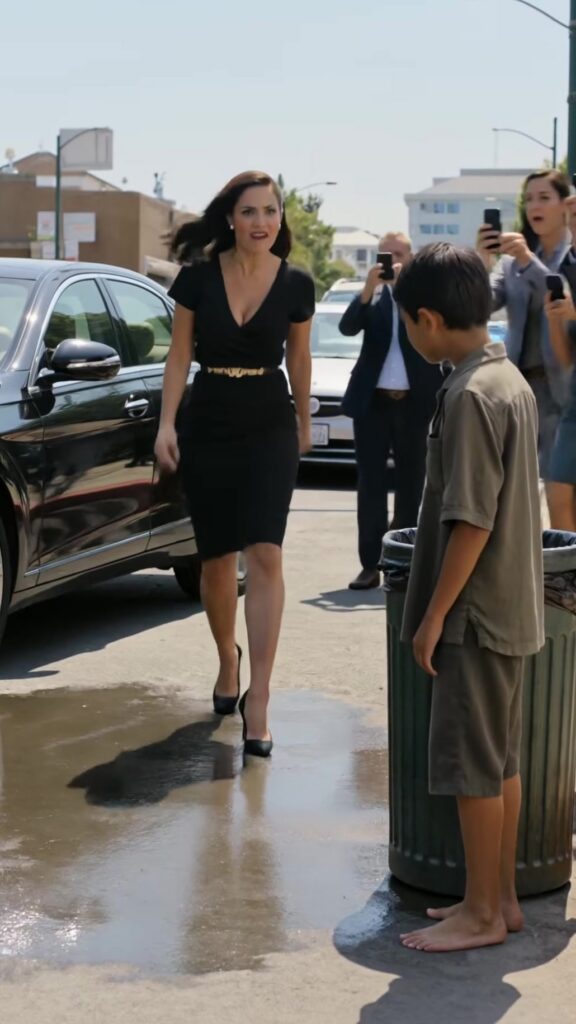
He hovered beside a trash bin that always smelled like old soup and engine oil. The bin sat near the curb where traffic crawled in angry little spurts, and he stayed close enough to it that people could pretend he belonged there, like the bin, like the cracks in the sidewalk. Invisible things were easier that way.
But the boy wasn’t lost. He wasn’t begging. He wasn’t even looking at the coins that sometimes bounced near his feet when someone tossed money without meeting his eyes. His attention was pinned to one thing only: the ribbon of cars inching forward, and within that ribbon, a black luxury sedan that looked like it had been polished with patience and pride.
The car wasn’t flashy in a loud way. It was sleek, confident, the kind of vehicle that didn’t need to show off because it already knew the rules were written for it. Its windows were tinted just enough to keep the world out. The hood caught the sunlight and threw it back like a mirror.
The boy watched it like a countdown. His hands were small but steady. Next to the trash bin sat a plastic bucket, the kind that used to hold paint. It was half-filled with water that looked like someone had rinsed a mop in it. Oil swirled across the top in rainbow streaks. Bits of leaf and grit floated around like tiny boats.
A woman in a bright blouse hustled past him, wrinkling her nose. “Disgusting,” she muttered, talking to nobody in particular. The boy didn’t flinch. He didn’t look at her. His eyes didn’t move from the black car.
When the car finally drew parallel to him, the street noise seemed to sharpen, as if the city leaned in without realizing it. The boy reached down, wrapped both hands around the bucket handle, and lifted. For a second the bucket looked too heavy for him, pulling his shoulders forward. Then he stepped off the curb with a quick, practiced motion.
He swung the bucket with everything he had.
The filthy water arced through the air and exploded across the sedan’s hood and windshield. Brown droplets slapped against the glossy paint. Thick streaks slid down the glass. The rainbow oil shimmered like an insult.
The entire street froze. Horns cut out mid-blare. A vendor stopped shouting. A couple of people gasped so loudly it felt staged. Then phones came out—always phones—raised like shields and spotlights.
The sedan halted immediately, brakes chirping. The back door opened with a sharp, offended motion.
Out stepped a woman who looked like she belonged on billboards. She wore a cream blazer and heels that clicked like punctuation marks. Her hair was pulled into a neat twist, and her earrings were small but expensive, as if loud jewelry was beneath her. She took one look at her ruined car and her face tightened, not just with anger, but with something like disbelief that the world had dared touch her.
“Are you insane?” she snapped, marching toward the boy. Her perfume hit the air—clean and floral, like money. “Do you know what you just did?”
The boy didn’t run. He didn’t even step back. Tears ran down his cheeks, carving pale lines through the grime on his face. His lips trembled, but his chin stayed up. He looked right at her, eyes too old for his age.
“You destroyed my family,” he said, the words barely louder than the traffic’s return to breathing.
The woman’s stride faltered like she’d stepped on an unexpected crack. Her fury flickered. For a second, her face went blank, and then it drained of color.
“What did you say?” Her voice dropped, careful now, as if speaking too loudly might wake a sleeping threat.
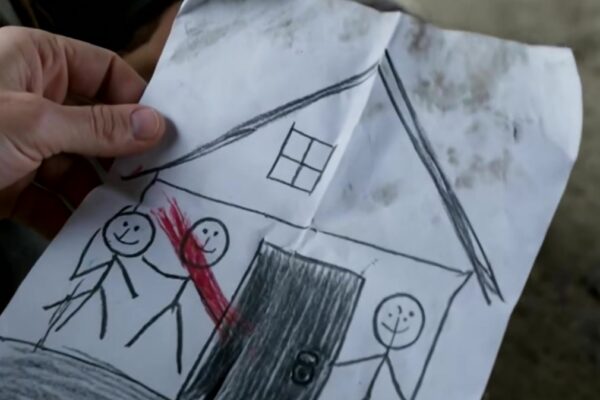
The boy blinked hard. “My dad,” he said. “My mom. Our house. Everything.” He swallowed, and it looked like it hurt. “You did it.”
People leaned in. Someone whispered, “Is that her?” like they were watching a show they couldn’t believe was free. The woman’s driver started to step out, but she lifted a hand without looking back, stopping him.
She crouched slightly, bringing her face closer to the boy’s, still keeping her distance like he might be contagious. “Listen,” she said under her breath, the anger gone now, replaced by a sharp panic she tried to hide. “You have the wrong person.”
The boy shook his head. “No.”
Her eyes flicked over him—his bare feet, his bruised knees, the thinness of his arms. Then, very quietly, she said something that turned the air strange, like the street itself had lost oxygen.
“I know who you are,” she whispered.
The boy’s tears stopped mid-fall. His mouth opened but nothing came out.
Behind them, the crowd went silent, not because they could hear her words, but because they could read the change on her face. The woman who had marched out like a queen now looked like someone who’d just seen a ghost with her own eyes.
“That can’t be,” the boy managed, voice cracking. “My name is—”
“I know,” she cut in, too fast. She glanced around at the phones, the staring faces, the building windows. “Not here,” she said, and her voice wasn’t a command anymore. It was a plea.
The boy’s hands curled into fists. “You’re scared,” he said, almost surprised.
She swallowed. Up close, the boy could see the fine lines near her eyes, the kind makeup tried to erase. He could also see something else: guilt, not the dramatic kind you confess in movies, but the kind that sits quietly in your chest for years and makes you flinch at certain names.
“What do you want?” she asked.
He pointed at the sedan, dripping with dirty water. “I want you to look at it,” he said. “Look at what happens when something clean gets hit by something you pretend isn’t there.”
The crowd murmured, like they’d been given permission to exhale.
The woman stared at the mess on her windshield, then back at him. “Your father,” she said slowly, choosing words like stepping stones. “He wasn’t supposed to be there.”
The boy’s face tightened. “He was working,” he said. “He always worked.”
She nodded once, miserable. “I know.”
Then she straightened, and for a moment she looked powerful again—except now the power seemed heavy, like armor that didn’t fit. She reached into her purse and pulled out her phone, hands not quite steady. She tapped the screen, then held it down at her side instead of raising it to her ear.
“Get in the car,” she said, eyes fixed on the boy. “Not the back. The front.”
“Why?”
“Because if you sit in the back, people will think you’re a problem I’m hiding.” She glanced at the crowd. “And I think you’ve had enough of being invisible.”
The boy didn’t move. His gaze searched her face, like he was trying to find the truth behind her polished skin. “Are you going to hurt me?” he asked, plain and direct.
Her throat bobbed. “No,” she said. “I’m going to tell you what actually happened. And then you can decide what you do with me.”
He hesitated, then stepped forward. The driver opened the front passenger door, eyes wide, confused but obedient. The boy climbed in, leaving wet footprints on the expensive floor mat.
The woman paused before getting in, turning briefly toward the crowd. For the first time, she looked at the phones without anger. She looked… resigned.
“Record if you want,” she said, voice carrying. “Just make sure you record the part where I stop pretending.”
Then she slid into the seat behind the driver, the door closing with a soft, final sound.
The sedan pulled away, windshield still streaked with brown water, and the crowd stood there with their devices held up like they’d caught something rare: the moment a powerful person got pulled into a story they couldn’t pay their way out of.
Inside the car, the boy stared ahead, heart hammering. The city blurred past like it didn’t matter anymore. Behind him, the woman took a long breath and spoke, her voice low and stripped of performance.
“Your father saved my life,” she said. “And that’s why they killed him.”
The boy’s fingers dug into the seat. The driver glanced in the mirror, startled, but she didn’t stop.
“I’ve been waiting for you to find me,” she added, quieter. “I just didn’t think you’d do it with a bucket.”
The boy finally turned his head, eyes burning. “Who is ‘they’?” he asked.
The woman looked out the window, watching the city like it was full of listening ears. “The people I used to call my partners,” she said. “And the people your parents trusted.”
Outside, traffic swallowed them, the black car sliding forward like a secret. And for the first time all day, nobody could pretend the little boy wasn’t there.