The street looked like it had been staged for an advertisement: clean sidewalk, tidy storefronts, trees doing their best to pretend they were in a park instead of wedged between traffic signs. It was the kind of afternoon where nothing dramatic should happen. Sunlight fell in polite rectangles. A delivery guy wheeled a dolly past the bakery. Somewhere, a dog barked once and seemed to immediately regret it.
On the bench near the bus stop sat a woman who made the whole scene look intentional.
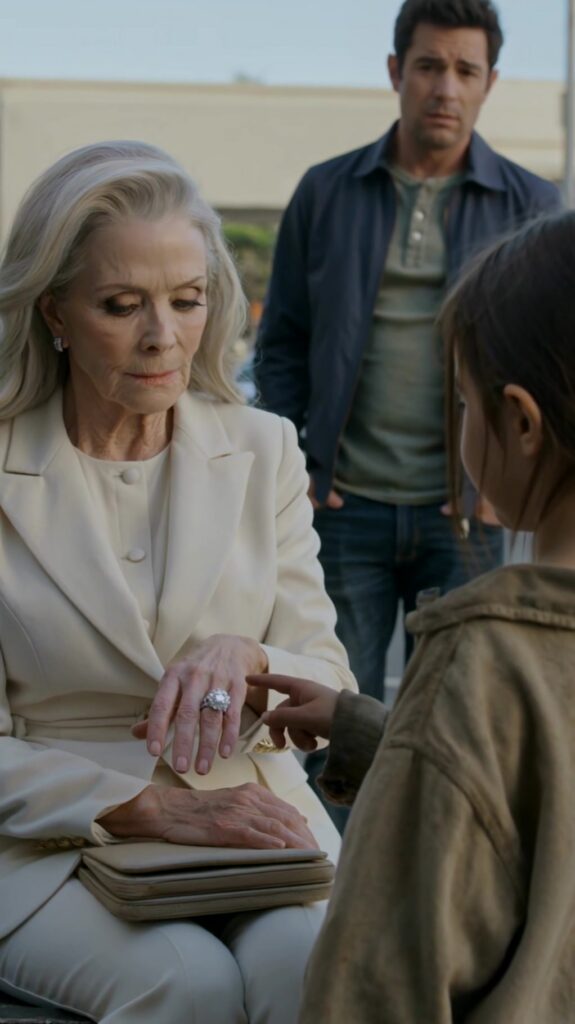
She was elderly, but not in a soft, shrinking way. She wore a cream coat that fit like it had been tailored this morning. Her hair was pinned neatly, silver with a faint bluish tone, and her posture was so straight it felt like a rebuke to the slouching world. She didn’t fidget. She didn’t scroll a phone. She simply sat, hands folded, watching nothing in particular with an expression that read: I have already decided what I think of you.
On her left hand, a gemstone caught the sun. It wasn’t big in a flashy way—more like it had no need to be. A pale, icy-blue stone, cut in a shape that seemed old-fashioned, set in a band that looked like it belonged to another era. When light hit it, it flashed once, cool and sharp, like a wink you weren’t sure you deserved.
People passed and didn’t look. They didn’t have time to notice things like silent elegance or stones that sparkled like secrets. The street had its own rhythm—feet, wheels, snippets of conversation. Ordinary. Almost too calm.
Then the rhythm hiccuped.
A small girl appeared from between two parked cars, as if the street had produced her by accident. She was thin in a way that made her limbs look too long for her body. Her clothes had once been bright but were now tired and torn at the knees and sleeves. Her feet were bare on the pavement, which should’ve been painful, but she moved like the pain had already been filed into the list of things she didn’t bother reacting to anymore.
She didn’t look at the bakery. She didn’t glance at the bus schedule. She didn’t scan faces the way kids usually do, hoping for someone they know.
Her eyes went straight to the bench. More specifically, to the woman’s left hand.
It was the ring. The light had touched it again, and the girl’s gaze locked like a magnet finding its match.
She started walking. Not fast. Not quite sneaking, either. More like she was negotiating with every step, asking her feet to keep going and her fear to wait its turn. She reached the edge of the bench and stopped close enough to be rude in any other context.
For a moment, she just stood there, breathing quietly. The woman didn’t react at first. She had perfected the art of not acknowledging things until she decided they deserved her attention. But the air around her shifted—some instinct, some old habit of reading spaces—and she turned her head.
Their eyes met.
Everything else on the street kept moving, but it blurred into background noise. A bus sighed at the curb and pulled away. A stroller’s wheels clicked over a crack. The girl stood so still she could’ve been a statue if not for the tremble in her chin.
Slowly, the girl lifted a hand. Her finger rose and pointed, not at the woman’s face, not at her coat, but directly at the ring.
Her voice came out like it had to squeeze through something tight in her throat. “My mommy… had a ring just like that.”
The sentence didn’t land like a casual comment. It hung there, heavy, as if the air itself didn’t know what to do with it.
The woman’s expression, previously smooth as porcelain, cracked. Her eyes widened, not in surprise alone but in the kind of recognition that feels like stepping on a memory you thought was buried. Her gaze dropped to the ring, then back up to the girl’s face—searching, measuring, scanning features as if the child were a photograph she’d once burned.
“What…?” The word came out thinner than it should have. Not strong. Not in charge. Just uncertain, like someone who’d suddenly realized the rules had changed.
A man walking by slowed down. He’d been on a normal path with a normal destination—coffee, errands, whatever. But something about the stillness of the three-foot circle around the bench pulled him like gravity. He stopped a few steps away, holding a paper bag at his side, and watched with the wary curiosity of someone who didn’t want to interfere but couldn’t pretend he hadn’t seen.
The girl didn’t drop her hand. Her eyes stayed on the ring as if it were the only solid thing in the world. Tears gathered but didn’t fall yet, clinging to her lashes.
She took a small breath. “She said… it was the only thing she had left.”
Silence, bigger now. The sort of silence that makes you hear your own pulse and the distant click of a pedestrian signal changing.
The woman’s fingers moved. Her hand tightened around the ring, thumb pressing the band like she could push it into her skin and hide it there. For a second, her mouth did something strange—almost a flinch. The man shifted his weight, looking from the girl to the woman, then down to the ring catching the light again, like it was insisting on being seen.
“Where is your mother?” the woman asked. Her tone tried to climb back into authority, but it didn’t fully make it. There was a tremor under the question, a crackle of something like panic.
The girl swallowed. “I don’t know.” She said it plainly, as if she’d practiced not making it sound like a tragedy. “She told me to wait in the library when she went to talk to somebody. Then it closed. Then I waited outside. Then I… I kept waiting.”
The woman stared at her. Her eyes flicked over the girl’s bare feet, the frayed hem, the thin arms. Something tightened in her jaw, not anger exactly—more like a person trying to hold a door shut against a flood.
“What’s your name?”
The girl hesitated, like names were dangerous to give away. “Lena.”
The woman repeated it softly, tasting it. “Lena.” Then, with a careful slowness, she turned her hand so the ring faced away from the sun, dulling its sparkle. It was a small motion, but it felt like a confession.
The man cleared his throat, unsure if he was allowed to exist in this moment. “Ma’am,” he said, gently, to the woman. “Do you… do you know her?”
The woman didn’t look at him. Her attention stayed fixed on the child, as if turning her head would make the girl disappear. “I don’t know,” she said, and the words sounded like a lie she didn’t have the energy to dress up.
Lena’s eyes finally rose from the ring to the woman’s face. They were the same shade as the gemstone in a strange way—pale but intense, like winter light. “Mommy said,” Lena whispered, “that sometimes people take things and then pretend they never saw you. She said sometimes they sit in the sun like nothing happened.”
The woman inhaled sharply. The bench creaked under the subtle shift of her weight, like even the wood noticed the change.
“Your mother,” the woman said, and now the tremor was obvious, “what did she look like?”
Lena frowned, concentrating. “She had dark hair. Not black. Like… like coffee. And she had a laugh that made her nose wrinkle.” A tiny smile tried to form, failed. “She wore a yellow scarf. Even when it was hot. She said it made her feel brave.”
The woman closed her eyes for a second—just a blink too long. When she opened them, they were wet. Not dramatically, not for show. Just wet, like a window starting to fog.
“She shouldn’t have come here,” the woman murmured, and it didn’t sound like blame. It sounded like regret that had been aging for years.
The man stepped closer, voice lower. “Do you want me to call someone? The police? Social services?”
The word police made Lena’s shoulders jump. She took half a step back, ready to bolt, eyes darting to the gap between cars like it was an escape route she’d memorized.
The woman noticed. Her hand, still tight around the ring, relaxed just a fraction. “No,” she said quickly. Too quickly. Then she softened it. “Not yet.”
She looked up at the man for the first time. There was something in her gaze that used to command rooms—money, influence, or simply the kind of certainty that makes other people fall quiet. But now it was threaded with fear.
“Would you,” she asked him, “do me the kindness of sitting for a moment? Just… stay. So she doesn’t think she’s alone with a stranger.”
He blinked, surprised to be given a role. Then he nodded and sat on the far end of the bench, leaving space like a respectful boundary.
The woman turned back to Lena. Her voice, when it came, was careful, like she was handling glass. “Why do you think your mother’s ring is like mine?”
Lena lifted her finger again, hovering. She didn’t touch. “Because of the crack,” she whispered.
The woman froze. Her thumb slid along the stone’s edge, and there it was—tiny, almost invisible unless you knew to look. A hairline fracture near the setting. The kind of flaw that made a jeweler sigh and a person with a story keep it anyway.
The woman’s breath hitched. For a second, all her elegance fell away, leaving an old person sitting in sunlight with something sharp lodged in her chest.
“She told me,” Lena said, “that it broke when she dropped it the day she left home.”
Home. The word landed like a stone.
The street kept being ordinary around them. People kept walking past, still not noticing, because most of the time you don’t see the moment a life changes. You only see what comes after.
The woman looked down at the ring again, and the sunlight caught it one last time—cold and beautiful, yes, but now also guilty. She held it as if it might burn.
Then she did something that surprised even herself. She slid it off.
It took effort; the band resisted, as if it had grown into her identity. When it came free, she held it between finger and thumb and stared at it like it was evidence.
“Lena,” she said, voice barely more than the girl’s earlier whisper, “I think we need to talk about your mother.”
Lena didn’t cry. Not yet. She just stood there, listening with the focus of someone who has been waiting a very long time to be seen.
The man on the bench looked from the ring to the woman to the child, and his confusion shifted into something steadier—concern, yes, but also the awareness that he’d stumbled into a story that had been quietly unfolding for years, right under a calm afternoon sun.
The camera, if there had been one, wouldn’t have moved. There were no cuts, no easy escape. Just a quiet daytime street, holding its breath, while three strangers realized they might not be strangers at all.
And above them, the pedestrian signal changed again, ticking away like a reminder: time keeps going, whether you’re ready or not.