The Valenwood Mansion had a way of making people whisper without meaning to. Even the air felt expensive—like it had been filtered through velvet. Sunlight poured through the two-story windows and landed in clean rectangles on the marble, bright enough to show your reflection if you dared to look down. Everything in the main salon looked arranged for a magazine shoot: pale cream sofas nobody actually sat on, a grand piano that never got played, vases with flowers that got replaced before they could wilt.
So when the cake hit the floor, it didn’t just make a mess. It sounded like a scandal.
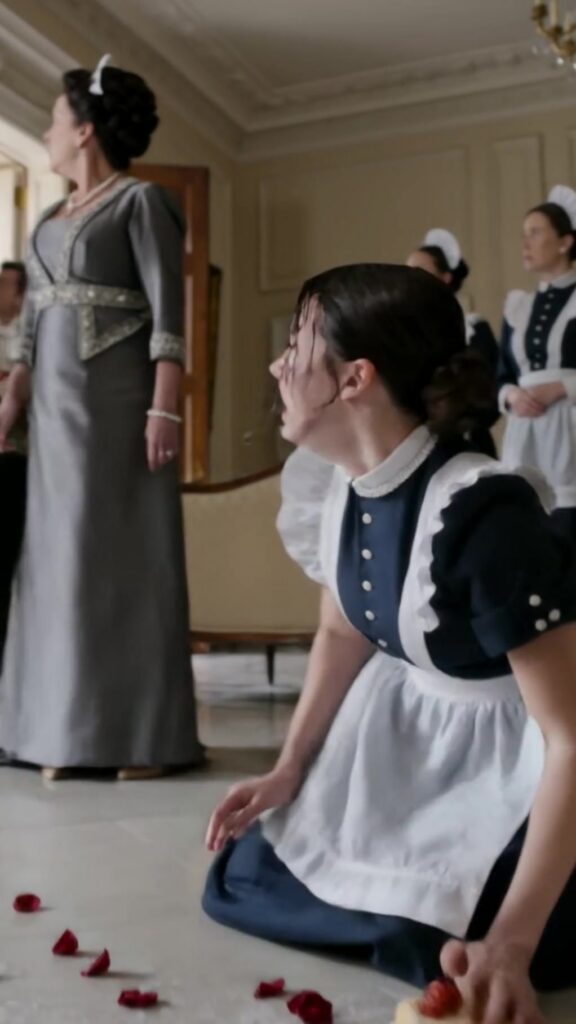
Frosting and strawberry filling spread out in a sloppy circle, crushed rose petals sticking to it like confetti at the world’s most depressing party. On her knees beside it, Lina scrubbed at the marble with shaking hands, the soapy water turning pink. She wasn’t really cleaning. She was trying to reverse time. Her dark hair was plastered to her cheeks, and her breath kept catching like her lungs had forgotten the rhythm.
Behind her, three other maids stood perfectly still, eyes wide, as if any movement might make the situation real. Near the sofa, Celeste Valenwood—widow, hostess, and the kind of woman who could make a room colder just by entering it—watched with her arms folded. Her pearl earrings didn’t move. Her face didn’t either.
“You should’ve remembered where you belong,” Celeste said, in a voice that somehow managed to be both calm and sharp. Not loud. Just final.
Lina stopped scrubbing. Her fingers curled around the cloth so tightly her knuckles went white. She looked up, mascara smeared, eyes bright with tears that didn’t seem like the kind you could simply blink away. “He deserves to know,” she said. The words came out rough, like she’d been holding them in for years and they’d grown thorns. “He deserves to know who I am.”
The salon doors opened before Celeste could reply. The sound of hinges was ordinary—except in that moment it landed like a judge’s gavel. Nathaniel Valenwood stepped inside with a bouquet in his hand, pale lilies and something lavender that smelled like it belonged in a spring wedding. He’d been gone for weeks, traveling for the family company, showing his face at fundraisers and pretending it didn’t cost him anything.
He paused after one step.
His gaze slid over the scene in quick, disbelieving pieces: the wrecked cake. The pink foam. Lina on the floor. Celeste standing like she was supervising a chore. Then Nathaniel’s eyes drifted upward, and his whole body stiffened in a way that didn’t have anything to do with surprise.
Because hanging above the fireplace was the formal family portrait. The big one. The one guests always admired because it screamed legacy. Nathaniel had walked past it a thousand times and barely registered it—his father seated in a dark suit, his mother looking soft and luminous, Nathaniel himself as a boy in pressed clothes with an expression like he’d been coached. But today his eyes locked onto a detail he’d never noticed, and his mind started kicking like a locked door.
There, between his parents, stood a little girl in a pale dress. Not a servant’s uniform. Not a background figure. She was placed with intention, close enough that his mother’s hand rested lightly on her shoulder. The girl had Lina’s eyes. Lina’s mouth. Even the same tiny scar at the edge of her eyebrow that Lina always tried to cover with bangs.
Nathaniel’s bouquet lowered in his hand until the flowers nearly brushed the floor. “No,” he muttered, and it came out like a refusal more than a word. He looked down at Lina, then back at the portrait, then down again, like he thought the angle was tricking him.
The room stopped breathing with him.
Lina’s face went so still it was almost blank, as if her emotions had run out of places to hide. Celeste’s perfect composure finally slipped—a crack in porcelain—just for a heartbeat. It was small, but Nathaniel saw it. He saw everything.
“Why is she in our portrait?” Nathaniel asked. His voice was quiet, which made it worse. Quiet meant he was trying not to explode. “Why was she erased from this family?”
No one answered. The maids stared at the floor like it had suddenly become fascinating. Lina swallowed, her throat moving hard. Celeste lifted her chin, a motion that usually meant the conversation was over, but she didn’t speak. For the first time in the salon, she looked… out of practice.
Nathaniel took two steps forward, the soles of his shoes clicking on marble. He stood close enough to Lina that she could smell his cologne—something expensive and clean, the kind of scent people wore when they didn’t sweat through anxiety. He didn’t offer a hand to help her up, not because he didn’t care, but because he was afraid that if he touched her, the last piece of denial would fall apart.
“Lina,” he said, tasting the name like it might be new even though he’d heard it from staff reports and passing comments. “How old are you?”
Her laugh came out broken and small. “Old enough to know I’m not supposed to ask questions.” She glanced toward Celeste, then back at him. “Twenty-four.”
Nathaniel’s eyes narrowed, calculating. “That portrait was taken twenty years ago.” He looked up at the little girl again. “You were there.”
Celeste finally spoke, each word clipped as if she were cutting thread. “Do not start digging up old dust in front of the staff.”
“The staff?” Nathaniel repeated, incredulous, gesturing sharply at Lina. “She’s the one in the portrait. She’s not ‘the staff.’” His voice rose on the last word, and one of the maids flinched.
Lina pressed her palms to the floor, pushing herself upright just enough to meet his gaze. “I’m not trying to ruin anything,” she said, though the wrecked cake at her knees argued otherwise. “I didn’t mean to drop it. It just—my hands—” She shook her head, frustrated at herself for sounding like she needed permission to speak. “I came back here because I thought if I could just get near you, maybe you’d remember. Or maybe you’d ask why there was a whole person missing from your life.”
Nathaniel stared at her, the pieces aligning in his mind with a sickening click. All those years of vague family stories, the way his father never liked talking about “complications,” how Celeste had arrived after his mother died and immediately rearranged the mansion like she was erasing fingerprints. How there were rooms they never went into. How his father used to get drunk and call someone’s name he couldn’t place.
“My mother,” Nathaniel said slowly, eyes still on Lina. “She knew you.” His throat tightened. “She loved you.” It didn’t sound like a question. It sounded like something he was suddenly certain about.
Lina’s eyes filled again, but this time the tears didn’t fall. They hovered, held in by stubbornness. “She used to braid my hair,” Lina whispered. “She used to call me her ‘bright stitch’ because I always asked too many questions.” A shaky breath. “And then she died, and everything changed. People stopped saying my name. They stopped letting me sit at the table. One day my clothes were gone and there was a uniform on my bed.”
Celeste’s voice cut through, frost thin and razor-edged. “Your father made choices for this family. Do you think it was easy to keep the household stable?”
Nathaniel turned his head toward Celeste so slowly it felt like watching a storm form. “Stable,” he repeated. “Is that what you call it when a child disappears and comes back as a maid?”
Celeste’s eyes flashed. “Do not imply—”
“I’m implying exactly what I’m seeing,” Nathaniel said, and now his quiet was gone. “There’s a girl in our portrait, positioned like she belonged. And there’s a woman on the floor being told to ‘remember her place.’ Those things don’t belong in the same reality unless someone forced them to.”
Lina’s hands trembled as she wiped her face with the back of her wrist, smearing soap and tears together. “I didn’t come here for money,” she said, words tumbling out in a rush. “I came here because I got tired of wondering if I was crazy. I found an old copy of that portrait in the attic storage—one before someone had it ‘fixed.’ I saw myself in it, and for the first time I knew I wasn’t imagining those memories.”
Nathaniel’s heart hammered so hard he could feel it in his teeth. He looked at Celeste again. “You had the portrait edited,” he said, voice low and lethal. “You literally tried to paint her out.”
Celeste didn’t deny it. Her silence was its own confession.
Nathaniel set the bouquet down on the nearest table with careful control, like he was placing down something fragile that might become a weapon if he held it too long. Then he reached out and offered Lina his hand. This time he didn’t hesitate. “Get up,” he said, not as an order, but as a promise. “Not to clean. To stand.”
Lina stared at his hand like it was a trap and a miracle at the same time. Slowly, she took it. His grip was warm, steady. He pulled her to her feet, and the whole room seemed to tilt, as if the mansion itself didn’t know which version of the truth it was supposed to support.
Nathaniel kept hold of her hand when she was upright. He faced Celeste, and for the first time, he looked like the heir everyone talked about—sharp, unafraid, impossible to intimidate. “Call the lawyer,” he said. “Call whoever you want. But today you’re going to tell me what happened. And if my father is the reason she was pushed into the shadows, then I’m going to drag that shadow into the light.”
Lina’s breath shook. “Nathaniel,” she started, almost pleading. “It’s not safe—”
He squeezed her fingers once, a small, grounding motion. “Then we make it safe,” he said. He glanced up at the portrait again, at the little girl caught forever between two adults who had once made room for her. “If the mansion wants to freeze, let it freeze. I’m done pretending we’re all just part of the decor.”
And in the silence that followed, it wasn’t the smashed cake that felt like the biggest mess anymore. It was the family history—cracked open, finally visible, and impossible to clean away with soap and water.