People were rushing through the gray downtown avenue like every other ordinary afternoon—heads down, coffee in hand, lost in their own lives. The sky was the color of printer paper left in the rain. A bus coughed at the curb. Somebody argued with a parking meter. The whole street smelled like espresso, exhaust, and that wet-concrete chill that seeps into your bones.
Madeline Lark moved against the current like she was walking through a dream she refused to wake up from. Beige dress, tailored coat, sunglasses that hid the worst parts of her face—meaning the parts that were trying not to fall apart. Her heels clicked too loudly. Heads turned, because of course they did. Downtown had a way of noticing polished things.
She kept scanning the sidewalk the way people scanned for lost dogs. Not anxious exactly—more like locked onto an invisible thread. She passed a florist closing up buckets of bruised tulips. She passed a young guy selling phone chargers out of a backpack. She passed a cluster of tourists trying to find a building that wasn’t there anymore.
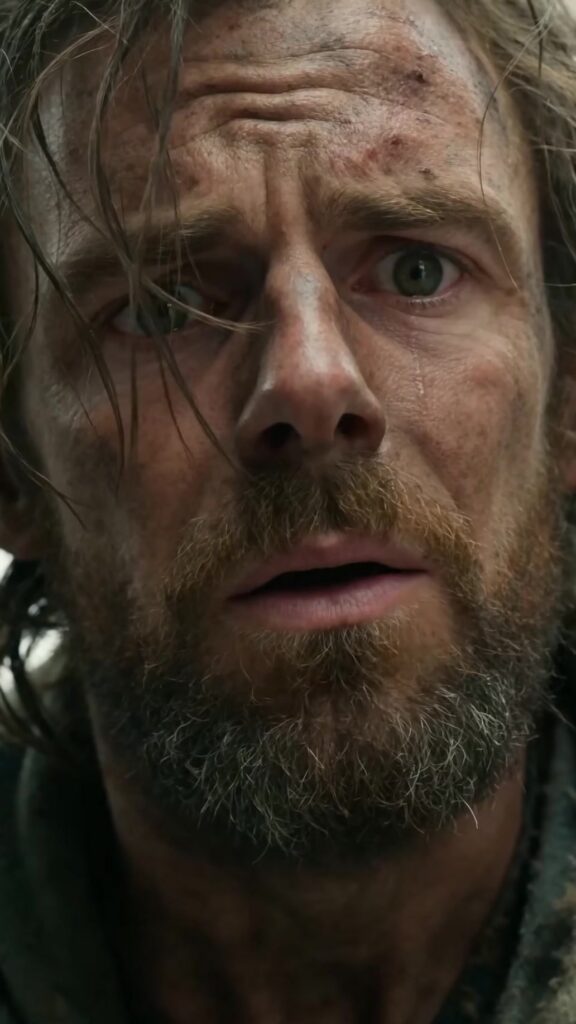
Then she saw him, tucked into the shallow alcove of a closed bank. A man shaped like a question mark under too many layers, hair in tangles, beard gone wild. He was holding a paper cup like it had once held something important, and his hands were cracked and red from the cold. A shopping cart leaned beside him, packed with a blanket, a battered duffel, and a plastic bag full of bottles.
Madeline stopped. And in a city where stopping was basically a crime, everything around her seemed to stall with her—like the sidewalk itself had hit pause.
She crossed the last few feet, ignoring the splash of slush that hit her hem, and dropped to her knees on the gritty pavement. Her handbag slid off her shoulder and hit the ground with a soft thud. Before her brain could talk her out of it, her fingers were already unfastening the clasp on a small velvet box she’d carried in her pocket like a live coal.
When she opened it, a diamond caught the weak daylight and threw it back with a little stubborn spark. It looked like a flame that refused to go out.
“Marry me,” she said, and her voice came out steadier than she felt. “Please.”
The man blinked at her like she’d spoken a language he used to know. His eyes weren’t empty. That was the part that broke her, every time—how much of him was still in there, behind the grime and the exhaustion. Like a house that had been boarded up, but the lights were still somehow on.
He pointed at himself with a knuckle that looked swollen. “Me?” A laugh escaped him, half disbelief, half pain. “Lady, I think you got the wrong—”
Madeline’s mouth trembled. Tears slid down from under the edge of her sunglasses and traced clean lines through her makeup. “I didn’t,” she said. “I found you.”
People stopped walking. That never happened. A delivery guy paused mid-swipe on his phone, thumb hovering. A woman with glossy shopping bags stared like she’d just stumbled into a movie set. Even a pigeon landed nearby and did that head-tilt thing pigeons do, as if it was trying to understand the plot.
The man’s gaze jumped from the ring to her face to the ground, as if expecting a camera crew to pop out of a trash can. He shifted back, careful, defensive. “Why,” he asked, and it wasn’t curiosity—it was the question you ask when the universe has already proven it doesn’t do favors.
Madeline swallowed. “Because I’m tired of letting other people decide what’s real,” she said. “And because I’m done being scared.”
He looked at his hands. They were filthy, nails dark, the kind of hands people pretended not to see. “I don’t even… I don’t have a—” He stopped, realizing how stupid that sounded. A life. He didn’t have a life, not one anyone respected.
The scream of tires cut through the moment like a blade.
A black SUV snapped to the curb, too clean for this street, too expensive for this weather. The back window lowered. A silver-haired man leaned out, coat collar up, face pale with fury. He looked like the kind of man who never had to wait in line for anything.
“Madeline!” he barked. “Stop this right now!”
Madeline didn’t flinch. She didn’t even turn her head. Her voice, when she spoke again, was raw and sharp like she’d been carrying it for years. “Don’t you come near him.”
The man in the alcove stared between her and the SUV, trying to stitch the scene together into something that made sense. He couldn’t. That woman belonged to that car, to that world. Not to him. Not to the cold sidewalk.
“Who are you?” he whispered, and the way he asked it made her chest ache. Not because he didn’t know her name. Because he didn’t recognize her soul.
Madeline’s shoulders shook once, like a sob tried to break free and she forced it back down. Then she reached into her coat pocket and pulled out an old photograph, folded so many times the creases had gone white. She handled it like it could cut her.
She opened it.
The man leaned forward despite himself. In the faded image, a younger version of him stood in the rain, hair darker, smile wide, an arm thrown around a younger Madeline. They were both drenched, laughing at something outside the frame. In his hand—steady, unashamed—was the same velvet box.
The color drained from his face so fast it was like watching a screen dim. His lips parted. “Mads…?” The name came out broken, like it had been trapped behind his teeth for a decade.
He lifted two fingers toward the photograph, as if touching it could confirm it was real. His hand hovered, trembling.
From the SUV, the silver-haired man’s voice cracked like a whip. “Don’t let him see that!”
Madeline finally turned her head, and the look she gave the man in the car wasn’t fear. It was something older. Something that had learned how to survive fancy dinners and closed doors and polite threats. “You don’t get to rewrite this,” she said. “Not anymore.”
The man in the alcove squinted at the SUV. Memory moved behind his eyes like fog lifting. A hospital hallway that smelled like bleach. A ring box pressed into his palm. Madeline crying into his chest. Someone in a suit saying the word “incident” like it explained everything. A signature. A check. A promise to disappear.
He pressed his fist to his temple. “I… I was David,” he said slowly, like he was testing the name. “David Mercer.”
Madeline’s breath hitched, relief and grief colliding. “You are,” she said. “You never stopped being you.”
The silver-haired man shoved the SUV door open and stepped out, shoes too shiny for slush. He strode toward them like he owned the sidewalk. “Madeline, you don’t understand what you’re doing,” he snapped, as if she were a child about to touch a hot stove.
Madeline rose just enough to put herself between him and David. Still kneeling, but somehow taller than the man standing over her. “Oh, I understand,” she said. “You paid to bury him.”
David’s throat worked. “Paid?” he echoed. The word tasted wrong. He looked at the older man, and something in his eyes sharpened. Not recognition of a face, but recognition of a type. “You’re… you’re her father.”
“I’m the person who kept her alive,” the man hissed. “After you ruined everything.”
Madeline let out a bitter laugh. “You mean after the crash you covered up,” she said. “After you told everyone David stole company funds so the headlines wouldn’t say your driver was drunk. After you had him declared dead on paper so I’d stop searching.”
The crowd had inched closer. Someone was filming now, of course. But for once Madeline didn’t care about the angle, the lighting, the way the story would travel without her permission. She’d spent too long living inside other people’s versions of her life.
David swayed slightly, like the ground had shifted. “They told me you moved,” he said to Madeline, voice hoarse. “That you—”
“They told me you were gone,” she said, reaching up and taking his hand without flinching at the dirt. “That I should ‘let it be a lesson.’ I didn’t.”
She held up the ring box again, the diamond catching another stubborn flash of light. “I don’t care where we start,” she said softly. “A shelter. A cheap apartment. A bench, if that’s what it takes. I just want to start where we left off. With the truth.”
David stared at the ring, then at her. He looked down at his own battered body, the layers of shame and weather. He swallowed hard. “You can’t just—”
Madeline squeezed his fingers. “Watch me.”
The silver-haired man’s face tightened, the kind of rage that came from losing control in public. “Get in the car,” he ordered.
Madeline didn’t move. “No,” she said plainly. Then, to David, quieter: “You don’t have to say yes today. I’m not trying to trap you. I’m trying to come back.”
David’s eyes shone, and for the first time, the haunted look eased, just a little. He exhaled like he’d been holding his breath since the day everything went wrong. “I don’t know how to be the guy in that photo anymore,” he admitted.
Madeline nodded, tears falling freely now. “Then be the guy here,” she said. “And we’ll figure out the rest.”
For a long moment, downtown held its breath.
Then David, trembling, reached out with his dirty fingers and gently closed the ring box. Not rejection. Not acceptance. Something in between. A promise to keep it safe.
“Okay,” he said, voice barely above the street noise. “But… no more disappearing.”
Madeline let out a sound that was half laugh, half sob. “Deal,” she said.
Behind them, the city started moving again—cars honking, footsteps resuming, the gray afternoon continuing like it always did. But for the people who saw it, the sidewalk in front of the old bank didn’t feel ordinary anymore. It felt like the exact spot where a life that had been erased started writing itself back in.