The diner ran on old habits and cheap coffee. It was the kind of place where the ceiling fans never really fixed the heat, the waitress called everybody “hon,” and the jukebox worked only if you slapped the right side of it like it owed you money.
It was lunchtime, but not the busy kind—just enough people to make a soft, constant hum. Forks pinged plates. A baby fussed in a booth. Somebody at the counter argued politely with ketchup, trying to get it out of the bottle without causing a scene.
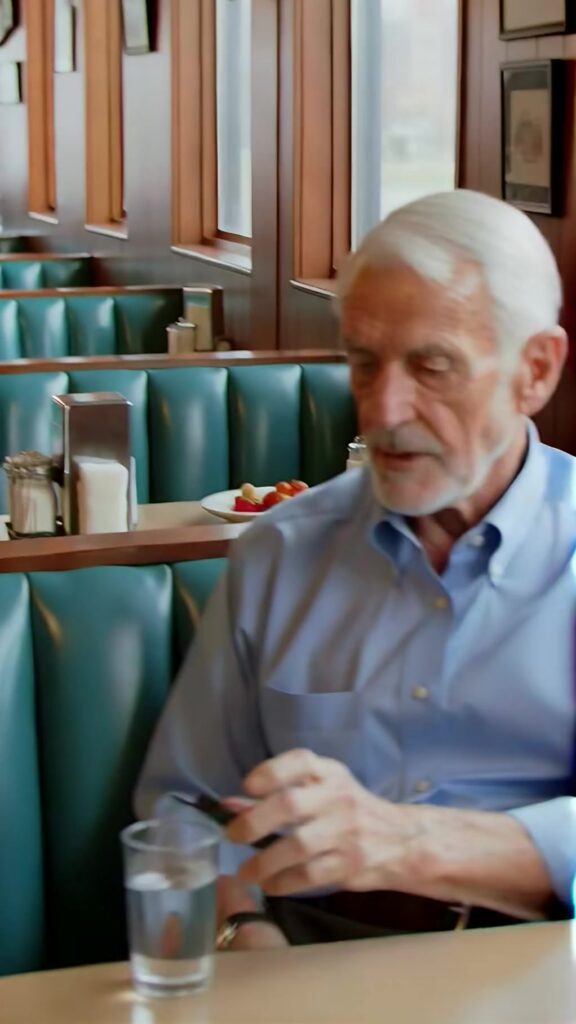
In the corner, where the sunlight came in at an angle and turned dust into glitter, an elderly man sat alone. White hair, short beard, face like worn leather that had survived a lot of weather. One hand rested on a wooden cane—dark walnut, smooth handle, more like a heirloom than a medical tool.
He wasn’t eating. Just had a glass of water and a plate of toast that had cooled enough to be ignored. He looked calm in a way that made other people glance at him and feel like they should keep their voices down. He wasn’t imposing. Just… steady. Like a fence post sunk deep.
I was at the counter with a grilled cheese, pretending not to listen to the two guys next to me complain about property taxes, when the door slammed so hard the bell above it rang like it was panicking.
Heavy boots hit the tile with a confident stomp. Leather jacket. Too many patches. A couple of friends behind him, same vibe—loud for the sake of being loud, laughing before anything funny had happened. The leader’s beard was more ambition than hair. He scanned the room like he was picking a fight off the menu.
His eyes landed on the old man in the corner booth and stuck there. I could tell right away: it wasn’t personal. That was the problem. It was just a cruel itch looking for something to scratch.
“Look at this,” the biker said, loud enough for the whole diner to hear. “We got ourselves a grandpa.”
Nobody laughed except his crew. Most people did that thing where they suddenly became extremely interested in their own pancakes. The waitress, Marcy—name tag and all—paused mid-step with a pot of coffee like she was deciding whether bravery paid overtime.
The biker walked straight to the corner booth and stopped so close his shadow fell across the old man’s toast. He leaned down a little, reading the man’s face like it was a challenge.
The old man didn’t flinch. He didn’t look impressed, either. Just looked up with patient eyes, as if the biker had asked him to repeat something he hadn’t heard.
Without warning, the biker grabbed the cane. Not just snatched it—yanked it hard, like he wanted the motion to hurt. The cane slipped from the old man’s hand, and the table shook. The water glass tipped and hit the edge of the table on its way down.
It shattered on the floor with a crisp crack. Water spread across the tile and under the booth, a thin, shining puddle that caught the diner’s lights.
The biker’s crew howled. “Ha! Look at him now!”
The biker held the cane up like a trophy. “What’s this, grandpa? You keep candy in it? Secret sword? You gonna tap me on the ankle?”
He swaggered away down the aisle with the cane dragging behind him, the rubber tip making a squeak that set my teeth on edge. Then he let it drop.
The cane clattered across the floor and came to rest near the counter, like a piece of someone’s dignity tossed aside.
More laughter. A couple of people shifted in their seats but stayed planted, eyes forward. No one wanted to be the first domino.
The old man looked down at the spilled water like he was studying the shape of it. His expression didn’t change. That was what made my stomach tighten. If he’d gotten angry, it would’ve felt normal. If he’d looked scared, it would’ve made sense.
Instead, he moved with the careful unhurried rhythm of someone who knew exactly what came next.
He reached into his jacket and pulled out a small black device—not a phone, not quite. More like a compact radio with one button worn shiny from use. He pressed it, brought it to his ear, and spoke softly.
“It’s me,” he said.
His voice didn’t carry, but the room had gone weirdly quiet around the edges, like everyone’s subconscious was listening. “Bring them.”
The biker’s crew kept laughing for a second longer, like an echo that hadn’t realized the sound had stopped. The leader turned halfway back as if he’d missed the punchline.
At the far end of the diner, one of the bikers—tall, older than the rest, with a patch on his jacket that looked less like a club logo and more like a warning—stopped mid-laugh. His grin drained as he squinted across the room.
He leaned forward, eyebrows knitting, like he was trying to recognize a face through fog. Then he muttered, not loud but clear enough that it hit the silence.
“No way.”
The leader frowned. “What?”
The older biker stood up slowly, chair legs scraping the tile. He didn’t look at his boss. He kept staring at the old man like he’d just seen a ghost step out of a photograph. “You don’t know who that is,” he said, and his voice had none of the earlier swagger in it.
The leader scoffed. “He’s an old dude with a stick.”
The older biker swallowed. “That’s not a stick.”
He took a cautious step toward the corner booth, like he didn’t trust the air between them. “Sir,” he said, and the word came out respectful despite himself. “I didn’t—”
The old man finally looked up again, meeting the biker’s eyes. “You weren’t the one who grabbed it,” he said. Not angry. Not triumphant. Just factual.
The older biker’s face went pale. He glanced down at the cane lying near the counter, then back at the old man’s hand—empty now, resting on the tabletop, steady as ever.
“That cane,” the older biker said, quiet. “Walnut. Carved handle. Small metal pin in the underside.” He shook his head like he wanted to wake up. “My uncle told me stories. Said if you ever saw it, you walked away. Because the man holding it… you didn’t fight him. You didn’t win. You just became a lesson.”
The leader laughed, but it came out thin. “Okay, sure. Folk tales.”
The old man’s gaze slid to the shattered glass and the water creeping under the booth. “This place is going to be a mess,” he said to no one in particular. Then he nodded once, like he was approving a schedule.
Outside, through the diner’s wide front windows, the parking lot shifted. It wasn’t dramatic at first—just a few cars that definitely hadn’t been there a minute ago. Dark sedans. Clean. Unmarked. They rolled in without squealing tires, like they’d planned the angles ahead of time.
The bell above the diner door didn’t ring. The door didn’t slam. It simply opened, smooth and controlled, and a man in a plain gray jacket stepped inside. Then another. Then another. They didn’t look like cops. They didn’t look like bikers. They looked like the people you never noticed until you absolutely had to.
Each of them wore the same little pin on their collar—black circle, silver line through it, simple as a slash of ink.
The room felt smaller. Even the jukebox seemed to hold its breath.
Marcy the waitress set her coffee pot down with both hands like she didn’t trust herself not to drop it. Somewhere behind me, the guy with the property taxes whispered, “Oh, man,” like he’d stumbled into the wrong movie.
The lead biker straightened, trying to find his voice again. “Who the hell are you people?”
The first gray-jacketed man didn’t answer. He walked past the biker as if he were furniture and went straight to the corner booth. He stopped a respectful distance away and nodded to the old man.
“Sir,” he said.
The old man nodded back. “Get my cane,” he said, still calm, like he was asking for the check. “And keep them from running.”
The gray-jacketed man turned slightly, and the others fanned out with practiced ease. Not aggressive. Just… inevitable. Like doors closing quietly in a house.
The older biker backed up a step, palms out, eyes darting. “We didn’t know,” he said, voice cracking. “We didn’t know it was you.”
The old man finally reached for his toast and broke off a piece, chewing thoughtfully while the diner watched. “That’s usually how it starts,” he said. “Someone decides the world has safe targets.”
The leader tried to laugh again, but it died in his throat as one of the gray jackets picked up the cane and carried it back like it was something sacred. When the cane returned to the old man’s hand, the room’s temperature seemed to drop a degree.
He rested his palm on the handle and looked at the biker who’d yanked it away. “You wanted attention,” he said. “Congratulations.”
Outside, more cars slid into the lot like shadows arriving for roll call. Inside, nobody moved—not the diners, not the bikers, not even the baby, who had gone silent as if it sensed the air had turned sharp.
The old man lifted the radio device again, not in a rush, and spoke one more sentence, barely louder than the hum of the ceiling fan.
“Make sure the owner gets paid for the glass,” he said. Then his eyes rose to the biker, and for the first time there was something in his expression that could’ve been mistaken for pity. “And someone get a mop. This is going to take a while.”