He was walking too fast to notice what had fallen from him, which was kind of impressive considering he’d built his whole life around noticing things.
Gideon Rusk noticed schedules. He noticed deadlines. He noticed the tiniest spelling errors on contracts and the faintest wobble in a chair leg. He noticed when a waiter refilled his water too slowly and when an elevator door hesitated before closing. He was a professional noticer. It’s how you become the guy people call when they need a problem solved quietly.
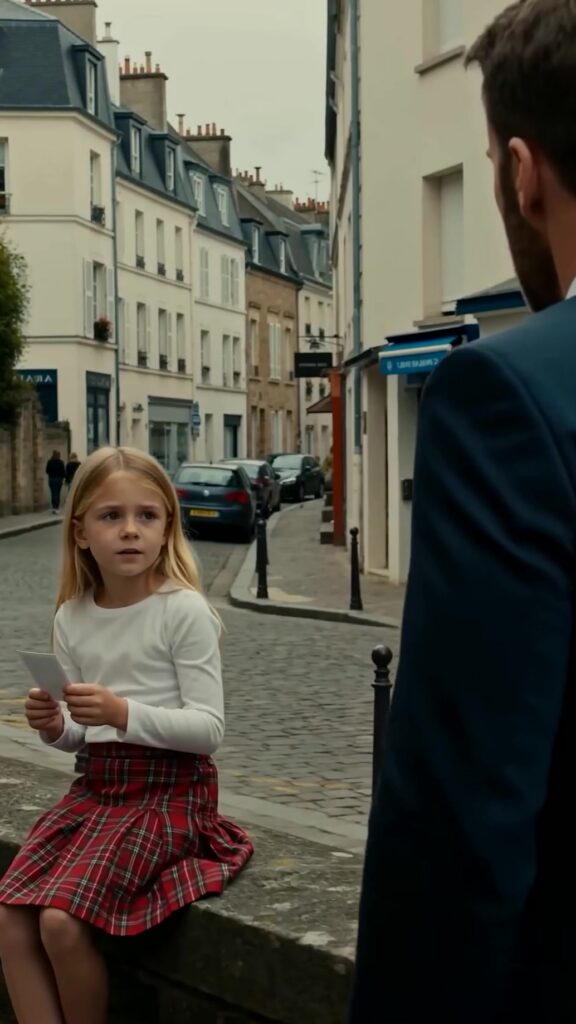
But that afternoon, on a narrow lane paved with uneven stones and framed by old buildings that looked like they’d been holding secrets since before electricity, Gideon didn’t notice a small square of glossy paper slip free from the inside pocket of his dark suit.
The photo slid out like it had been waiting for a chance. It rode a little draft, turned once, and drifted down behind him. It landed face-up on the cobblestones, catching a stripe of sun.
Gideon kept moving. His steps were too quick, too purposeful, like the street was a moving walkway and he was afraid to fall off.
On a low stone step outside a bakery that smelled like cinnamon and burnt sugar, a little girl sat with her legs tucked under her. Her hoodie was bubblegum pink, and it looked slightly too big, the sleeves swallowing her hands when she tried to fidget with the drawstrings. There wasn’t an adult next to her, just a paper bag and a half-eaten roll she didn’t seem interested in anymore.
She saw the photo flutter down. Kids notice dropped things. They notice lost balloons and untied shoelaces and the exact moment someone’s face changes. She leaned forward, scooped it up with both hands like it might crack, and stared.
At first her expression went blank in that way children get when they’re sorting reality. Then her eyebrows pulled together. Her mouth opened just a little.
She looked from the photo to the man’s back. The man in the dark suit with the brisk walk and the closed shoulders.
“Mister,” she called.
Her voice wasn’t loud. It didn’t need to be. It had that sharp clarity kids have, like a bell tapped with a spoon.
Gideon stopped mid-stride.
The street around them kept going: a cyclist rattled over stones, someone laughed behind a window, a delivery van honked somewhere too far away to matter. But Gideon’s body had gone still, the way it did when his mind hit something it couldn’t process.
“Mister,” the girl said again, and this time there was something else in it. Not fear. Not accusation. Just confusion that had nowhere to go. “Why do you have a picture of my mom?”
Gideon turned slowly. It felt like turning against gravity.
The kid sat on the step, holding the photo out in front of her like evidence. Sunlight hit the glossy surface. Gideon could see the woman clearly even from several feet away: dark hair, soft smile, the slight tilt of her head like she was listening to someone tell a joke.
His throat tightened so fast it surprised him.
He walked back, but his pace had changed. Every step was careful, like the cobblestones might rearrange themselves and drop him into something deep.
“Where did you get that?” he asked, though he already knew.
The girl lifted her shoulders in a small shrug. “It fell.” She nodded at his coat. “From you.”
Gideon reached for the photo, stopped himself, then crouched so he wasn’t towering over her. He tried to make his face neutral, calm, adult. It came out looking like a man holding a door shut in a storm.
“That’s… that’s my wife,” he said, and even saying it felt like pressing on a bruise he’d trained himself not to touch. “Her name was Lila.”
The girl’s eyes widened a fraction. “Lila,” she repeated, like it was a word she’d heard in a dream.
Gideon swallowed. “She died,” he added, and the word was familiar and awful. “Years ago.”
The girl looked down at the photo again. Her fingers tightened at the corners. For a second she held it to her chest like she was keeping it safe. Then she shook her head, slow and certain.
“No,” she said. “My mom is alive.”
Gideon forgot how to breathe.
He stared at her. The pink hoodie. The smudge of flour on one sleeve. The way she held herself like she was used to waiting. She didn’t look like she was lying. She didn’t even look like she understood what lying would accomplish here.
“What’s your name?” he asked, because it was something to say that wasn’t a scream.
“Junie,” she said. “Juniper, but only my mom calls me that when she’s being serious.”
Gideon’s heart did something stupid, a small painful leap. “How old are you, Junie?”
She held up five fingers, then remembered something and added another finger quickly. “Six. I can read chapter books now.”
Six. Gideon did the math before he could stop himself, the way he always did math. Lila had been gone for seven years. There was no version of this that fit neatly inside the rules he’d built his life on.
“Where is your mom?” Gideon asked.
Junie pointed down the street, not toward the sunlit cafés and postcard storefronts, but toward a narrower side passage where the buildings leaned in and the light thinned. “She works at the place with the green door. She said to wait by the bread shop and not talk to strangers.”
“And yet,” Gideon said, voice rough, “you talked to me.”
Junie studied him with an intensity that made him feel exposed. “You look like you got lost,” she decided. “Not like a bad stranger. Like a sad stranger.”
He almost laughed. It came out as a strained exhale. “Smart kid.”
Junie held the photo out again. “If that’s your wife, and she’s my mom, then… maybe she’s both?”
Gideon stared at the glossy image. He remembered the day it was taken—an outdoor fair, Lila stealing a bite of his food, the way she’d laughed and then insisted he take a picture because she’d actually bothered to do her hair. He’d kept the photo through everything: the phone call, the funeral, the long years when her name became something people avoided like it was contagious.
He hadn’t shown it to anyone in a long time. He told himself it was private. Really it was because if he looked too long, he’d start expecting her to walk in the door.
“Junie,” he said carefully, “does your mom have… a scar?”
Junie nodded immediately. “On her shoulder. Like a little moon. She says it’s from when she fell off a bike when she was a kid.”
Gideon’s hands went cold. Lila had that scar. He’d kissed it once, absentmindedly, while they were making dinner. She’d squealed and swatted him with a dish towel.
He looked down the street toward the shadowed passage. His brain tried to do what it always did: build a theory, find the angle, locate the trick. But there were no clean lines here. Just a kid on a step and a photograph that suddenly felt like a key.
“Okay,” Gideon said, and his voice sounded unlike him—soft, almost hopeful. “Let’s not break your mom’s rule. I’m going to stand over there where you can still see me.” He pointed to the edge of the bakery window. “And when she comes out, you can tell her… you found something.”
Junie’s face brightened with relief, like she’d been holding her breath too and didn’t know it. “Okay.”
Gideon stood, smoothing his jacket out of habit even though his hands were shaking. He backed up to the bakery window. His reflection stared back: beard neatly trimmed, suit too dark for the sunshine, eyes that looked older than they had any right to.
He watched the passage with the green door at the end. He listened for footsteps. He told himself he was imagining it, that grief does weird things, that sometimes people resemble people.
Then the green door opened, and a woman stepped out into the thin light with a canvas bag over her shoulder. She turned her head, smiling down at something Junie said, and the sun caught her face.
Gideon’s knees almost gave out.
Because it wasn’t just a resemblance.
It was Lila—older, yes, and thinner around the cheeks, and with hair cut shorter than he’d ever seen it. But the tilt of her smile was the same. The way she blinked, quick and bright, was the same.
Junie hopped off the step and ran toward her. “Mom! Mom! Look!”
The woman glanced at the photo in Junie’s hands. Her smile faltered. Her entire body went still.
Her eyes lifted across the street and met Gideon’s.
In that moment, Gideon understood what had fallen from him wasn’t just a photograph. It was the carefully sealed version of his life. The tidy story he’d told himself for years to keep moving.
Lila stared at him like she’d seen a ghost. Gideon stared back like he’d become one.
Junie stood between them, holding the photo up like a bridge, unaware she’d just yanked open the hidden door in two grown-ups’ lives.
“Gideon?” Lila said, and his name sounded like it hadn’t been used in a long time.
He took one step forward, then another, slower than he’d walked all day. “You died,” he managed.
Lila’s laugh was small and shattered. “Yeah,” she said, eyes shining with something that wasn’t quite tears yet. “That’s the version they gave you.”
Junie looked up at her mom, then at Gideon, then at the photo, like she was piecing together a puzzle that had way too many edges. “Are you mad?” she asked quietly.
Gideon shook his head, because mad was the wrong word for whatever was happening inside him. “No,” he said. “I’m… I’m here.”
Lila swallowed, and for the first time Gideon saw fear on her face. Not fear of him. Fear of the past catching up.
“We need to talk,” Gideon said, and his voice finally found steadiness, the kind that comes not from control but from surrender. “All of it.”
Lila glanced down at Junie, then back at Gideon. She nodded once, sharply, like agreeing to step into cold water. “Okay,” she said. “But not here.”
Junie tugged on Lila’s sleeve. “Can he come?”
Lila hesitated. Gideon held still, letting her make the choice, because if this was real, he wasn’t going to rush it and scare it away.
Then Lila exhaled. “Yeah,” she said, voice breaking just a little. “He can come.”
And as they started walking—Junie in the middle, swinging their hands like she’d accidentally collected two grown-ups who needed help finding their way—Gideon realized something else.
He’d been walking too fast for years.
Not just down this street, but through his own life, outrunning pain like it couldn’t keep up.
Now, finally, he slowed enough to look down and see what he’d dropped: the possibility that the story wasn’t finished after all.