The basket hit the wooden table so hard that peaches rolled everywhere. It wasn’t a graceful spill either—this was a full-on fruit avalanche, the kind that makes a sound like someone dumping marbles onto a drum. A couple peaches bounced and rolled right up to the edge of the spice vendor’s stall, stopping beside little piles of turmeric and cumin like they’d come to shop.
People turned at once, because markets don’t really do “private moments.” Even a sneeze is public entertainment. In the middle of the sunny lane between stalls, a little girl in a faded blue dress stood locked in place like someone hit pause. One peach—bruised, the kind you’d pick if you didn’t have the luxury of choosing—was gone from her hand. Her dusty shoes were surrounded by runaway fruit.
The fruit seller, a broad-shouldered man with arms like he lifted crates for fun, stared at her with the kind of annoyed surprise reserved for spilled inventory. “Did you steal it?” he snapped, though his voice had a little breathlessness, like he’d already been running on fumes all morning.
The girl shook her head so hard her braid slapped her collarbone. “I saved coins,” she squeaked, and then, as if speed could erase the accusation, she dropped to her knees and started gathering peaches. She worked fast but careful, like each one had a pulse. She looked more heartbroken about the fruit getting bruised than about being called a thief.
That odd little detail—the way she apologized with her hands—made the old florist from the next stall stop trimming stems. Mrs. Kline was her name, but the market mostly called her “the florist” like she was a job title carved into her bones. She paused mid-snipping, eyebrows lifting, eyes narrowing in a way that suggested she was about to file this moment away for later.
Nearby, a well-dressed man in a crisp shirt and sunglasses let out an impatient sigh. He’d been hovering near the stall like he was waiting for the world to finish inconveniencing him. The sigh wasn’t loud, but it had the energy of someone who believed time was a luxury item and he’d paid extra for it.
“If you saved coins, show me,” the seller said, not unkindly now, just wary. “Because I can’t be giving away fruit, kid.”
“I have them,” she said, voice still tiny, and she patted a small cloth pouch hanging from a string around her wrist. She leaned forward to scoop another peach—one with a little sunspot—and the motion tugged the pouch free.
It slipped from her fingers and hit the ground with the sad softness of fabric, then spilled open like it had been waiting for an excuse. A few coins clinked onto the stones. Not many. Enough to buy maybe two peaches, three if the seller felt generous.
But that wasn’t the part that made the air change.
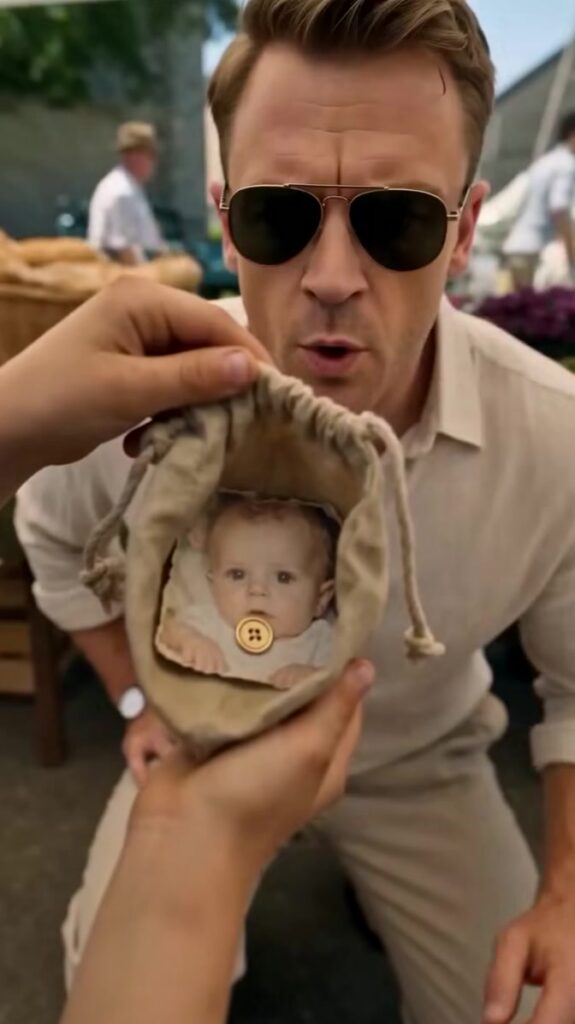
A small gold button rolled out too, dull from years of handling. It caught the sunlight once, a quick wink, and then settled against a coin. A faded baby photo followed, curling at the corners like it had been folded and unfolded a thousand times. It landed face-up: a chubby baby in someone’s arms, both of them half-cropped like the photographer didn’t know where to point the camera.
The well-dressed man went still. Not the casual stillness of someone watching a scene. This was full-body, held-breath stillness, like his bones had turned to glass and he didn’t dare move in case he shattered.
He took off his sunglasses slowly, as if he didn’t trust what he was seeing through tinted lenses. His eyes fixed on the button like it had crawled out of his past and laid itself at his feet.
“Where did you get that?” he asked.
The girl snatched the pouch to her chest and backed up, fear finally catching up to her. She tucked her chin, clutching the fabric as if it could protect her from grown-up questions. “My mother kept it,” she whispered.
Something about that—my mother kept it—made the fruit seller’s face soften in one swift, helpless slide from suspicion to regret. “Oh, sweetheart…” he murmured, like he wished he could un-say what he’d said.
But the man stepped closer. He didn’t loom. He didn’t grab. He moved like someone walking across thin ice, careful not to crack the moment. His voice lost its earlier impatience and came back quieter, rougher around the edges. “What was her name?”
The girl’s eyes darted toward Mrs. Kline, then to the seller, then back to the man. Like she’d been told not to talk to strangers, and yet she’d come here anyway, and now she wasn’t sure which rule mattered more. “She said you know,” the girl said, exhausted and brave in the same breath.
The florist leaned forward a fraction, stem trimmers forgotten. “Hold on now,” she muttered, mostly to herself. She studied the man’s face as if she was trying to place him in some old market memory, or decide whether his softness was real.
Market noise kept going—the distant argument over tomatoes, the clang of a metal scoop in a bin of rice—but it felt like someone had turned it down a notch, like all the background sounds were suddenly polite enough to wait.
The little girl hesitated, then slowly pulled the baby photo out again. Her fingers trembled so much the picture shook, making the baby’s face blur for a second. She turned it over.
On the back was faded handwriting in blue ink, smeared and thin like it had been written in a hurry on a rainy day. The man leaned in. Two words were visible before the girl’s thumb covered the rest, either by accident or instinct.
The girl swallowed hard. “Mom said you left before I could…” Her voice cracked at the end, like the sentence was a bridge she didn’t want to cross.
The man’s sunglasses slipped from his hand and hit the ground. He didn’t even flinch at the sound. His face drained of color as if someone pulled a plug. His mouth opened, closed, then opened again, but nothing came out at first.
Mrs. Kline made a sound that was almost a gasp, almost a growl. The fruit seller shifted his weight like he wanted to step between them, protective now, like the stall had become a courtroom and he’d decided which side he was on.
The man finally found his voice, but it came out small. “What’s your name?”
“Lena,” the girl said, and then added quickly, “I didn’t steal. I really didn’t. I just… I need peaches. For her.”
“For your mother?” he asked.
Lena shook her head. “For my grandma. Mom’s mom. She’s sick. Mom—” She stopped, eyes shining, and the way she stopped said a lot without words. Like “Mom” was a door she didn’t like opening in public.
The man crouched down so his face was closer to hers, so he wasn’t towering. He didn’t reach for the pouch. He just looked at it, at the button, at the photo, like he was reading his own life written in objects. “That button,” he said, voice trembling now, “it was on my coat. I—” He swallowed. “I gave that coat away years ago.”
Mrs. Kline stepped in, because of course she did. She set her flower trimmers down like a judge setting down a gavel. “If you’re about to make promises,” she said sharply, “you better not be the kind of man who forgets them by tomorrow.”
He looked up at her, startled, then back at Lena. His eyes were wet, and he seemed angry at himself for it, like tears were a weakness he didn’t allow. “I’m not here to make excuses,” he said. “I just… I didn’t know. I swear I didn’t know.”
Lena hugged the pouch tighter. “Mom said you’d say that,” she whispered, and the way she said it made it sound like her mother had practiced the conversation with her, like they’d prepared for disbelief the same way you prepare for rain.
The fruit seller cleared his throat awkwardly and began gathering peaches into a fresh paper bag, his hands suddenly gentle. “Look,” he said, “we can sort money later. Kid needs fruit.”
Lena looked at the peaches, then back at the man. Her fear was still there, but now something else had joined it—hope, maybe, or curiosity, or the dangerous idea that the world might change if you ask it to.
The man reached into his wallet, then stopped himself, like throwing money at this would be an insult. Instead, he picked up his sunglasses from the ground and set them on the table with a careful, deliberate motion, as if declaring he would not hide behind them anymore.
“Can I see the rest of the writing?” he asked softly.
Lena hesitated. Then, with the slow solemnity of someone handing over a secret, she shifted her thumb. The ink was faint, but more words appeared. A name. A date. And beneath it, the shaky message her mother had left, like a note in a bottle tossed into the future.
The man read it, and his face crumpled in a way that didn’t match his polished clothes or his expensive watch. He exhaled a sound that wasn’t quite a sob, wasn’t quite a laugh. “She kept it,” he whispered, stunned. “All this time.”
Mrs. Kline watched him like a hawk with a conscience. The fruit seller stood there with the bag of peaches, waiting. The market, for once, seemed willing to let a quiet moment happen in the middle of the noise.
Lena lifted her chin. “Are you going to be mad?” she asked. “Because Mom said you might be mad.”
He looked at her, really looked. Not at the pouch or the button or the photo. At her face. Like he was searching for someone he’d lost without realizing he’d lost them. “No,” he said, voice breaking. “I’m not mad at you. I’m mad at me.”
Lena blinked hard, trying not to cry, and nodded like she understood even if she didn’t. She held the photo against her chest, the way you hold something fragile that’s also important. “Then… can you come with me?” she asked. “To see Grandma. She said if I found you, I should bring you. Before it’s too late.”
The man’s throat bobbed as he swallowed. He glanced around at the staring crowd, at Mrs. Kline’s stern face, at the fruit seller’s kind hands, at the peaches finally contained in a bag instead of rolling away. Then he looked back at Lena, and something in his expression settled, like a decision sliding into place.
“Yes,” he said, and the word sounded like it cost him something and gave him something at the same time. He stood, offered his hand, and waited—didn’t push, didn’t rush.
Lena stared at his hand, then slipped her small fingers into it, still clutching the pouch with her other fist. Mrs. Kline exhaled through her nose, like she was satisfied but not done keeping an eye on the world. The fruit seller pressed the bag of peaches into Lena’s free arm and waved off the coins with a rough, embarrassed shrug.
As Lena and the man stepped away from the stall, the market’s noise swelled back up around them, life resuming its normal volume. But the trail of peaches on the stones—scuffed, rolling, gathered, forgiven—felt like proof that sometimes a mess is exactly what it takes to make people finally look at each other.